


Ohio Payroll Compliance Guide 2026: Taxes, Laws & Employer Requirements Explained
Date Released
12 May, 2026
Being an employer in Ohio has obligations, and the most important is payroll compliance. Regardless of whether you run a growing startup in Columbus, a manufacturing company in Cleveland, or any other business type in Cincinnati, you must be up-to-date with the payroll tax laws in Ohio. If there is any delay in filing or any mistake made in the tax form filed, you will be fined.
This manual provides details of what Ohio employers must be aware of regarding their payroll in 2026, including Ohio state income tax, unemployment insurance, and more. This information might seem complex, but that is precisely the reason PayProNext was created.
Why Ohio Payroll Compliance Matters More Than Ever in 2026
Payroll compliance in Ohio remains dynamic. For example, in 2026, regulatory bodies will target small companies that improperly classify their employees, submit tax returns past deadlines, or withhold insufficient taxes. Both the Ohio Department of Taxation and the Ohio Department of Job and Family Services (ODJFS) are stepping up their enforcement actions, so it's essential to get ahead.
Aside from fines, failing to comply can harm your company's reputation among its workers and cause financial problems once you receive notices about owing taxes. But here's the thing: with the proper framework in place, payroll compliance in Ohio is entirely doable.
| Pro Tip: Small companies with fewer than 10 employees are some of the most common targets for audits in Ohio. It's not because they evade taxes but rather because they don't employ HR and payroll professionals who can spot mistakes. |
Ohio Payroll Taxes: What Employers Must Withhold
1. Ohio State Income Tax Withholding
For 2026, Ohio operates on a graduated income tax scheme. Employers must withhold state income tax on the pay of each employee using the Ohio withholding tables prepared by the Ohio Department of Taxation. The Ohio IT 4 form is used to file for exemptions, which influences your withholding amount.
Important facts regarding Ohio state income tax withholding:
- The withholding rates change each year, so it’s imperative that you use the latest 2026 withholding tables.
- The IT 4 form has replaced the old withholding exemption certificate process.
- Employees working from outside Ohio who are employed by Ohio companies could still fall under Ohio withholding taxes.
- The supplemental wages have a fixed withholding tax rate.
2. Ohio School District Income Tax (SDIT)
There is a school district income tax and payroll tax in Ohio which catches many employers unawares, especially if they are relatively new to the area. In addition, there are more than 600 different school districts in Ohio, and each one levies their own personal income tax on all the residents in the relevant district.
Therefore, it is the duty of the Ohio employer to collect the school district income tax from workers who have been issued the school district number (from the Ohio IT 4). Non-payment of this tax results in the Ohio employer being made responsible for the amount.
3. Federal Payroll Taxes
Other payroll taxes in Ohio involve obligations to the government under various federal acts:
- Social security: withholding 6.2% (with employer matching contribution)
- Medicare: withholding 1.45% (with employer matching); another 0.9% withheld if wages exceed $200,000
- Federal Unemployment Tax Act: withholding 6.0% on the first $7,000 earned, with 5.4% FUTA credit available
4. Ohio Unemployment Insurance (UI) Tax
Ohio employers contribute to the Ohio State Unemployment Insurance (SUI) tax fund through payments made to the Ohio Department of Job and Family Services (ODJFS). The new employer SUI rate varies according to industry, but for existing firms, it is experience rated depending on their claims record. In 2026, the taxable wage base and rate structure must be determined through direct communication with ODJFS, as they change each year.
| Note: The Ohio SUI tax is paid solely by the employer; employees cannot contribute to it. Maintaining a low UI rate depends on controlling turnover and handling unemployment claims correctly. |
Ohio Payroll Filing Deadlines: Key Dates for 2026
Late submissions are among the most frequently occurring errors in payroll processing in Ohio. Below is a list of the payroll obligations Ohio businesses have to fulfill:
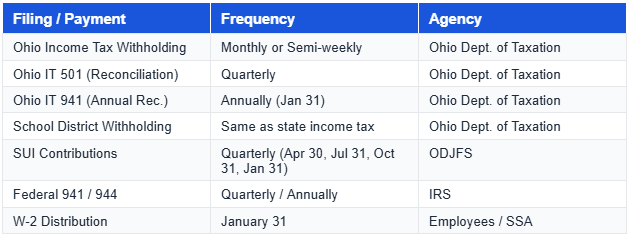
Note: Frequency of Ohio withholding deposits (monthly and semi-weekly) depends on your withholding liability during the look-back period. Check the required frequency at the start of each year.
Ohio Payroll Laws Every Employer Must Know
Ohio Minimum Wage
The Ohio minimum wage is updated every year based on the Consumer Price Index. For 2026, you need to confirm the minimum wage rate established by the Ohio Department of Commerce, Division of Industrial Compliance. Ohio's minimum wage law covers most workers, but it provides a different wage for tipped employees.
Overtime Requirements
Ohio has adopted the federal Fair Labor Standards Act (FLSA), which mandates employers to pay 1.5 times the worker's regular rate for any hours worked beyond 40 in a week. The state doesn't have its own laws regarding overtime pay that differ from the federal law.
Ohio New Hire Reporting
In Ohio, employers are required to report all new hires and rehired employees to the Ohio New Hire Reporting Center within 20 days after their hiring. This requirement applies to all workers. Not reporting new hires will result in sanctions.
Pay Stub and Record-Keeping Requirements
According to Ohio laws, employers are mandated to give their employees a detailed wage statement that includes gross pay, deductions, and net pay for each payroll cycle. The employer is required to keep payroll records for a minimum of three years. This information can be accessed during a payroll audit.
Payroll Compliance Checklist for Ohio Employers
Employers can use this checklist to ensure compliance with Ohio payroll regulations:
- Registered for withholding account with the Ohio Department of Taxation
- Enrolled with ODJFS for unemployment insurance contribution reporting
- Obtained the Ohio IT 4 form from all employees upon hiring
- Determined the school district number of all employees
- Established withholding deposit schedule (either monthly or semi-weekly)
- Confirmed SUTA rate and taxable wage base for 2026 with ODJFS
- Updated payroll software with Ohio tax tables for 2026
- Verified Ohio minimum wage compliance for all employees
- Filed new hire reports within twenty days after each hiring date
- Maintained payroll records for three years as required by law
- Filed SUI returns quarterly on April 30, July 31, October 31, and January 31
- Filed W-2 forms before January 31
Common Payroll Compliance Mistakes Ohio Businesses Should Avoid
Even seasoned employers can be guilty of making payroll errors. These are the most expensive ones made by Ohio companies, and ways to avoid them:
1. Misclassifying Workers as Independent Contractors
Both state and federal governments have been increasing efforts at worker classification audits, resulting in severe consequences if you have classified employees as independent contractors for tax purposes. Consult an employment lawyer or apply the IRS common law test when in doubt.
2. Missing School District Withholding
Small Ohio employers often forget to withhold school district tax from employees. Should there be any withholding failure, the employer will likely end up responsible for the tax.
3. Late Deposits
Tax authorities charge penalties on late tax deposits, beginning with 2% for 1-5 days delay, and reaching 15% for deposits that are late by more than 10 days. Using automated payroll tax services will help you avoid these fees.
4. Incorrect Overtime Calculations
Errors with overtime calculation, such as neglecting to account for bonuses or commissions when figuring out the employee’s regular pay rate, are amongst the most common and costly payroll mistakes. Wage claims by Ohio workers can be made, which will involve back pay and liquidated damages.
5. Poor Record-Keeping
Your lack of adequate record keeping could result in being taxed and fined even if your payroll is compliant. Consider investing in a good record keeping system.
| Do not forget that payroll compliance errors in Ohio are not only costly but may lead to audits, which will take many valuable hours from managers’ schedules. It is cheaper to do things right the first time around. |
How to Simplify Payroll Compliance in Ohio
Managing Ohio payroll compliance manually is not only risky but very time-consuming. Here's how modern-day Ohio employers manage it with ease:
Get Payroll Software with Ohio-Specific Tax Tables
Sometimes, generic payroll programs may not be able to provide you with necessary compliance measures. To ensure proper tax withholding in your payroll processes, you should use software that calculates Ohio state income tax, school district tax, and SUI automatically based on 2026 rates.
Connect HR and Payroll Software
As soon as you integrate HR and payroll software, new hire information will be seamlessly transmitted from one system to another. By doing so, you will prevent any mistakes during manual processing and ensure prompt submission of the new hire report.
Automate Tax Deposits and Payments
Using payroll automation software will enable you to automate Ohio withholding deposits and SUI payments automatically, so the risk of making late deposits will go down to zero. Moreover, your payroll automation solution will file your forms for you.
Find a Payroll Compliance Professional to Work with
The best approach for growing businesses is to delegate all compliance tasks to professional service providers specializing in payroll management services. In such a way, you'll save money on hiring additional personnel for this task.
Stay Compliant with PayProNext
Payroll compliance in Ohio in 2026 will be fairly easy as long as you are equipped with the necessary resources. Our company PayProNext is dedicated to providing small Ohio employers with all necessary payroll services, including automatic tax withholdings and deposits, quarterly and annual tax filings, W-2 forms.
No matter whether you run a small business in Columbus, Cleveland, or Cincinnati, or somewhere else in Ohio, we know exactly what is needed from an Ohio payroll service provider. Let us take care of it for you.
| Ready to simplify Ohio payroll compliance? Contact PayProNext today for a free payroll compliance consultation. www.payopronext.com | Let's make payroll simple. |