


What Ohio Businesses Need to Know Before Hiring Employees in Multiple States
Date Released
13 May, 2026
The advent of remote working has completely reshaped how Ohio-based companies form their workforces. You are either a company in Columbus that employs a software developer from Texas or a manufacturer from Cleveland that is looking to add some logistical workers from Indiana; either way, the fact remains that once you start hiring in other states, you get bogged down by multiple payroll requirements.
Multi-state payroll compliance might be one of the trickiest issues that Ohio employers face today – and there are actual consequences for mishandling it. From penalties for failing to register properly to additional tax withholdings and even back payments, you definitely don't want this process to cause problems.
In this guide, we will cover everything you need to know about employing people in different states.
1. Understanding Payroll Nexus: Where It All Starts
First things first: For your Ohio-based business to expand into another state, you will need to know about what’s known as payroll nexus, which is the connection required to establish your liability to register and pay taxes in another state.
Payroll nexus can be established based on:
- Having an employee living and working in another state;
- Having an employee working in another state on a temporary basis;
- Having some physical assets, such as offices, facilities, or machinery, in another state;
- Having an employee perform work that benefits clients of another state.
When payroll nexus is established, you automatically become liable for payroll registration and payroll tax obligations in another state. Failing to do so, even by mistake, is perhaps the number-one payroll mistake Ohio employers make.
2. State Payroll Registration: Your First Step in Every New State
The process of hiring an employee in a new state cannot be equated to adding the new employee to your already existing payroll system, because each state will have different payroll registration requirements and will need you to be registered prior to or shortly after making the first hire.
The following processes are usually part of state payroll registration:
- Registration with the Department of Revenue or Taxation of the state for income tax withholding
- Registration with the Unemployment Insurance agency of the state
- Owning any necessary state employer identification numbers
- Being registered for state disability, paid family leave, and/or workers’ compensation coverage
The problem with payroll registration for Ohio employers is that all states are not alike in the way they handle payroll registration, meaning that while some states process these applications quickly, others may take longer. Some states will need you to provide written documentation, while others will allow you to do it online.
Pro Tip: Get started with your registration as soon as you know that you’ll make the first hire in the new state.
3. Multi-State Tax Withholding: Who Gets What?
One of the things that can confuse employers about Ohio payroll in multiple states is the issue of deciding on which state's income tax should be withheld. The basic principle in this regard is that you withhold taxes based on the location where the work is performed, rather than the location of the business.
However, it becomes more complicated:
Reciprocity Agreements
There are reciprocity agreements between Ohio and Indiana, Kentucky, Michigan, Pennsylvania, and West Virginia. According to the agreement, employees from Ohio working in those states, or vice versa, pay taxes only in their own state. When dealing with reciprocity agreements, you should only withhold income tax from the home state of your employee who has provided a reciprocity certificate.
No-Income-Tax States
Some states, such as Texas, Florida, and Nevada, have no state income tax. If you employ workers from any of these states, even if your Ohio business pays them remotely, you don't have state income tax to withhold, but there are other obligations, such as the unemployment tax.
Convenience-of-Employer Rules
There are a few states (including NY and Delaware) that have what is referred to as a “convenience rule,” which implies that if the worker is telecommuting for their own convenience and not as a result of any directive from the employer, then they will be liable for taxes in the employer’s home state, irrespective of the worker’s location.
4. Unemployment Insurance (SUI) in Multiple States
State Unemployment Insurance (SUI) is also one more aspect of multi-state payroll compliance that Ohio businesses often fail to recognize. In contrast with the federal unemployment tax, the state unemployment insurance is regulated only by the state, and different states set their own rates, wage base, and experience rating.
To establish whether SUI applies according to the four-factor test, you need to consider the following:
- Localization: Where is the major portion of work performed?
- Base of operations: If it isn’t localized, where did the work originate?
- Direction and control: Where is the employee being directed from?
- Place of residence: None of the three previous factors applies – the state where the employee resides prevails
Misunderstanding SUI regulations will have much more consequences than mere penalties; your employees might not get their rights to unemployment benefits. This should concern any business owner in Ohio.
5. Payroll Reporting Requirements Across Multiple States
In addition to withholding and paying taxes, Ohio companies that employ staff across multiple states will have to comply with payroll tax reporting obligations. Each state will require its own forms, deadlines, and filing schedule, and these can differ greatly from one state to another.
Multi-State Payroll Tax Reporting Compliance usually includes:
- Quarterly or annual state withholding tax returns
- New hire reporting for each state in which new hires are made
- Annual wages and tax statements prepared according to each state's unique requirements
- State-specific workers' compensation tax reporting and payments
- Contribution to paid family leave/disability insurance program, where applicable
Manually keeping track of such complex and numerous deadlines is not only very laborious but also error-prone; failing to make even one filing may result in audits throughout all states of operation.
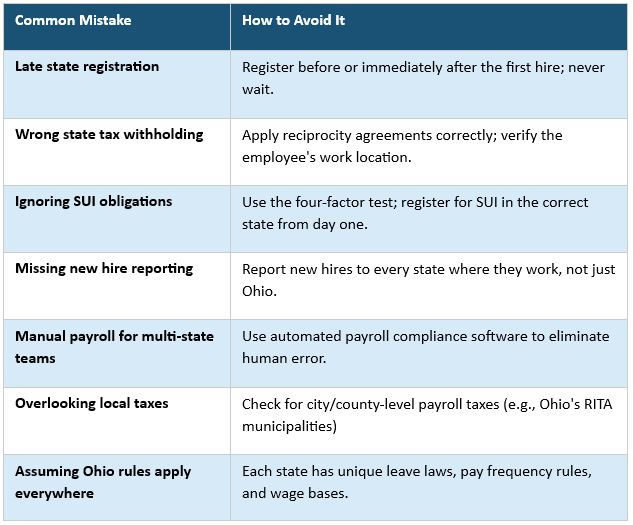
6. Common Multi-State Payroll Mistakes, and How to Avoid Them
Ohio employers new to multi-state hiring often stumble on the same issues:
7. HR and Payroll Integration: Why It Matters for Distributed Teams
Managing a remote team throughout Ohio and other states is not only about payroll processing; it also requires human resources management. In cases where HR and payroll management are not linked, mistakes increase: there won’t be proper onboarding information for payroll, changes in employee addresses won’t update state taxes, and compliance gaps will arise.
Proper HR and payroll management in Ohio’s case should provide:
- Automated setup of state taxes based on employee address
- Dynamic updating of employee compliance according to a change in the location of employment
- Multi-state tracking of new hires
- State-specific benefits administration
- Multi-state reporting without double data entry
Using multi-state compliance-based payroll automation solutions can significantly decrease the occurrence of mistakes associated with human error.
8. How PayProNext Simplifies Multi-State Payroll for Ohio Businesses
PayProNext's platform was developed with the modern workforce in mind. Our team at PayProNext knows that payroll compliance in Ohio, whether in Columbus or Cleveland, requires the flexibility to adapt to any number of hires.
How does PayProNext make multi-state payroll compliance easy?
- Automatic Assistance with State Registration: PayProNext will walk you through the process of registering for payroll compliance in every new state without surprises.
- Automatic Tax Withholding: PayProNext calculates the appropriate tax withholdings, taking into account reciprocity agreements, convenience-of-employer rules, and other factors based on where your employees work.
- Legal Compliance Updates: As states alter their laws, PayProNext monitors the latest legislation in all 50 states and adjusts your payroll compliance calculations accordingly.
- Automatic Multi-State Filing: Whether filing quarterly SUI forms or annual W-2 forms, PayProNext files all necessary paperwork on time for every single state.
- Smooth Integration with HR: Connect HR data with payroll processing to ensure seamless integration when an employee starts working for you, moves to another location, or receives a pay raise.
- Expert Compliance Advice: PayProNext can connect you with payroll compliance experts if you have questions about multi-state payroll compliance.
| Ready to Simplify Your Multi-State Payroll Stop guessing. Stop worrying about penalties. PayProNext gives Ohio businesses the tools and expertise to hire across state lines with complete payroll confidence. Contact PayProNext today for a free multi-state payroll consultation. |
The Bottom Line for Ohio Employers
Multi-state staffing is one of the best ways for Ohio companies to reach top talent, grow their business, and create a solid workforce. This process involves strict requirements, but non-compliance with them is not without serious repercussions.
The best news: with the help of a payroll company specializing in multistate staffing, all compliance requirements will become an easy task, something like a system.
If you are running a multistate payroll from Columbus, Cleveland, Cincinnati, or expanding from Ohio to other states such as Pennsylvania and Michigan, then PayProNext can provide the best assistance.
Because in today's world, your best hire might be in any state. Your payroll should be ready for all of them.