


Ohio Employer Payroll Checklist for 2026: Everything You Need to Stay Compliant
Date Released
15 May, 2026
Being an employer in the state of Ohio comes with a set of duties and liabilities. If you have a company that employs people in Columbus, Ohio, or even somewhere in Cleveland, failing to do the payroll correctly can result in various problems, including fines, employee dissatisfaction, and government audits.
The positive thing is that following all the requirements needed to conduct payroll correctly doesn't need to be difficult. Our Ohio Employer Payroll Checklist 2026 covers everything important regarding the process, from registration, taxes, and payments, to filing and documents.
PayProNext has helped thousands of businesses in Ohio get their payroll right and has experience in providing payroll services to companies around Ohio. Let our checklist be your first step in getting payroll under control.
Step 1: Register Your Business for Ohio Payroll Taxes
To comply with Ohio laws before processing your payroll payments, your business needs to be registered first. Otherwise, your company will immediately fall into legal trouble.
Ohio Employer Registration Checklist:
- Register with the Ohio Secretary of State (if you have not yet)
- Get an EIN number from the IRS
- Apply to register for withholding at the Ohio Department of Taxation
- Register at the Ohio Department of Job and Family Services (ODJFS) for Unemployment Insurance (UI)
- Register for local income tax accounts when necessary (Columbus, Cleveland, Cincinnati, etc.)
Reminder: There are more than 600 cities in Ohio collecting local income taxes. Do not forget to register locally; it is one of the most common payroll compliance pitfalls Ohio companies face.
Step 2: Understand Ohio Payroll Tax Requirements for 2026
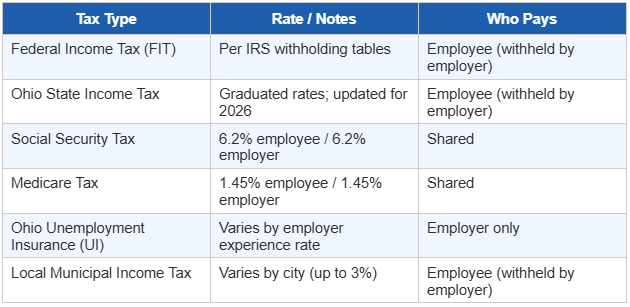
Ohio employers have multiple tax responsibilities when they issue their payroll payments each time. The following table shows those obligations:
Step 3: Ohio Payroll Filing Deadlines for 2026
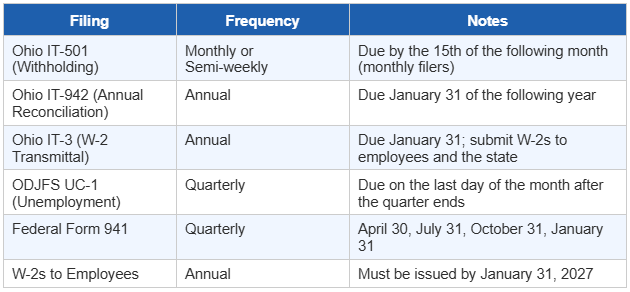
Missing any of your payroll deadlines in Ohio can lead to fines and interest charges. Understand your deadlines:
Step 4: Ohio Unemployment Tax Rules, What Employers Must Know
Ohio's unemployment insurance program is managed by ODJFS. As an Ohio business owner, you are responsible for:
- Submitting Ohio UI tax payments according to your assigned experience rate (new companies use a base rate)
- Sending quarterly UC-1 wage statements to ODJFS for each employee
- Registering new hires in the state of Ohio within 20 days after they start working
- Keeping employment earnings and work hours records for at least four years
- Treating unemployment cases efficiently to keep your experience rate high
Reminder: You can get a new experience rate for your Ohio UI contributions each year.
Step 5: Payroll Documentation Requirements for Ohio Employers
Good record keeping isn't optional; it's mandatory. Ohio employers need to keep records for:
- Employee W-4 forms and IT-4 forms from the state of Ohio
- Their wages earned, hours worked, and dates of payment
- Their deposits or taxes paid
- The records of reports made about new hires in Ohio
- A copy of all the payroll records submitted
- Any I-9 employment eligibility verifications
- A record of payroll deductions such as health insurances, 401 (k) s, and garnishments
Reminder: It is mandated that all payroll records, except for the FLSA wages earned, have to be kept for at least four years, while FLSA mandates that wage records should be held for three years.
Step 6: Common Payroll Compliance Mistakes Ohio Businesses Should Avoid
Here’s the list of common payroll errors that PayProNext frequently encounters from our clients:
❌ Worker Classification Error
Misclassifying workers as independent contractors is one of the most costly errors made on the payroll. Ohio follows very strict criteria, so be sure to double-check yourself.
❌ Failure to Account for Local Taxes
The multitude of Ohio's local taxing authorities is often overlooked. Your employee is working in Columbus but living in Dublin? Both municipalities might require their portion.
❌ Delayed or Unmade Deposits
Missing just one deposit to the Federal or State government results in a penalty fee between 2 and 15 percent. Always keep track of or automate your deposits.
❌ Withholding Errors
Failure to use proper tax tables and update information from the latest W-4/IT-4 form will result in under-withholding.
❌ Inadequate Documentation and Recordkeeping
Not being able to present payroll documentation during an audit is a major red flag. Consider using cloud-based payroll documentation systems.
❌ Non-reporting New Hires
Failing to report new hires within the required period (20 days in Ohio) is a punishable offense that will complicate unemployment and child support proceedings.
Step 7: Payroll Compliance Checklist for Small Businesses in Ohio
Use this handy guide during every payday to make sure you have covered all your bases:
Every Payday:
- Compute gross wages of all employees (hourly wages + salaries + overtime pay)
- Subtract proper Ohio and federal income tax withholdings
- Deduct and remit FICA (Social Security + Medicare)
- Withhold proper municipal taxes, if applicable
- Make payments for voluntary deductions
- Make payments for mandatory deductions
- Provide payslips to all employees
Every Quarter:
- Complete Ohio IT-501 if you are a monthly filer (by 15th day of following month)
- Fill out federal Form 941 for tax filing (by quarterly deadline)
- Submit Ohio ODJFS UC-1 (unemployment compensation) form and remit due UI taxes
- Check if employee information requires updates
Every Year (By January 31):
- Provide W-2 forms to all employees
- Submit Ohio IT-3 W-2 transmittal to the state
- Submit Ohio IT-942 annual form (for reconciling your withholding tax)
- Submit W-3 and W-2 to the SSA
- Recheck employee classifications, pay rates, and withholdings
- Update withholding tax tables
Stop Managing Payroll Manually, Let PayProNext Handle ItOhio payroll processing is difficult, and it becomes even more difficult due to the constant changes every year. PayProNext was designed especially for Ohio employers who want to maintain their compliance status without worrying about anything. We take care of all your payroll tax filing, local tax processing, unemployment payments, and W-2 generation at the end of the year. ✅ Reliable partner of Ohio companies from Columbus to Cincinnati ✅ Automatic compliance with Ohio, US Federal, and Local Taxes ✅ Immediate payroll reporting and audit compliance ✅ Specialized service for Ohio SMBs 👉 Try PayProNext right away at www.paypronext.com |
Final Thoughts: Payroll Compliance Is Non-Negotiable in Ohio
The world of Ohio payroll compliance will become even more complex in 2026, with state withholding rules, numerous local jurisdictions to account for, ODJFS unemployment rules, and several federal compliance requirements to adhere to. As an entrepreneur operating in Ohio in 2026, the use of this Ohio payroll compliance checklist as your starting point might prove to be wise, but the truly clever decision would be to choose a payroll service provider who is well aware of how payroll compliance in Ohio works.
At PayProNext, we offer our payroll service clients automated solutions for managing their payroll in addition to our vast expertise in the field of Ohio employer payroll compliance. We have been doing Ohio payroll for years, and we have learned a thing or two along the way.
Interested in making Ohio payroll one of the easiest things about your business operation in 2026? Contact us at www.paypronext.com or schedule a free initial consultation.