


How Logistics Companies Can Streamline Payroll Operations
Date Released
01 July, 2026
If payroll for logistics companies still means spreadsheets, three time zones, and a Sunday-night scramble before drivers get paid, you're not alone. Logistics payroll management is one of the most complex payroll categories in any industry, mixing hourly warehouse staff, mileage- and load-based driver pay, multi-state tax rules, and constant schedule volatility. This guide breaks down exactly how logistics payroll operations can be streamlined in 2026, with practical steps you can start using this week.
Why Logistics Payroll Is So Difficult to Get Right
Unlike a typical office payroll run, logistics payroll processing has to account for drivers crossing state lines, warehouse shifts that change daily, overtime rules that differ by classification, and pay structures that blend hourly wages, mileage, per-load rates, and bonuses. Add fuel surcharges, detention pay, and layover time, and it's easy to see why payroll challenges in the logistics industry rank among the toughest of any sector.
Most of these challenges come from a single root cause: fragmented data. Dispatch systems, ELD/telematics platforms, timekeeping tools, and HR software often don't talk to each other, forcing payroll teams to manually reconcile hours, routes, and pay codes before every run.
Multi-State Complexity
Drivers routinely work across state lines, triggering different tax withholding, wage, and overtime rules for the same paycheck.
Mixed Pay Structures
Hourly warehouse pay, per-mile driver pay, and per-load bonuses often live in separate systems that don't sync automatically.
High Turnover & Onboarding
Seasonal hiring and driver turnover mean payroll setup and tax profiles need to be created and closed constantly.
Compliance Exposure
Missed overtime, misclassified drivers, or incorrect per diem handling can trigger DOL audits and costly back-pay claims.
Core Components of Logistics Payroll Operations
Before automating anything, it helps to understand the moving parts that make up payroll for logistics companies. A streamlined logistics payroll operation typically includes:
- Time and mileage capture — pulling hours and miles directly from ELDs, telematics, or time clocks instead of manual entry.
- Pay rule engines — automatically applying the correct rate for hourly, per-mile, per-load, or hybrid pay structures.
- Tax jurisdiction mapping — assigning the correct state and local tax rules based on where work was actually performed.
- Compliance tracking — monitoring overtime, meal-break rules, and driver classification in real time.
- Reporting and audit trails — keeping a clean, timestamped record for every pay decision in case of dispute or audit.
Truck Driver Payroll Management: What Makes It Unique
Truck driver payroll management is arguably the single hardest piece of logistics payroll. Drivers may be paid per mile, per load, by percentage of revenue, or a flat day rate, sometimes all in the same pay period. On top of that, per diem allowances, detention pay, layover pay, and stop pay all need to be tracked accurately.
Best practice: separate "base pay" logic from "supplemental pay" logic in your system. Base pay (mileage, hourly, load rate) should be calculated automatically from telematics or dispatch data. Supplemental pay (detention, layover, bonuses) should route through a simple approval step so dispatchers can flag exceptions before the payroll run locks.
Warehouse Payroll Management: A Different Set of Challenges
Warehouse payroll management looks more like traditional hourly payroll, but logistics-specific wrinkles still apply: shift differentials for overnight crews, seasonal surge staffing, and overtime spikes during peak fulfillment windows. Automating shift-based rate assignment and overtime alerts prevents the most common warehouse payroll mistakes: underpaid overtime and missed shift premiums.
| 40% Payroll errors in logistics stem from manual time entry |
3–5 average number of states a mid-size fleet operates across |
60%+ time saved with payroll automation logistics tools |
Multi-State Payroll for Logistics Companies, Explained
Multi-state payroll logistics compliance is one of the biggest sources of risk. A driver who lives in one state, is dispatched from a terminal in another, and delivers in a third can trigger multiple tax withholding obligations, and the rules for which state "wins" vary. Reciprocity agreements, state unemployment insurance, and local wage laws all layer on top of federal rules like the FLSA.
A solid multi-state payroll compliance approach includes:
✓ Maintaining an updated matrix of state tax reciprocity agreements relevant to your routes
✓ Tracking the physical work location (not just home address) for every pay period
✓ Automating state unemployment insurance (SUI) assignment based on work-state data
✓ Reviewing driver classification (employee vs. owner-operator) against current state and federal standards
✓ Auditing overtime calculations against the most restrictive applicable state rule
Logistics Payroll Compliance Guide (2026 Update)
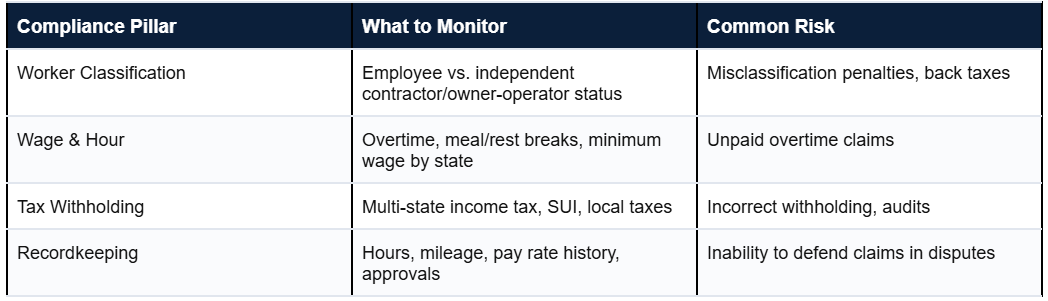
Compliance requirements shift often, and 2026 brings continued state-level attention to driver classification and warehouse overtime enforcement. A practical logistics payroll compliance guide should cover four pillars:
Payroll Automation in Logistics: What to Automate First
Payroll automation logistics doesn't need to happen all at once. The highest-impact starting points are usually:
1. Time and Mileage Sync
Connect ELD, telematics, or time-clock data directly into your payroll system so hours and miles flow in without manual re-entry.
2. Pay Rule Automation
Build rate logic once per mile, per load, hourly, shift differential, and let the system apply it automatically every pay run.
3. Tax Jurisdiction Automation
Automatically assign the correct state/local tax treatment based on where work was actually performed, not just a static home address.
4. Exception-Based Approvals
Instead of reviewing every line item, route only flagged exceptions (detention pay, manual overrides, missing punches) for manager approval.
Payroll Software for Transportation Companies: What to Look For
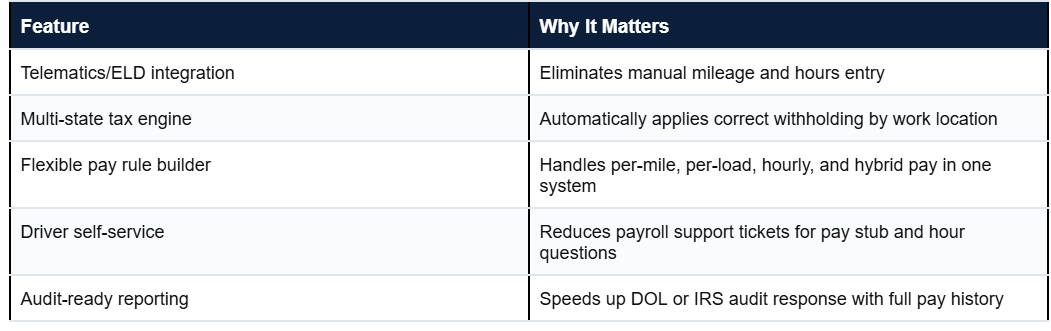
When evaluating logistics payroll software or payroll software for transportation companies, prioritize platforms that were built with logistics workflows in mind, not generic payroll tools retrofitted for the industry.
Logistics Payroll Best Practices for 2026
✓ Centralize time, mileage, and pay-rate data into a single source of truth
✓ Standardize pay codes across all terminals and warehouses
✓ Run a quarterly multi-state compliance audit, not just an annual one
✓ Automate exception routing instead of manual full-batch review
✓ Give drivers and warehouse staff self-service access to pay stubs and hours
✓ Reconcile payroll data against dispatch and WMS records every cycle
How to Improve Payroll Efficiency in Logistics Companies: A 5-Step Rollout
If you're planning to overhaul logistics payroll operations, don't try to fix everything at once. A phased rollout works better:
- Audit current state — map every pay type, data source, and manual step in your existing process.
- Consolidate data sources — connect telematics, timekeeping, and dispatch into one payroll-ready feed.
- Automate base pay rules — start with your highest-volume pay type (usually mileage or hourly).
- Layer in compliance checks — build automated flags for overtime, classification, and multi-state issues.
- Roll out self-service — give employees direct access to pay stubs, hours, and mileage records.
Frequently Asked Questions
What is the biggest payroll challenge for logistics companies?
Multi-state compliance combined with mixed pay structures (mileage, load, and hourly) is consistently the top challenge, since it requires both accurate location data and flexible pay-rule logic.
Can payroll automation handle truck driver pay?
Yes — modern logistics payroll software can automate mileage-based, load-based, and hourly pay simultaneously, as long as it integrates with your telematics or dispatch system.
How often should logistics companies audit payroll compliance?
Quarterly audits are recommended given how frequently multi-state tax and wage rules change, rather than relying solely on an annual review.
Final Thoughts
Logistics payroll management will never be as simple as office payroll; the industry's mobility, mixed pay structures, and multi-state footprint make sure of that. But most of the pain logistics companies experience isn't inherent to the industry; it's the result of fragmented systems and manual processes that were never designed for this level of complexity.
The good news is that logistics payroll operations are highly automatable once the right data connections and pay-rule logic are in place. Companies that invest in payroll automation, multi-state compliance tracking, and purpose-built logistics payroll software in 2026 aren't just reducing errors; they're freeing up payroll teams to focus on strategy instead of spreadsheet reconciliation. Start with one high-impact fix, like automating mileage capture or centralizing tax jurisdiction data, and build from there.
| Ready to streamline your logistics payroll operations? Talk to a specialist who understands multi-state trucking payroll, warehouse shift pay, and logistics payroll compliance, and get a tailored rollout plan for your fleet. Book a Free Payroll Consultation with PayPronext |