

W-2 vs 1099 for Real Estate Professionals: What Brokers Need to Know
Date Released
15 July, 2026
Every real estate broker eventually faces the same question: should agents be brought on as W-2 employees, or classified as 1099 independent contractors? The answer shapes payroll taxes, benefits obligations, liability exposure, and how much control a brokerage can legally exercise over its sales team.
Get it wrong, and the IRS or state labor department can hand your firm back taxes, penalties, and interest that stretch back years.
Why Real Estate Worker Classification Is Different
Most industries classify workers using the IRS common-law test, which looks at behavioral control, financial control, and the relationship between the parties. Real estate has an additional layer: a special statutory category under Internal Revenue Code Section 3508 for "qualified real estate agents."
Under Section 3508, a licensed real estate agent can be treated as a statutory nonemployee, and therefore as an independent contractor for all federal tax purposes, when three conditions are met:
- The individual holds an active real estate license.
- Substantially all of their compensation is tied directly to sales output rather than hours worked.
- The agent works under a written contract stating they will not be treated as an employee for federal tax purposes.
Important: Section 3508 determines classification for federal tax purposes only. It does not automatically determine the agent’s status under the Fair Labor Standards Act, state wage laws, unemployment insurance, workers’ compensation, or other employment laws. Brokers must review each applicable legal framework separately.
This is a major reason so many residential and commercial real estate agents are paid on 1099s. But the statutory nonemployee rule only covers real estate sales activity. Property management duties, administrative work, or supervisory roles outside of sales generally fall back under ordinary common-law employee tests, which is where many brokerages get tripped up.
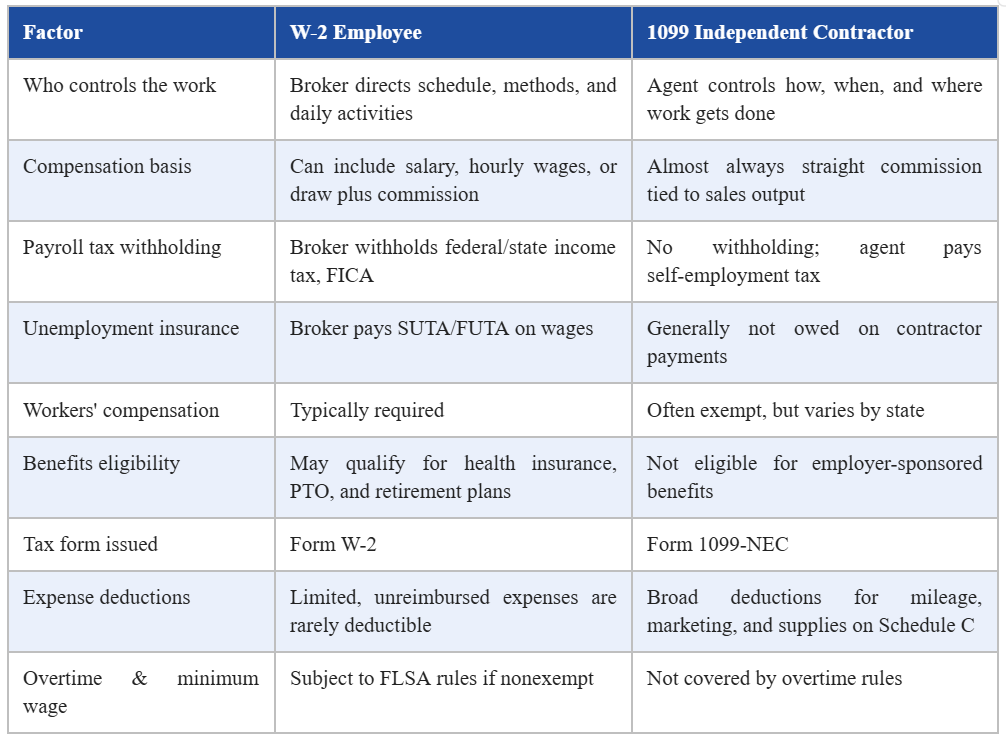
W-2 vs 1099 Real Estate Agents: Side-by-Side Comparison
Here's how the two classifications compare on the factors that matter most to brokers running payroll and managing compliance risk.
When an Agent Should Be a 1099 Contractor
Independent contractor status generally fits when the brokerage:
- Pays agents on commission, with little or no guaranteed base pay or hourly wage.
- Let agents set their own schedules, choose their own leads, and market themselves independently.
- Doesn't require agents to use company email, dress codes, or mandatory desk time.
- Has a signed independent contractor or brokerage agreement that meets the Section 3508 requirements.
Commission-based residential and commercial agents, and many referral-based real estate sales teams, typically meet this profile, which is why 1099 real estate agents remain the industry norm.
When an Agent Should Be a W-2 Employee
Employee classification tends to be the safer and often legally required path when the brokerage:
- Pays a salary, hourly wage, or guaranteed draw regardless of sales performance.
- Sets fixed schedules, requires in-office hours, or closely supervises daily activity.
- Provides training that goes beyond basic licensing requirements and directs how tasks are performed.
- Employs agents primarily for property management, transaction coordination, or administrative functions rather than direct sales.
Property management companies, in particular, should pay close attention here. Property managers and leasing coordinators typically fall outside the Section 3508 real estate agent exemption, since their duties center on managing property rather than selling it, which means common-law employee rules usually apply.
The Cost of Misclassification
Worker misclassification is one of the most common and expensive compliance failures in real estate. If the IRS or a state agency determines that agents classified as 1099 contractors were functioning as common-law employees, brokerages can face:
- Back payroll taxes, including the employer's share of Social Security and Medicare that was never withheld.
- Penalties and interest under IRC Section 3509, which can still be substantial even with relief provisions.
- Retroactive unemployment insurance and workers' compensation premiums.
- State-level fines, which in some states are assessed per misclassified worker, per pay period.
- Exposure to wage-and-hour claims, including unpaid overtime, if agents were treated as exempt without meeting the criteria.
Multi-state brokerages face compounded risk, since state agencies often apply stricter classification tests, such as the ABC test used in several states, that are harder to satisfy than the federal statutory nonemployee rule.
| Not Sure Which Agents Are Correctly Classified? PayProNext's payroll compliance team can review your current agent agreements, commission structures, and pay practices against IRS and state classification rules, then flag any risk areas before they become penalties. |
How Brokers Can Stay Compliant
Classification decisions shouldn't be made once and forgotten. Use this checklist to keep your brokerage on solid ground:
- Confirm every 1099 agent holds a current, active real estate license.
- Verify that substantially all compensation for qualifying real estate services is tied to sales or other output rather than hours worked.
- Put a written independent contractor agreement in place for every 1099 agent, referencing Section 3508 language.
- Separate sales duties from property management or administrative duties in job descriptions and pay structure.
- Review classification rules for every state where you have licensed agents, since state tests can be stricter than federal rules.
- Avoid directing schedules, requiring in-office hours, or closely supervising 1099 agents' daily activity.
- Run periodic classification audits, especially after growth, acquisitions, or changes in commission structure.
- Use payroll software built to handle mixed W-2 and 1099 workforces without manual reconciliation.
Can a Broker Hire Both W-2 Employees and 1099 Contractors?
Yes. Most brokerages operate a hybrid workforce: commission-only sales agents on 1099s, alongside W-2 employees such as transaction coordinators, marketing staff, front-desk personnel, and salaried team leads or managers. The key is documenting the classification logic for each role separately and making sure pay practices actually match the classification on paper. A written contract alone will not protect a brokerage if the day-to-day working relationship looks like employment.
Why Brokers Choose PayProNext
Running payroll for a brokerage means juggling commission schedules, split payments, multi-state licensing, and a workforce that mixes W-2 employees with 1099 contractors, often within the same office. PayProNext was built to handle exactly that complexity, with:
- Automated commission and split-pay processing for real estate sales teams.
- Simultaneous W-2 and 1099 payroll runs, with correct tax treatment applied automatically to each worker type.
- Multi-state payroll tax compliance, including state-specific classification rule tracking.
- Year-end Form W-2 and Form 1099-NEC generation and e-filing.
- Ongoing compliance support to help brokers document classification decisions and reduce audit risk.
Brokerages that outsource payroll and classification compliance to PayProNext spend less time worrying about IRS scrutiny and more time growing their agent roster and closing deals.
| Get a Free Payroll Compliance Review Talk to a PayPronext payroll specialist today and get a no-cost review of your brokerage's current W-2 and 1099 setup, plus a clear action plan for staying compliant as you grow. |
Frequently Asked Questions
Are real estate agents W-2 employees or 1099 contractors?
It depends on how they're paid and supervised. Most commission-only agents qualify as 1099 statutory nonemployees under IRC Section 3508, but agents who receive salary or hourly pay, or who are closely directed by the broker, are typically W-2 employees.
What is the difference between W-2 and 1099?
A W-2 employee has taxes withheld by the employer and may receive benefits, while a 1099 contractor receives gross pay with no withholding, pays self-employment tax, and reports income on Schedule C.
How does the IRS classify real estate professionals?
The IRS applies the statutory nonemployee test under Section 3508 first: an active license, commission-based pay, and a written contractor agreement. If those three conditions aren't met, standard common-law employee tests apply instead.
Can a real estate broker hire both W-2 employees and 1099 contractors?
Yes. It's standard for brokerages to have 1099 sales agents alongside W-2 support staff, managers, or property management employees, as long as each role's classification is documented and matches actual working conditions.
What are the tax differences between W-2 and 1099 workers?
Employers withhold income tax and FICA for W-2 workers and pay employer-side payroll taxes, unemployment insurance, and often workers' compensation. For 1099 contractors, no taxes are withheld, and the contractor pays self-employment tax directly.
What happens if a worker is misclassified?
Brokerages can owe back payroll taxes, penalties, and interest, retroactive unemployment and workers' compensation premiums, and may face wage-and-hour claims for unpaid overtime.
How can brokers stay compliant with worker classification rules?
Use written contracts that meet Section 3508 requirements, keep sales and non-sales duties separate, avoid controlling contractors' schedules, review state-specific classification tests, and audit classifications regularly, ideally with payroll software or a compliance partner built for real estate.
The Bottom Line
W-2 vs 1099 classification isn't a one-time paperwork exercise. It's an ongoing compliance responsibility that touches every agent, every state, and every pay period. Brokers who understand the Section 3508 rules, document their agreements correctly, and use payroll systems designed for mixed real estate workforces put themselves in the strongest position to grow without unexpected tax exposure.
Ready to simplify payroll for your brokerage? PayPronext gives real estate firms the payroll automation, classification support, and compliance tools they need to pay agents accurately, on time, and in full compliance with IRS and state rules.