


Can an Employee Be Paid Two Different Hourly Rates? What Employers Should Know
Date Released
24 April, 2026
If you have employees who perform different job duties, such as a warehouse employee working some shifts as a forklift driver or a nurse taking administrative and nursing shifts, chances are that you’re already paying them two hourly wages. Is it allowed? If yes, how would you handle their overtime?
The simple answer is that paying an employee two hourly rates is completely allowed in the United States. However, if you make any mistakes in implementing this policy, your company risks being in violation of federal regulations concerning wages. Let’s take a closer look at all the things you should know about dual rate payments and payroll.
Is It Legal to Pay an Employee Two Different Hourly Rates?
Yes, the Fair Labor Standards Act (FLSA), which is the principal wage regulation of the U.S., clearly states that workers are allowed to get paid different rates for different kinds of tasks. That applies particularly to industries such as retail, healthcare, hospitality, manufacturing, logistics, and so on.
Thus, it's perfectly acceptable for a retail store clerk who earns $14 per hour on regular sales work and $18 per hour for inventory work. In this case, however, there is only one catch. It lies in the proper accounting of such different rates during overtime calculation.
| Legal Basis (FLSA Section 7(g)) It goes without saying that employers have to comply with some rules when calculating overtime pay. There are two recognized methods outlined in Section 7(g) of the FLSA. Neither employer should invent their own procedure. |
Why Employers Use Multiple Pay Rates
Here are some genuine reasons why a worker can be paid at various hourly wages:
- Workers performing different types of jobs have various skill sets (e.g., regular workers vs. forklift certified)
- Workers working night shifts (shift differential)
- Workers involved in training or supervision are receiving better wages
- Seasonal or project-specific rates negotiated by contract
- Temporary coverage of a higher-paid position
With multiple pay rates, there is no way to avoid paying the employees accurately for what their services are worth, which makes this practice effective not only in terms of staff retention but also in terms of accounting practices.
How to Calculate Overtime With Two Different Pay Rates
This is exactly the point when things can go wrong for employers. If an employee works more than 40 hours in the workweek and earns different pay rates for his or her work, it becomes illegal to choose one pay rate for the calculation of overtime.
The Blended (Weighted Average) Rate Method, FLSA Section 7(g)(1)
The first one is a calculation based on a weighted average or a blended rate formula. Let us see how it is calculated:
- The total straight-time earnings for the workweek
- Total earnings divided by total hours gives the blended regular rate
- The blend rate multiplied by 0.5
- Multiplying by the number of overtime hours
| Blended Rate Calculation Example An employee works 30 hours at $14/hr ($420) and 15 hours at $18/hr ($270). Total earnings = $690. Total hours = 45. Blended rate = $690 / 45 = $15.33. Overtime premium = $15.33 x 0.5 = $7.67. Overtime pay for 5 OT hours = $7.67 x 5 = $38.33. Total weekly pay = $690 + $38.33 = $728.33. |
Real-World Blended Rate Examples
Below are common scenarios employers encounter and how blended overtime applies:
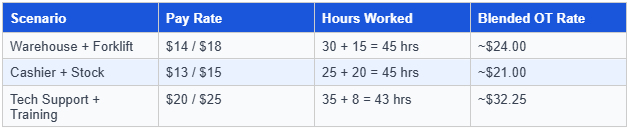
Note: OT rates above are approximate. Actual calculations must use exact hours and wages per the FLSA method.
The Rate-in-Effect Method, FLSA Section 7(g)(2)
The second FLSA-compliant way is easier to implement but much less common. In this case, an employee will be paid overtime at a 1.5 times higher pay rate than what was in place at the moment of performing the overtime work. Such an agreement must be made in writing before the work commences.
| Important Note Without a documented prior written agreement, the rate-in-effect method cannot be used. Employers who try to apply it retroactively may face wage violations and back-pay liability. |
Payroll Compliance Rules for Multiple Pay Rates
Beyond the overtime calculation, there are several compliance requirements employers must follow when managing employees with two different hourly rates.
1. Document Everything
Your HR and payroll records must clearly show which hours were worked at which rate. Vague timekeeping records are a compliance liability. If your records cannot prove which hours were charged at which rate, you may default to the higher rate and owe back wages.
2. State Wage Laws May Be Stricter
While the Federal FLSA provides the minimum standards, other states like California, New York, Washington, and Colorado have their respective wage and hour laws that may be stricter than the FLSA. An example is the law in California, where there is an overtime requirement on a daily basis (overtime after 8 hours per day). It is crucial to confirm the specifics regarding the laws in your state.
3. Pay Rate Policies Must Be Applied Consistently
Employees assigned similar job responsibilities should be paid equally. It is a violation if you pay two employees at two different rates without an objective and documented reason for such payment arrangements. Provide the reasons for such pay rates within the policy.
4. Payroll Tax Reporting Must Reflect Actual Earnings
The reporting of taxes includes all wages irrespective of the pay rate used. All wages must be included in the payroll tax reporting as required by the IRS and state taxing authorities.
Common Payroll Mistakes With Multiple Pay Rates (And How to Avoid Them)
In view of the above trends in DOL audits and common HR mistakes, below are some of the most commonly made mistakes by employers:
- Calculating overtime using only the high rate: This is the most common mistake and could lead to considerable amounts owed in back pay.
- Not keeping hours-by-rate records: It is difficult to determine whether the correct blend was used without proper documentation of the hours worked at each rate.
- Skipping the written agreement for the rate-in-effect method: Applying this method without prior documentation is a wage violation.
- Inattention to State requirements: Use of the federal requirement in a jurisdiction that has additional rules, such as daily overtime in California, results in underpayment.
- Calculation Mistakes: Manual calculations of blended rates, even with the aid of computers, are prone to errors.
How PayProNext Handles Multiple Pay Rates Automatically
Managing employees with two different hourly rates manually is not just tedious; it is a compliance risk. PayProNext is built specifically for businesses that need accurate, automated payroll processing across complex compensation structures.
Multi-Rate Time Tracking
Using PayProNext allows users to apply several pay rates to an employee profile, associated directly with job codes and shift times. The system applies the corresponding pay rate automatically once an employee clocks in or out from a specific job position.
Automatic Blended Overtime Calculation
The payroll software calculates all overtime payments automatically based on the Fair Labor Standards Act (FLSA). The program is capable of processing hundreds of overtime calculations each week without any errors.
State Law Compliance Built In
PayProNext maintains an up-to-date database of state and local wage laws. If you have employees in California, New York, or any other state with additional overtime requirements, the system applies the correct rules automatically, no manual overrides needed.
Real-Time Payroll Audit Trail
Every pay rate, hour, and calculation is stored with a timestamped audit trail. If a DOL audit or employee dispute arises, you have complete, exportable documentation ready in minutes, not days.
Payroll Tax Automation
It is worth mentioning that PayProNext will automatically figure out and send federal and state payroll taxes from your income in real-time, leaving you worry-free about compliance with both the IRS and state tax laws.
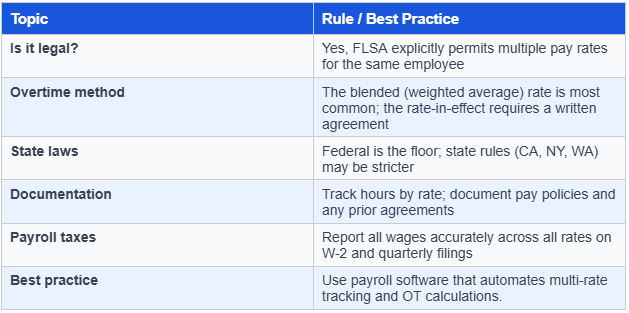
Quick Reference: Multiple Pay Rate Rules for Employers
Frequently Asked Questions
Can a salaried employee also receive an hourly rate?
Yes, with care. An exempt salaried employee may earn a salary and hourly earnings for any extra work; however, overtime must be computed based on total earnings. Nonexempt employees do not typically qualify for further hourly payment without losing exempt classification. Check with an employment lawyer to verify your specific situation.
Do both pay rates need to be in the employee's offer letter?
Best practice is to document all applicable pay rates in the employment agreement, job description, or a formal pay rate addendum. This protects both the employer and employee, and is required for using the rate-in-effect overtime method.
Can employees be paid different rates for the same job across different locations?
As far as I know, yes, if there exists an objective justification (for example, varying minimum wage laws per state or cost-of-living adjustment). Nonetheless, inconsistent payment rates for the same job position can result in equal pay problems if the reasons for pay disparities are not well-documented.
What happens if I miscalculate blended overtime?
Underpayment of overtime pay, whether intentional or not, leads to a back-pay claim under the FLSA, entitling employees to up to two years of back pay (or three if it was done knowingly and willfully), as well as an equivalent sum in liquidated damages. DOL has the right to audit any company at any time.
Bottom Line: Multiple Pay Rates Are Legal, But Require Precision
Paying employees two different hourly rates is a common, legal, and often necessary practice. The compliance burden comes from doing it correctly: accurate time tracking by rate, proper blended overtime calculation, state law adherence, and thorough documentation.
For small businesses managing a handful of employees, manual tracking is possible, but risky. For growing businesses, the cost of a payroll error far exceeds the cost of the right payroll software.
PayProNext was built by payroll professionals who understand the real complexity behind multi-rate compensation. From automated blended overtime to state-specific compliance rules and real-time audit trails, we make sure your payroll is always right, the first time.
Ready to Simplify Multi-Rate Payroll?PayProNext automates blended overtime, multi-rate tracking, and wage compliance, all in one platform. Start Your Free Trial at PayProNext.com |