


How to File Form 941: A Step-by-Step Guide for Employers (2026)
Date Released
26 March, 2026
The payroll tax is one of the most important tasks that employers have to manage. Form 941 is one of the most important IRS forms that is intended to identify wages, tips, and other types of compensation, as well as the federal income tax, social security, and medicare taxes withheld, which makes this the main form of reporting information on a quarterly basis. As an employer, it is important to know how to fill out Form 941 to remain in compliance and avoid expensive fines. The guide will take you through all you should know about the IRS Form 941 and the instructions on it, its deadlines, and the most frequent errors to make in 2026.
What is Form 941?
Form 941, which is also referred to as the Employer's Quarterly Federal tax return, is filed by businesses reporting payroll taxes to the IRS. The following are the key elements of this form:
- Wages paid to employees
- Federal income tax withheld
- Social Security and Medicare taxes
- Adjustments for tips and sick pay
- Tax credits, such as the Paid Family Leave or Employee Retention Credit
Most employers are required to file Form 941, with penalties and interest being the possible outcomes of failure to submit it in time or correctly. It is basically a record of what you are required to pay in terms of payroll taxes every quarter of your business. Proper reporting of this information makes your business compliant and prevents avoidable audits.
Form 941 Filing Requirements
The recognition of the requirements concerning the filing of the Form 941 is essential to ensure compliance. The employers are required to submit Form 941 in every calendar quarter in 2026:
- Quarter 1: January 1 – March 31 | Due: April 30, 2026
- Quarter 2: April 1 – June 30 | Due: July 31, 2026
- Quarter 3: July 1 – September 30 | Due: October 31, 2026
- Quarter 4: October 1 – December 31 | Due: January 31, 2027
It is also the responsibility of employers to make the appropriate federal tax payments on behalf of Social Security, Medicare, and withheld income taxes at the right time, as stated by the IRS. Being aware of these requirements can enable both large and small enterprises to be ready and remain up-to-date with their employer tax compliance obligations.
Step-by-Step Guide: How to File Form 941
The process of filing Form 941 may appear to be complicated, but adherence can be made easy by a systematic procedure. Such a step-by-step method can allow you not to make any mistakes and be sure that your payroll reporting is up-to-date with the standards of the IRS. Let’s break it down.
Step 1: Gather Payroll Information
Gather all required payroll information before completing the form, which includes:
- Total wages and tips paid
- Federal income tax withheld
- Social Security and Medicare wages
- Adjustments for sick pay or tips
- Tax credits applicable
Precise data is vital in reporting the payroll tax Form 941. Detailed payroll records eliminate discrepancies and facilitate the filing process.
Step 2: Choose Your Filing Method
Form 941 can be submitted by employers either:
- Electronically (e-file): The fastest and most secure way.
- Paper filing: Allowed, however slower; only suggested in case your business is unable to e-file.
E-filing reduces human error, and it is also a way to have instant confirmation of submission. Finding an appropriate approach to the scale of your business will save time and eliminate stress.
Step 3: Complete the Form
Using the IRS Form 941 instructions 2026, fill out the form carefully. Key sections include:
- Part 1: Employer information, including EIN, name, and address
- Part 2: Tax liability for the quarter, including wages, tips, and withheld taxes
- Part 3: Adjustments for sick pay, tips, and group-term life insurance
- Part 4: Tax deposits and balance due
- Part 5: Certification and signature
Be very careful with details. Among the most frequent mistakes that attract IRS punishment are small ones, such as misreporting wages or omitting adjustments.
Step 4: Verify the Calculations
Recheck the calculations. Errors can be reduced by using payroll software, or a tax professional can facilitate the process of filing Form 941. Proper computations will ensure that the liabilities you report are equal to your deposits, which will keep you from undesirable audits or interests.
Step 5: Submit the Form
Once complete:
- E-file: This is submitted via the authorized e-file provider of the IRS.
- Mail: When you use a paper filing, you can mail the form to the address with the IRS that is assigned to your state and quarter.
Once submitted, keep a copy of the form and a receipt of payment. This is essential in documenting payroll and reference in the future.
Payroll Tax Compliance Tips for Employers
Doing the right filing is more than just completing the form. The following are some of the tips to ensure compliance with payroll tax:
- Maintain accurate payroll records: Keep detailed records of all wages, tips, and deductions.
- Follow deposit schedules: Pay taxes on time to avoid penalties.
- Use updated IRS instructions: IRS Form 941 instructions are updated annually, so always refer to the 2026 version.
- Review tax credits: Claim eligibility on federal tax credits to decrease your tax bill.
- Automate the processes of payroll: Payroll programs can assist in the computation of taxes properly and in creating Form 941 automatically.
Using these tips, you will make sure that your business is not in violation, is less prone to mistakes, and does not need undeserved fines.
Understanding Form 941 vs Form 944
There are small businesses that might be left wondering what the difference between Form 941 and Form 944 is. Here’s a quick comparison:
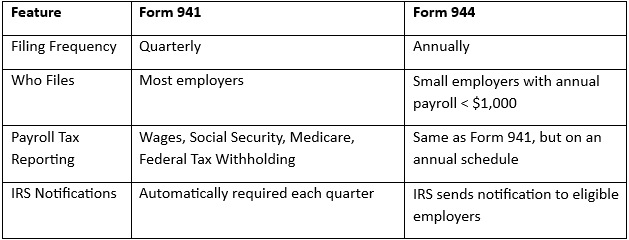
These differences are important as the employer is able to know their employer tax filing obligations and prevent unnecessary filings. Selecting an appropriate form will ensure that you are reporting correctly and in compliance.
Common Form 941 Mistakes to Avoid
The most common mistakes are in filing. Some mistakes include:
- Reporting taxable wages or tips wrongly.
- Overlooking tax adjustments or tax credits.
- Missing deadlines for the 2026 Quarterly Form 941 filing.
- Submission of wrong EIN or business information.
- Leaving out the date and signature of the form.
Employers ought to establish the review procedures that would identify errors prior to submission. The step-by-step payroll tax filing guide tools or software will significantly minimize errors and make the process easy.
Step-by-Step Payroll Tax Filing Guide in Practice
The following is a stepwise breakdown of the fill-out of Form 941:
- Prepare all payroll documentation for the quarter.
- Calculate the total wages, tips, and tax withheld.
- Complete Form 941 as per the instructions of the IRS.
- Check everything and make sure that everything is calculated.
- Send the form through the mail or electronically.
- Clear up any outstanding balance.
- Keep a copy for your records.
This employer guide to Form 941 payroll taxes will help in making sure that all is good, eliminate errors, and enhance the general payroll management.
Filing Deadlines and Penalties
Timely filing is crucial. The employers need to know:
- Quarterly deadlines: April 30, July 31, October 31, and January 31 (following year)
- Late filing penalty: 5% of unpaid taxes per month, up to 25%
- Late payment penalty: 0.5% of unpaid taxes per month, up to 25%
The knowledge of deadlines and fines would enable employers to save on unnecessary fines, as well as maintain payroll tax reporting. The most important component of filing federal payroll tax is planning in advance.
Additional Resources
For employers seeking official guidance:
- IRS Form 941 Page: https://www.irs.gov/forms-pubs/about-form-941
- IRS provides detailed Form 941 instructions 2026 and worksheets for calculations.
It is imperative to have these resources available in order to report on payroll taxes accurately on behalf of employers in 2026. They also provide examples and frequently asked questions to assist in complicated payroll scenarios.
Conclusion
Form 941 filing is an important aspect of the operation of a compliant business. Knowing the form, recording properly, and with a step-by-step process of filing Form 941, employers will save a lot of money, will not fall into some of the expensive errors, will not exceed the IRS regulations, and will be able to organize their payroll taxes in a cost-effective way.
In submitting forms and becoming tax compliant, PayProNext is a software that enables businesses to simplify payroll and automate the filing of federal payroll taxes. With automated calculations to reminders on submission, PayProNext will have your Form 941 as an employer submitted correctly and on time, so you can focus on expanding your business rather than running around after tax deadlines.
Get started with PayProNext today and make payroll compliance effortless.