
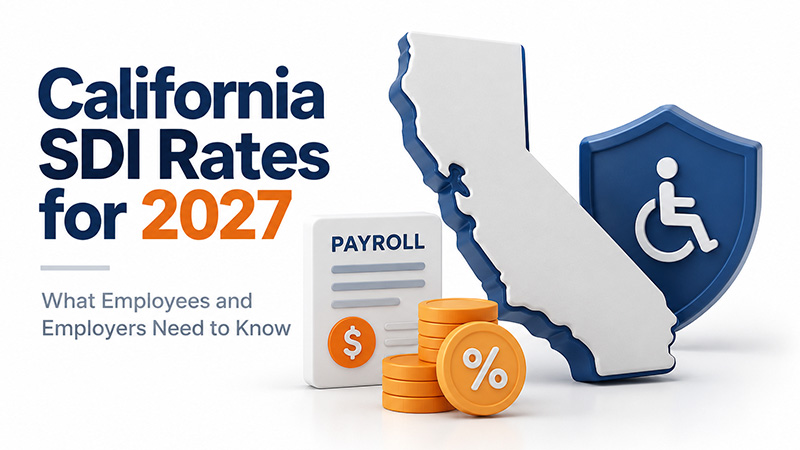
California SDI Rates for 2027: What Employees and Employers Need to Know
Date Released
22 October, 2026
What
Is California SDI?
California State Disability Insurance (SDI) is funded through contributions generally withheld from covered employees’ wages. If you are looking up California SDI rates for 2027, the short answer is that the Employment Development Department (EDD) has projected a change but has not confirmed one. SDI supports two programs:
- Disability Insurance (DI): Partial wage replacement for eligible workers who cannot work because of a qualifying non-work-related illness, injury, pregnancy, or childbirth.
- Paid Family Leave (PFL): Benefits for eligible workers who take qualifying leave to care for a seriously ill family member or bond with a new child.
Employers need to apply the correct rate every payroll, because a small error repeats on every paycheck.
California
SDI Withholding Rate for 2027: Confirmed or Forecast?
EDD confirms that the 2026 SDI withholding rate is 1.3 percent, and since January 1, 2024, all wages are subject to SDI contributions.
For 2027, EDD’s May 2026 Disability Insurance Fund Forecast projects an increase to 1.4 percent. That is a projection, not a final rate. As of October 2026, EDD’s rates page still lists 1.3 percent for 2026, and we found no official 2027 announcement.
|
Year |
SDI withholding rate |
Status |
|
2024 |
1.1% |
Confirmed by EDD |
|
2025 |
1.2% |
Confirmed by EDD |
|
2026 |
1.3% |
Confirmed by EDD |
|
2027 |
1.4% |
Projected (May 2026 forecast), not final |
|
Bottom line: Treat 1.4 percent as an expectation, not a fact. If adopted, it would be a 0.1 percentage point increase from 2026. Check EDD’s rates page for the official rate before changing payroll settings. |
Is
California SDI Paid by Employees or Employers?
SDI contributions are generally withheld from covered employees’ wages by the employer and remitted to EDD. They are separate from other payroll items:
- Employer-paid taxes: Unemployment Insurance (UI) and Employment Training Tax (ETT) are generally paid by the employer, not withheld from employees.
- Personal income tax (PIT): California income tax withholding is a separate deduction, not part of SDI.
Is
There a Wage Limit for California SDI?
No. California eliminated the SDI taxable wage ceiling and maximum employee contribution effective January 1, 2024, and EDD states that all wages are subject to SDI. In plain terms, employees do not stop paying SDI once their annual earnings pass a certain amount.
How
Is California SDI Calculated on a Paycheck?
SDI withholding = SDI-taxable wages × applicable SDI rate
Hypothetical example based on $1,000 in wages:
- At the confirmed 2026 rate of 1.3 percent, the deduction is $13.
- At the projected 2027 rate of 1.4 percent (hypothetical until EDD confirms it), the deduction would be $14.
Actual deductions depend on the rate in effect and the wages subject to SDI. California income tax brackets are not used to calculate SDI.
Does
California SDI Include Paid Family Leave?
Yes. SDI contributions support both DI and PFL. DI generally applies to an employee’s own non-work-related medical condition, including pregnancy and childbirth, while PFL applies to time off to care for a seriously ill family member or bond with a new child. Paying SDI does not automatically qualify anyone for benefits, because eligibility and benefit amounts depend on program rules.
Can
Employers Deduct SDI From Employee Wages?
Yes. Employers generally withhold the required SDI contribution from covered employee wages and remit it to EDD. Good payroll practice includes:
- Applying the correct annual rate
- Calculating deductions accurately for each pay period
- Updating payroll settings when EDD officially changes the rate
- Maintaining accurate payroll records
Remember that SDI is an employee contribution, while UI and ETT are generally employer-paid. This article is general information, not individualized legal or tax advice.
Frequently
Asked Questions
What is California’s SDI
rate for 2027?
EDD confirms 1.3 percent for 2026. Its May 2026 forecast projects 1.4 percent for 2027, but that remains a projection until EDD officially announces the rate.
Is California SDI tax paid by employees or employers?
SDI is generally withheld from employees’ wages by the employer and remitted to EDD. Employer-paid taxes such as UI and ETT are separate.
Is there a wage limit for
California SDI?
No. The taxable wage ceiling was eliminated effective January 1, 2024, so all wages are subject to SDI.
How is California SDI
calculated on a paycheck?
Multiply SDI-taxable wages by the applicable rate. For example, $1,000 in wages at 1.3 percent results in a $13 deduction.
Does California SDI
include Paid Family Leave?
Yes. SDI contributions support both Disability Insurance and Paid Family Leave, though eligibility and benefit amounts depend on program rules.
Can employers deduct SDI
from employee wages?
Yes. Employers generally withhold the required SDI contribution from covered employee wages and remit it to EDD.
Conclusion
Understanding SDI withholding helps employees read their paychecks and helps employers keep payroll calculations accurate, especially when a new rate is announced. Businesses that use California payroll software should still confirm each year’s rate against EDD’s official publications.
|
Looking to simplify payroll management for your business? Explore PayProNext to learn how its payroll services can support your payroll and employee payment processes. |