
Employee Onboarding Mistakes That Create Payroll Problems Later
Date Released
19 June, 2026
Why Onboarding Is the Foundation of Payroll Accuracy
Every payroll cycle you run is only as accurate as the information that is entered into your system on an employee's very first day. Onboarding is not just paperwork; it's the foundation that determines whether your payroll runs smoothly for years or causes recurring headaches every pay period.
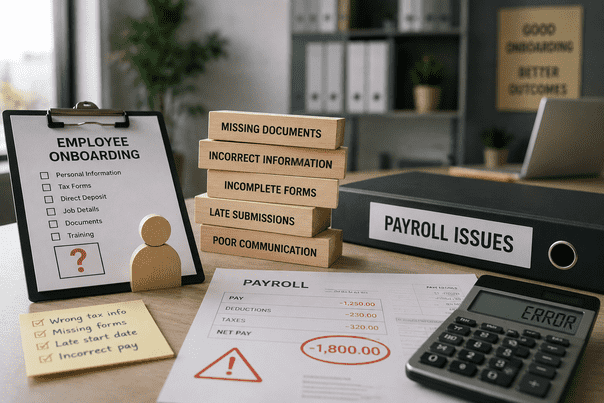
A rushed or incomplete onboarding process feels harmless in the moment. A missing form, a quick guess at a pay rate, a classification decision made without a second thought, none of it seems urgent when you're focused on getting a new hire up and running. But these small gaps don't disappear. They sit quietly in your payroll system until they surface as an underpayment, a tax notice, or a frustrated employee asking why their paycheck looks wrong.
First impressions matter, too. A new employee's confidence in your company is shaped heavily by whether their very first paycheck is accurate, on time, and free of confusing errors. Onboarding mistakes don't just cost you money; they cost you trust.
The Hidden Link Between Onboarding and Payroll Problems
Most employers think of onboarding and payroll as two separate processes. HR handles the welcome, paperwork, and culture; payroll handles the money. In reality, they're deeply connected, and the handoff between them is where most errors begin.
- Incorrect employee data entered during onboarding leads directly to wrong payments down the line.
- Missing or incomplete tax forms create compliance gaps that surface months later, often during an audit.
- Worker misclassification, even when unintentional, can trigger back taxes, penalties, and legal exposure.
Each of these issues starts as a small onboarding shortcut. By the time they show up in payroll, they've often compounded across multiple pay periods, making them far more expensive and time-consuming to fix.
Common Onboarding Mistakes That Lead to Payroll Issues
Below are the most frequent onboarding errors employers make and how each one quietly creates payroll problems.
Incorrect Employee Classification (W-2 vs. 1099)
Classifying a worker as an independent contractor when they should be a W-2 employee (or vice versa) is one of the costliest onboarding mistakes employers make. Misclassification affects tax withholding, benefits eligibility, and overtime obligations, and it's a common trigger for IRS and state labor department audits.
Missing or Incorrect Tax Forms
A W-4 that's incomplete, an I-9 that's missing supporting documentation, or a state withholding form that was never collected can delay payroll setup or result in incorrect tax withholding from day one. These gaps often go unnoticed until tax season, when discrepancies are far harder to correct.
Wrong Salary or Pay Rate Setup
A simple typo, entering an annual salary as an hourly rate, or rounding a pay rate incorrectly can cause significant overpayments or underpayments. These errors are especially damaging because they often aren't caught until the employee notices a paycheck that looks off.
Incomplete Employee Data
Missing details such as a Social Security number, direct deposit information, home address, or department code can stall the first payroll run entirely or cause payments to be sent to the wrong account.
Benefits & Deductions Setup Errors
If health insurance premiums, retirement contributions, or garnishments aren't configured correctly during onboarding, employees may see incorrect net pay for months before anyone catches the mistake.
Not Setting Payroll Schedule Properly
Assigning a new hire to the wrong pay group or pay frequency, weekly instead of biweekly, for example, can result in missed paychecks, duplicate payments, or confusion that takes hours of administrative time to untangle.
How These Mistakes Turn Into Bigger Problems
Onboarding errors rarely stay contained. Left unaddressed, they tend to grow into larger operational and financial issues:
- Payroll errors that repeat every pay period until someone catches and corrects the root cause.
- Employee dissatisfaction and lost trust, especially when paycheck issues happen in an employee's first few weeks.
- Compliance penalties from federal and state agencies for incorrect tax filings or worker misclassification.
- Hours of rework for HR and finance teams who must trace, correct, and document each error after the fact.
Compliance Risks of Poor Onboarding
Beyond the operational headaches, poor onboarding creates real legal and financial exposure for employers:
- IRS penalties for incorrect withholding or late tax deposits are tied to inaccurate onboarding data.
- Payroll tax errors at the state level are particularly around unemployment insurance and state withholding.
- Legal issues related to wage and hour violations stemming from misclassification or incorrect pay setup.
- Increased audit risk, since onboarding records are often the first documents regulators request.
Step-by-Step Onboarding Process to Avoid Payroll Issues
A structured onboarding process closes the gaps that lead to payroll problems. Here's a practical framework employers can follow:
Step 1: Collect Complete Employee Information
Gather full legal name, Social Security number, address, date of birth, and direct deposit details before the employee's first day, not after.
Step 2: Verify Tax Forms (W-4, I-9)
Confirm every federal and state tax form is fully completed, signed, and accompanied by the required identification documents.
Step 3: Classify Employee Correctly
Review the role against IRS and state guidelines to confirm whether the worker is an employee or independent contractor, and whether they're exempt or non-exempt.
Step 4: Set Accurate Pay Structure
Double-check salary, hourly rate, pay frequency, and pay group assignment against the signed offer letter before the first payroll run.
Step 5: Configure Benefits & Deductions
Enter health insurance, retirement contributions, and any other deductions accurately, and confirm that effective dates align with eligibility rules.
Step 6: Integrate with Payroll System
Sync onboarding data directly into your payroll platform rather than re-entering it manually, reducing the risk of transcription errors.
Employee Onboarding + Payroll Checklist (2026)
- Collect all employee data (SSN, address, banking details)
- Complete and verify tax forms (W-4, I-9, state withholding)
- Verify worker classification (W-2 vs. 1099, exempt vs. non-exempt)
- Set the correct salary or hourly pay rate
- Configure benefits and deduction elections
- Review every detail before the first payroll run
How Payroll Automation Prevents Onboarding Errors
Manual onboarding is where most payroll mistakes are born, not because HR teams are careless, but because spreadsheets, paper forms, and disconnected systems leave too much room for human error. Automation closes that gap.
- Standardized onboarding workflows ensure no required field or form is ever skipped.
- Automated tax form handling reduces missing or incomplete W-4 and I-9 submissions.
- Built-in validation catches classification and pay-rate errors before they reach payroll.
- Continuous compliance tracking flags state-specific requirements automatically.
| How PayProNext Helps PayProNext connects onboarding directly to payroll, so employee data, tax forms, and pay setup flow into your payroll system automatically with built-in compliance checks at every step. Employers using PayProNext eliminate the manual hand-off between HR and payroll, cutting down on the data-entry errors that cause most first-paycheck problems. The result: fewer corrections, faster onboarding, and a payroll process your employees can trust from day one. |
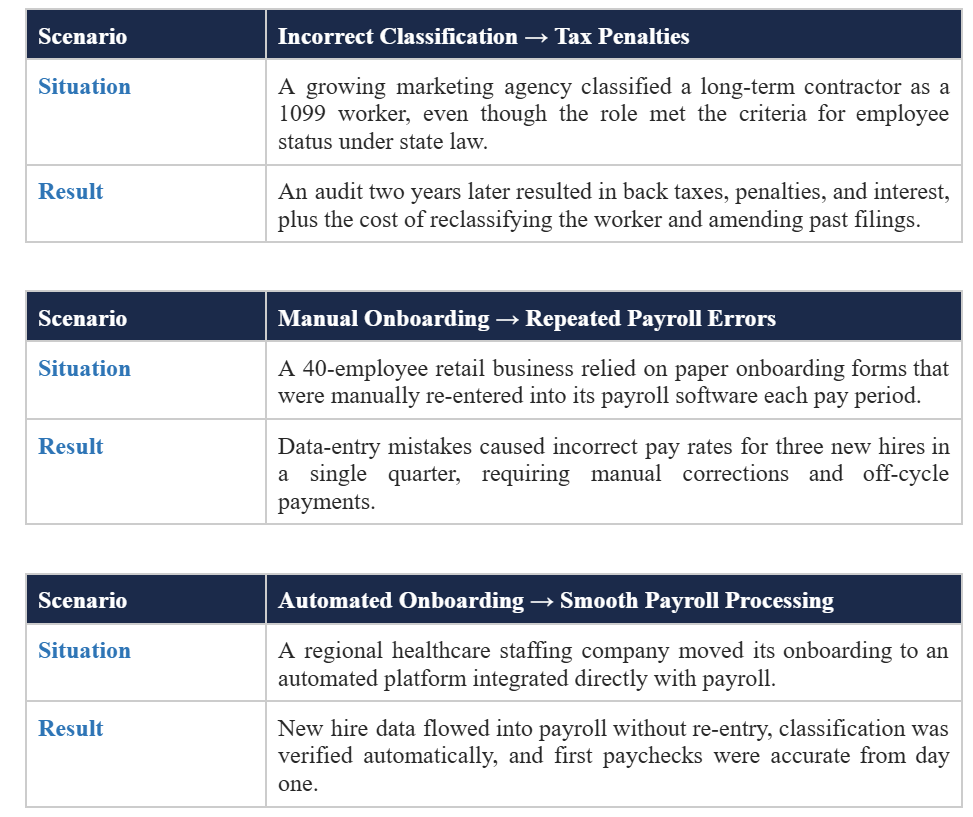
Real Business Scenarios
FAQs
How does onboarding affect payroll?
Onboarding determines the accuracy of the data your payroll system relies on, including classification, pay rate, tax withholding, and benefits, all of which originate during onboarding. Errors at this stage carry forward into every future pay period.
What are the common onboarding mistakes?
The most common mistakes include misclassifying workers, missing or incomplete tax forms, incorrect pay rate entry, incomplete employee data, and benefits or deduction setup errors.
Can onboarding errors cause payroll penalties?
Yes. Misclassification and incorrect tax withholding tied to onboarding mistakes can trigger IRS penalties, state payroll tax issues, and increased audit risk.
How can employers avoid onboarding mistakes?
Use a standardized onboarding checklist, verify all tax forms and classifications before the first payroll run, and integrate onboarding data directly with your payroll system to avoid manual re-entry.
What tools help streamline onboarding and payroll?
Integrated payroll platforms like PayProNext connect onboarding directly to payroll processing, automating tax form collection, classification checks, and pay setup to reduce errors.
Final Thoughts
Onboarding mistakes don't stay small. A missing form or a misclassified worker may seem like a minor oversight on day one, but it can quietly create payroll problems that take months and high cost to unwind.
The truth is, most payroll problems don't start in the payroll department. They start on Day 1, during onboarding, when data is collected, forms are signed, and pay structures are set. Employers who build a strong, standardized onboarding process protect themselves from compliance risk while giving new employees a better, more confident start. Strong systems lead to fewer errors and a better employee experience, and that starts with getting onboarding right.
| Ready to Eliminate Onboarding-Driven Payroll Errors? PayProNext helps U.S. employers connect onboarding and payroll into one accurate, compliant workflow so every new hire's first paycheck is right the first time. Talk to PayPronext today to see how automated onboarding can reduce payroll errors, protect you from compliance penalties, and improve the new hire experience from day one. |