
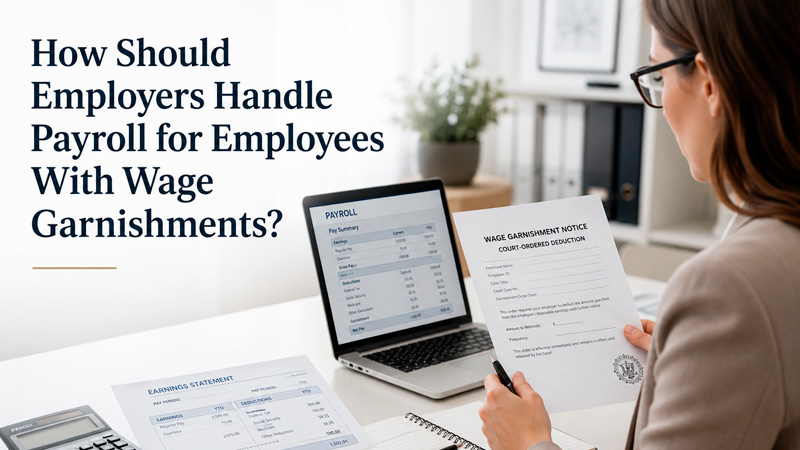
How Should Employers Handle Payroll for Employees With Wage Garnishments?
Date Released
20 August, 2026
A garnishment order doesn't ask your payroll team for permission, and it doesn't wait for a convenient pay period. It arrives in the mail, sets you a deadline and expects an accurate answer. That's where errors occur for employers who are managing payroll on their own: legal accuracy, timely processing and cash in a real person's pocket.
This guide explains what a wage garnishment is, what employers must do when an order is received, how to properly calculate withholding and where payroll software can help eliminate a lot of guesswork from a process that has very little room for error.
What Is a Wage Garnishment?
A payroll wage garnishment is a court order to withhold part of an employee's wages and to pay it directly to the creditor, court or government agency. It is something that the employer is legally obliged to calculate, withhold and remit, it is something that the employer does not initiate and has little control over, and as soon as an order is valid, the employer must do what the order says to do and obey it until it is terminated.
There are several circumstances that can lead to wage garnishment of an employee and each case has unique rules:
- Judgments that can be issued against consumers include unpaid credit card bills, accrued medical bills and unpaid taxes.
- Federal or state tax levies
- Child support or spousal support orders
- Defaulted federal student loans
- Bankruptcy court orders
For most of this, the federal regulations are contained in Title III of the Consumer Credit Protection Act (CCPA). Title III has been in effect since 1968 and covers wage garnishment in all 50 states. It places limits on the amount which can be deducted and prevents employees from losing their jobs for one garnishment.
Why Getting This Right Matters
(Beyond Compliance)
The stakes are complicated and go both ways when it comes to garnishments, and payroll personnel often view garnishments as a compliance box to check. If the payroll is not garnished enough, the employer may face personal liability, in some jurisdictions, for the whole amount that should have been garnished. But don't withhold it too much, or the employer may have taken the money that the employee was legally entitled to keep, which could result in back-pay claims, erosion of trust, and in extreme and repeat instances, penalties from the issuing agency.
A less obvious price is also the stress on employees who are suffering from a garnishment. Add a payroll mistake to the list: a miscalculated deduction, missed start date, a garnishment that was supposed to end, but didn't- and a legal requirement becomes an employee relations challenge. The mechanics are not only about avoiding fines, but they are a part of a payroll function employees can trust.
What Should an Employer Do When
They Receive a Garnishment Order?
The moment a garnishment order lands, a clock starts. While the dates vary from employer to employer and state to state, the steps are fairly standard:
- Check if the order is a valid order. Check that it comes from a court, governmental agency or authorized collection organization, and that it specifies the name of the current employer and employee.
- Notify the employee. Most states require the employer to inform the employee that an order has been received, and some require this in writing within a set number of days.
- Calculate disposable earnings. This is gross pay minus legally required deductions only: taxes, Social Security, and Medicare. Voluntary deductions like a 401(k) contribution or health premium are not subtracted first.
- Apply the correct cap. Run the applicable federal and state tests and withhold the lesser amount, unless the order is for support, taxes, or a defaulted federal student loan, which follow separate rules.
- Set up recurring withholding. Build the deduction into the payroll cycle so it applies each pay period automatically until the order specifies otherwise.
- Remit funds on schedule. Send the withheld amount to the correct agency or creditor by the required date; remittance deadlines are typically separate from, and shorter than, ordinary pay cycles.
Documentation matters at every step. If a garnishment is ever disputed, the employer's records- when the order arrived, when the employee was notified, how the withholding was calculated- are what demonstrate good-faith compliance.
How Do Employers Calculate Wage
Garnishments?
For ordinary consumer debt, the kind most employers see most often, the federal formula under the CCPA withholds the lesser of two numbers: 25% of the employee's disposable earnings, or the amount by which weekly disposable earnings exceed 30 times the federal minimum wage ($7.25, so $217.50 per week). Whichever calculation produces the smaller garnishment is the one that applies.
|
Weekly Disposable Earnings |
Maximum Ordinary Garnishment |
Why |
|
$217.50 or less |
$0 fully protected |
Equals 30x the $7.25 federal minimum wage floor |
|
$217.50–$289.99 |
Only the amount above $217.50 |
The dollar-floor test produces a smaller number than 25% |
|
$290.00 or more |
Up to 25% of disposable earnings |
The percentage test now produces the smaller number |
Other garnishment types follow entirely different rules and don't share the 25% ceiling:
|
Garnishment Type |
Typical Cap |
Court Order Required? |
|
Child support/alimony |
50%–65% of disposable earnings |
Yes |
|
Federal/state tax levy |
Set by IRS exemption tables, not the 25% cap |
No |
|
Defaulted federal student loan |
Up to 15% of disposable earnings |
No |
|
Ordinary consumer debt (credit card, medical bill) |
Lesser of 25% or amount over $217.50/week |
Yes |
If a garnishment is attached to more than one employee, the employer needs to only calculate the disposable income once, apply the orders in the proper priority child support order first, and ensure that the total withholding under all orders does not exceed the highest possible limit. That's where manual and spreadsheet-based payroll systems often fail, particularly for those who are handling garnishments with employees who work in multiple states.
Are Wage Garnishments Different
by State?
Yes, and often it's a big difference. Each State must require compliance of the CCPA as a floor, but some States impose higher caps, longer or shorter employee-notice requirements, added anti-retaliation protections, or additional fees, if any, the employer may impose (or be required to) on the processing of the order. Only a few states impose narrower limits on ordinary wage garnishment on consumer debt than the federal law.
This is because there isn't one formula that can be applied across the entire company by an employer who has workers in more than one state. Payroll teams should have a state-by-state reference they keep updated, or a system that has built-in state rules and keeps them up-to-date when state laws are modified.
Can an Employer Refuse a Wage
Garnishment?
No, once an order has been issued, it is valid. Employers cannot consider the underlying debt, nor can they negotiate on the employee's behalf or decide that it isn't convenient to process the order. An employer's failure or refusal to comply with a valid garnishment order may result in an award of penalties, in addition to the amount of the garnishment, from the issuing court or agency.
The best the employer can do, and should do, is to verify that the order is legitimate (and directed to the right employer), and that it names the correct employee, comes from an authorized source, and is not already satisfied or superseded. That is a verification step and that will protect the employer but not come close to refusal.
What Happens If an Employer
Makes a Garnishment Mistake?
Garnishment errors are common precisely because the calculation looks simple and isn't. A missed pay-period start date, an incorrect disposable-earnings figure, or a failure to apply the right priority order between multiple garnishments can all trigger consequences, including:
- Employer liability for the amount that should have been withheld and remitted
- Interest or penalties assessed by the court or agency
- Back-pay obligations if too much was withheld from the employee
- Increased scrutiny on future garnishment compliance from that same agency
Most of these mistakes trace back to the same root cause: garnishments are handled as a manual, one-off task layered on top of an already complex payroll run, instead of a standardized, repeatable process.
Where Payroll Software Fits In
This is exactly the kind of recurring, rules-heavy, high-consequence task that payroll software with wage garnishment support is built to handle. Instead of a payroll administrator manually re-running the CCPA math every pay period, and re-checking it every time a state's rules change, the calculation happens automatically, applied consistently across every affected employee and every pay cycle.
|
Stop calculating garnishments by hand. PayProNext automates wage garnishment withholding, federal caps, state-specific limits, and multi-order prioritization, directly inside your payroll run, with remittance tracking built in. Employers using PayProNext no longer have to manually re-verify garnishment math every pay cycle or track state-by-state rule changes on their own. See how PayProNext handles wage garnishments → |
For employers managing garnishments across multiple states, or handling several concurrent orders for the same employee, this isn't just a convenience; it's a meaningful reduction in compliance risk. An accurate system doesn't just calculate correctly today; it keeps calculating correctly as state minimum wage figures, agency rules, and employee circumstances change.
Frequently Asked Questions
What is a wage garnishment?
A wage garnishment is a legal order requiring an employer to withhold part of an employee's paycheck and send it directly to a creditor, court, or government agency to satisfy a debt, tax obligation, or support order.
What should an employer do when
they receive a garnishment order?
Verify the order is valid and correctly directed, notify the employee as required by state law, calculate disposable earnings, apply the correct withholding limit, and set up recurring withholding until the order specifies otherwise.
How do employers calculate wage
garnishments?
For ordinary consumer debt, employers withhold the lesser of 25% of the employee's disposable earnings or the amount by which weekly disposable earnings exceed 30 times the federal minimum wage. Support orders, tax levies, and student loan garnishments follow separate, higher limits.
Can an employer refuse a wage
garnishment?
No. Once a valid order is received, the employer is legally required to comply. Employers can verify an order's legitimacy before acting, but they cannot decline to withhold once it's confirmed valid.
How much can an employer deduct
from an employee's paycheck?
It depends on the garnishment type. Ordinary debts are capped at 25% of disposable earnings (or less, depending on income level). Child support can reach 50–65%. Tax levies and student loan garnishments follow their own separate formulas.
Are wage garnishments different by state?
Yes. States must honor the federal CCPA floor, but many impose stricter limits, different notice requirements, or added employee protections. Employers with multi-state workforces need to track these differences by state.
What happens if an employer
makes a garnishment mistake?
Under-withholding can make the employer liable for the shortfall; over-withholding can create back-pay obligations. Repeated or serious errors can also draw increased scrutiny from the issuing court or agency.
Can payroll software automate wage garnishments?
Yes. Payroll software with built-in garnishment support can automatically apply federal and state limits, prioritize multiple concurrent orders, and track remittance deadlines, reducing the manual calculation errors that cause most garnishment compliance issues.
The Bottom Line
Wage garnishments aren't optional, and they aren't simple. Between federal caps, state variations, multiple garnishment types, and the need to recalculate correctly every single pay period, it's a process built for automation, not spreadsheets. Employers who treat garnishment compliance as a standardized payroll function, rather than a manual exception handled case by case, protect themselves from liability and give employees a payroll experience they can trust, even in a difficult financial moment.
If your team is still calculating garnishments by hand, it's worth asking what that's actually costing you in staff time, risk exposure, and accuracy, and whether a payroll platform built to handle it automatically would pay for itself the first time it catches an error before it happens.