

Your Payroll Software Is Your Employee Experience: Why Accuracy and Speed Drive Retention in 2026
Date Released
21 April, 2026
Why getting pay right, fast, is one of the biggest things you can do to keep your team happy in 2026
Here's the thing most HR leaders miss: payroll isn't just an admin task; it's one of the most emotional moments in your employees' lives.
Think about it. Rent, groceries, school fees, the electricity bill, all of that depends on your payroll being right. When it goes wrong, it doesn't just cause a headache. It breaks trust. And broken trust is really hard to fix.
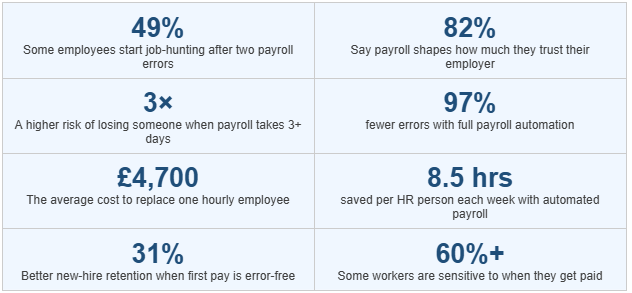
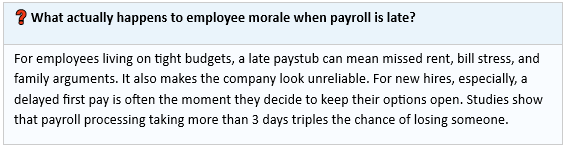
The data backs this up. One wrong paystub can knock employee trust by up to 49%. Two payroll errors, and nearly half your team starts quietly looking for other jobs. Payroll delays triple the risk of someone walking out.
The good news? All of this is totally fixable with the right payroll software. This article breaks down why payroll matters so much, what goes wrong, and exactly what to look for in a modern payroll system.
The Numbers You Need to Know
Section 1: Why Payroll Is More Than Just Admin
If you ask most HR directors what shapes employee experience, they'll talk about onboarding, career growth, flexible working, and good management. Payroll rarely comes up.
But here's the problem with that: payroll isn't just a process. It's a feeling. It touches people's finances, their family life, and their ability to plan. And it happens every single pay cycle, over and over again, for as long as someone works for you.
Behavioral researchers call this the "peak-end rule"; people remember experiences based on the most intense emotional moments, not averages. In an employment relationship, payroll is one of those intense moments every single month. Get it wrong once, and it sticks.
And today's workers aren't comparing you to employers from ten years ago. They're comparing you to apps that send money in seconds, instant bank transfers, and real-time financial tools. When payroll feels slow or broken by comparison, it doesn't just feel inconvenient; it feels disrespectful.

Section 2: What Actually Happens When Payroll Goes Wrong
The phrase "payroll error" sounds dry and technical. But the experience of it is anything but. Here's what it actually looks like in real life:
Stage 1: The Immediate Panic
An employee gets paid $200 short on Thursday. Their direct debit for rent goes out on Friday. They're suddenly scrambling, checking balances, calling the bank, asking if they'll get charged overdraft fees. Their weekend is ruined because of a number in a spreadsheet.
Stage 2: The Trust That Quietly Disappears
Even if you fix it fast, something has shifted. Now, every time payday rolls around, there's a little nagging voice in the back of their head: "Will this be right this time?" That anxiety is silent; you won't see it on an engagement survey, but it's there. And it quietly chips away at motivation, focus, and loyalty.
Stage 3: The Reputation Damage
People talk. Not just to their friends, on Glassdoor, LinkedIn, and professional networks. "They couldn't even get my pay right" is one of the most damaging things a former employee can say. And it spreads fast. One viral review about payroll problems can cost you more qualified candidates than an entire recruitment campaign can recover.

Section 3: Speed Matters Too; Not Just Accuracy
For a long time, everyone focused on whether payroll was correct. In 2026, how fast it gets done matters just as much.
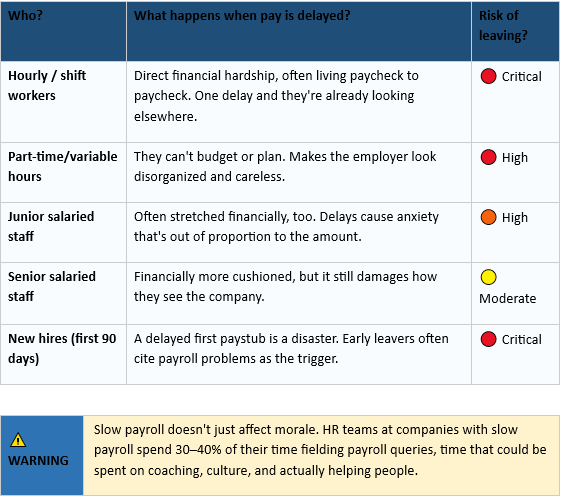
Why? Because the workforce has changed. More than 60% of employees at most medium-to-large businesses are hourly workers, shift workers, part-timers, or people with variable pay. For these folks, a 3-day payroll run isn't just slow, it's genuinely harmful.
How payroll speed affects different types of employees
Section 4: Why Automating Payroll Is a No-Brainer
Payroll automation usually gets sold as a way to save money. That's true, but the bigger story is what it does for your people.
Manual payroll has a 1–3% error rate, even when experienced professionals are running it. For a 200-person company, that's 2–6 people dealing with a payroll problem every single month. Over a year? Between 24 and 72 trust-damaging moments, each one a potential resignation, each one leaving a mark.
Automation doesn't reduce these errors. It eliminates them. Calculation mistakes, wrong tax codes, missed bonuses, and holiday miscalculations are solved.
What else does payroll automation do for you?
- Saves 8.5 hours per week per HR person, that's time back for the work that actually matters.
- Keeps you compliant automatically, tax codes, pension contributions, and statutory pay are all handled without anyone having to check.
- Scales with you, as you hire more people, your payroll doesn't get more complicated or more error-prone.
- One source of truth, HR, payroll, and finance all see the same data. No more reconciliation headaches.
- Employees can help themselves; they can check their paystubs, download documents, and submit queries, all without going through HR.
- Full audit trail, every payroll event is timestamped and logged automatically. No scrambling when you need to check something.
"Payroll automation doesn't just save time, it saves the trust that keeps your best people from leaving."
Section 5: Simple Things You Can Do Right Now
Making payroll a better experience for your team doesn't have to be complicated. Here are six things that genuinely make a difference:
1. Give employees a heads-up before payday
Send paystub previews or payment notifications 48–72 hours before pay arrives. It lets people flag problems in advance, and it shows you respect them as adults who can manage their own finances. Most payroll queries happen because people were surprised; remove the surprise, and you remove the query.
2. Respond to payroll issues the same day
When someone has a payroll problem, they need to know you've heard them, fast. Commit to responding within 4 business hours. You don't have to have fixed it yet. You just have to acknowledge it. That alone preserves a huge amount of trust.
3. Make pay stubs easy to access on a phone
Not a PDF attached to an email. Not a desktop portal. Paystubs people can check on their phone, right now, from anywhere. In 2026, if employees can't see their pay breakdown on their commute, your company already feels a little behind the times.
4. Tell employees what you're doing right for them
Most employees have no idea that their employer is correctly calculating their pension, applying the right tax code, or handling their statutory leave properly. Make that visible. Tell them. Compliance that's invisible is a missed trust opportunity.
5. Connect your systems together
The biggest source of payroll errors is data living in different places, your HR system, time-tracking tool, and payroll platform not talking to each other. Integrating these removes an entire category of mistakes before they can happen.
6. Let employees access their pay early if they need to
Earned wage access, letting employees withdraw what they've already earned before payday, costs very little to set up and sends a big message: we trust you, and we've got your back. It's particularly valued by hourly workers and younger employees.

Section 6: What to Look For in Payroll Software
The best payroll software isn't just built for the person running payroll; it's built for the people receiving it. That's a big shift from older systems, which were designed around accountants and compliance teams.
Modern payroll platforms put the employee first: clean paystub interfaces, mobile access, proactive notifications, and self-service tools that mean employees don't have to go through HR for basic information.
Your 8-point checklist when evaluating payroll software
- Real-time accuracy checking, errors get caught before the run is approved, not after money has gone out.
- Same-day or next-day processing, paystubs, and payment confirmations land fast, not three days later.
- Mobile-first employee self-service, paystubs, documents, and queries all work properly on any phone.
- Proactive notifications, employees know when they're getting paid before payday arrives.
- Automatic sync with HR and time-tracking, no manual re-entry, no data mismatches.
- Compliance on autopilot, tax codes, pension contributions, and statutory payments update automatically.
- Full audit trail, every payroll event is logged, timestamped, and easy to access.
- Earned wage access: Employees can opt in to access earned wages early if they need to.
Section 7: The Business Case (Spoiler: It's Obvious)
The companies winning at talent retention right now aren't necessarily the ones with the biggest salaries or the fanciest offices. They're the ones who've removed the basic frustrations that make good people look elsewhere. Payroll is at the top of that list.
When we look at businesses dealing with unexplained staff turnover, payroll problems, errors, delays, lack of transparency, and no self-service, are almost always a factor. And unlike a bad manager or a toxic team, these are completely fixable problems.
The maths is pretty simple:

In 2026, your payroll software is not a back-office detail. It's the most repeated, most emotionally significant touchpoint you have with every single employee. It deserves the same attention you give to onboarding, management training, or culture, because for a lot of employees, it's what decides whether they stay.
Frequently Asked Questions
1. How does payroll software improve employee experience?
It comes down to three things: accuracy (people get exactly what they're owed), speed (money arrives on time and paystubs are immediately accessible), and transparency (employees can see a clear breakdown of their pay whenever they want). Get all three right, and payroll quietly becomes one of the strongest loyalty signals you send your team.
2. What's the real impact of payroll errors on
trust and staff retention?
Even small errors hit hard. A $50 underpayment
can trigger the same emotional response as a much larger problem, because it
signals that the employer isn't paying proper attention. Research shows 49% of
employees start looking for new jobs after just two payroll errors. Trust
that's damaged by payroll mistakes is very hard to rebuild through other HR
initiatives.
3. What are the main benefits of automating payroll for staff retention?
Fewer errors (97% reduction), faster processing, real-time paystub access, automatic compliance calculations, and HR teams freed up to focus on people rather than queries. Businesses that switch from manual to automated payroll typically see significant improvements in employee satisfaction within one or two pay cycles.
4. Why
should modern businesses care so much about payroll experience?
Payroll is the one thing that happens to
every employee, every pay cycle, for the entire time they work for you. In a
world of instant payments and real-time banking, employees judge their employer
partly on how good their payroll experience is. Poor payroll = higher turnover,
damaged reputation, and bigger recruitment bills.
The Bottom Line
Accurate payroll stops trust from breaking in the first place. Fast payroll reduces financial stress for the people most likely to leave if their needs aren't met. Automated payroll frees your HR team to do work that actually moves the needle on retention. And transparent, mobile-first paystub access sends a signal, 52 times a year for weekly-paid workers, that your company is competent, caring, and worth staying at.
In 2026, your payroll software is your employee experience. The businesses that get this and act on it will keep more of their best people, spend less on replacing them, and build the kind of employer reputation that attracts talent rather than pushes it away.
"The businesses winning the talent war in 2026 aren't the ones with the best office snacks. They're the ones that pay people right, pay people fast, and make every employee feel financially respected."
Ready to Make Payroll Your Biggest Retention Win?
See how PayProNext helps businesses get payroll right, every time, on time, for every employee.
👉 Book a Free Demo: paypronext.com/demo
No commitment. Just better payroll.