

Managing Payroll in California: What Growing Businesses Need to Know About Compliance & Costs
Date Released
03 March, 2026
Payroll management in California does not merely involve paying the employees on time and correctly. It is a compliance-based role that has a direct impact on financial forecasting, the stability of operations, and legal exposure. The California payroll compliance is a more complex and complicated burden with each addition of a new employee, place of operation, and pay structure to growing companies.
Businesses have to deal with changing California payroll laws 2026, rising payroll expenses California employers face, and stringent regulations by agencies such as the California Employment Development Department (EDD). The impact of the small payroll errors increases as the size of your workforce increases.
Payroll needs to evolve beyond being a back-office exercise to be a formal compliance framework to scale organizations.
Core California Employer Payroll Requirements
All employers are first required to register with EDD in order to get a state payroll tax account number. Businesses in California cannot legally process payroll without this registration.
When operational, there are various continuing commitments that employers have to address. These are state income tax withholding, unemployment contribution, disability insurance deductions, and correct reporting in California payroll tax filing schedules. California workers also demand that employers maintain California workers' compensation insurance, which also has a direct effect on the total payroll expenses California businesses incur.
The payroll system in California is a combination of the taxes paid by the employer, withholdings of employees, and reporting. The table below has a summary of the major components:
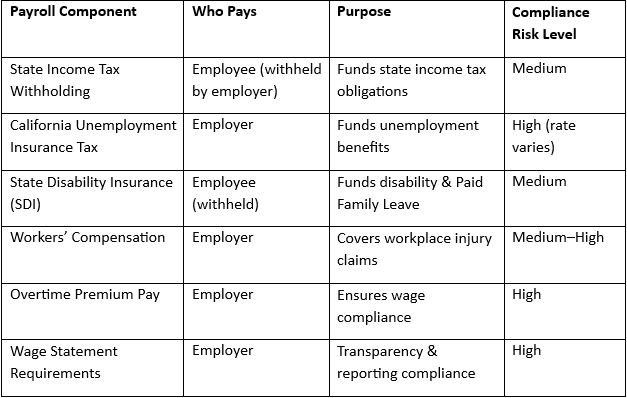
In the case of expanding businesses, failure to consider any of these elements can escalate payroll audit risk.
Minimum Wage and Overtime: The Most Common Risk Areas
California's minimum wage in 2026 is still growing, and local cities often have a higher minimum wage than the state minimum wage. Companies with branches in different cities need to monitor the work location of the employees to prevent underpayment.
The California overtime laws further complicate the matter. Compared to federal laws that focus on the weekly thresholds, California counts overtime on a day-to-day basis. This has a massive impact on the businesses that employ hourly workers, rotating shifts, or fluctuating schedules.
The overtime requirements usually arise when:
- Employee works over 8 hours a day.
- An employee is working longer than 40 hours a week.
- Premium pay requirements are triggered by consecutive workdays.
Due to these rules (daily), payroll systems that are not specially designed to handle California usually fail to compute earnings properly. Overtime compliance becomes a significant area of control in growing businesses that add departments or increase working hours.
Wage Statements and Final Paycheck Laws
The state of California has stringent wage statement requirements. The gross wages, total hours worked, deductions, net wages, dates of pay period, and employer details should be clearly noted on each pay stub. Even formatting errors are subject to statutory penalties that are imposed on each employee at the end of the pay period.
Final paycheck laws are also strict. Fired workers have to be paid instantly. Employees who leave with due notice should be paid on their day of resignation. Delays in these timelines may also result in penalties of as much as 30 days' wages in waiting time.
In businesses that lack an organized offboarding payroll, it is an area of avoidable financial exposure.
Employee Classification Under AB5
One of the compliance areas that the company is still facing is the classification of employees (AB5). The ABC test identifies the qualification of a worker as an independent contractor. In case a worker fails any of the aspects of the test, they have to be considered as an employee.
Back payroll taxes, unpaid overtime, retroactive benefits, and penalties may be misclassified. The frequent classification reviews should be performed to minimize the exposure to compliance by growing businesses with the involvement of freelancers or consultants.
The Real Cost of Payroll in California
Base wages are not the only factor when California businesses are evaluated in terms of payroll expenses. The labor expense is added through employer payroll taxes, unemployment contributions, SDI administration, workers’ compensation premiums, and overtime requirements, as well as compliance administration.
In most organizations, the amount of money spent on payroll is up to 20-30% or even higher than base salaries. These expenses are multiplied rapidly through rapid hiring, and precise budgeting is crucial to sustainable growth.
Knowing the cost of payroll in California will help the leadership teams make sound decisions regarding the rate of hiring, remuneration structures, and expansion strategies.
Multi-State Payroll and Growing Complexity
In case your business is outside California, multi-state payroll management in California would demand systems that would implement state-specific regulations precisely. California tends to have more rigid wage requirements than most states, especially on overtime and employee categorization.
Multi-state employers are forced to deal with different tax schedules, different unemployment accounts, and different leave regulations. Lack of structured oversight may lead to compliance gaps during expansion.
Strengthening Your Payroll Strategy in 2026
Growing businesses ought to concentrate on organized compliance methods instead of corrective responses to enhance the accuracy of payroll and minimise risk.
Key strategic steps include:
- Regular reviews aligned with California payroll laws 2026
- Automated tracking of minimum wage and overtime rules
- Accurate SDI and tax withholding calculations
- Documented final paycheck procedures
- Ongoing evaluation of employee classification
Some companies choose to outsource payroll California operations to reduce administrative burden. While outsourcing can improve efficiency, employers remain legally responsible for compliance accuracy.
Ready to Simplify California Payroll Compliance?
When you find it time-consuming, compliance stressful, or slowing down your growth to manage your payroll in California, it might be time to upgrade your system.
PayProNext is designed to enable businesses that are growing and multi-state in their operations to manage complex payroll environments, such as California, with confidence. PayProNext, whether it is automated tax calculations and overtime tracking or correct wage statements and streamlined California payroll tax filing, will minimize payroll audit risk and provide you with full visibility of the payroll costs that California employers incur.
You can avoid responding to compliance problems, but instead, you can be proactive in controlling them.
In case you are scaling in California and want a smarter compliance-first payroll, contact PayProNext, as we can help you grow better, more accurately, safely, and efficiently.