


Why Small Business Payroll is Getting More Complex in Oregon and Arizona
Date Released
17 April, 2026
Small business owners in Oregon and Arizona know the drill: payroll used to be a simple twice-a-month task. Sign the checks, submit your taxes, and get back to running your business. In 2026, small business payroll has become one of the greatest operational nuisances of all time.
With new notifications mandated by states, tiered minimum wage requirements, paid-time-off contributions, more rigorous requirements, increased penalties for non-compliance, and more, the payroll complications faced by small business owners are skyrocketing. Whether your business employs an expanding workforce from Portland to Phoenix and any other point in between, you may be experiencing this firsthand.
This is not simply a case of tax season being a burden. The payroll regulations of the United States are rapidly changing, meaning payroll compliance in the states of Oregon and Arizona is far more complicated than ever before. It is obvious that there is now more time consumed by administrative tasks, more costs associated with operation, and an increased risk of payroll errors. Payroll is no longer simply an operational issue for small business owners but rather a strategic one.
The National Picture: Why Payroll Is Getting More Complex
Tax issues have gotten increasingly complicated across the nation in 2026. The government has brought about changes such as electronic filing, improved reporting procedures, and increased enforcement that raise the bar for all employers. However, the greatest burden lies with the state.
States are implementing various programs and enforcing compliance strictly. They have made it difficult by increasing the requirements an employer has to comply with, resulting in many challenges, particularly for those who do not have specialists in this field.
Key drivers behind payroll complexity:
- Rapid payroll regulatory changes at the state and federal levels
- Increased payroll compliance requirements and enforcement
- Growth of remote and multi-state workforce management
- More detailed payroll reporting systems
- Increasingly higher levels of accuracy and transparency
The small firms, particularly those with fewer than fifty workers, find this to be very problematic. Such firms do not have the capacity to meet these new demands, and any small error in payroll could result in sanctions, audits, or conflict with employees.
Oregon Payroll Compliance: A System That Keeps Expanding
Payroll for small businesses in Oregon has become very complicated because of some changes in legislation and other compliance matters. Perhaps one of the biggest changes is the requirement for employees to be properly notified, which is a result of current legislative changes.
It is mandatory that employers give written notices on salaries and payroll practices. This adds an administrative layer that must be updated regularly and delivered accurately.
On top of that, Oregon’s tiered minimum wage system continues to create challenges. Different regions have different wage requirements, meaning businesses must track where employees work, not just where the business is based. For companies with hybrid or mobile teams, this adds another level of payroll system complexity.
Paid leave policies are also part of the burden as employers will need to deal with contributions, manage eligibility, and make sure they comply with job protections. The programs are helpful for employees, but add to the employer’s burden.
What makes Oregon payroll particularly complex:
- Multiple payroll-related taxes and contribution programs
- Regional minimum wage variations
- Paid leave contribution tracking and compliance
- Strict reporting and documentation requirements
All these things come together to form a process where any mistakes can carry severe repercussions.
Arizona Payroll Compliance: Simplicity with Hidden Complexity
While Arizona’s payroll tax compliance process is simpler than Oregon's, it does not mean that it is easy. The challenges involved with payroll in Arizona arise due to consistency and compliance.
The state requires that businesses pay higher wages, which necessitate frequent adjustments. On top of this, paid sick leave laws mean that companies need to account for accrual, usage, and limitations depending on employer size.
The tax withholding and filing processes have to remain accurate as well, even as they become less difficult to handle.
Challenges in payroll compliance in Arizona:
- Keeping up with minimum wage increases
- Tracking payments for PTO
- Keeping tax withholdings up to date and accurate
- Complying with payroll laws and requirements
These demands put constant strain on growing organizations to keep their systems up-to-date and accurate.
Multi-State Payroll: Where Complexity Multiplies
One of the biggest reasons why payroll is becoming more complex for small businesses in Oregon and Arizona is the rise of multi-state employment. Hiring remote workers or expanding into another state introduces entirely new compliance requirements.
A business based in Oregon hiring an employee in Arizona must now follow both states’ payroll tax rules, filing requirements, and labor laws. This creates a system where each employee may require a different payroll setup.
Common multi-state payroll issues:
- Determining the correct tax withholding by state
- Managing different payroll compliance requirements
- Tracking multiple filing deadlines
- Double taxation or improper tax reporting
Small companies find themselves overwhelmed by these factors when they don't have proper tools and resources.
Payroll Errors and Compliance Risks Are Rising
With increasing complexity, the risk of making payroll mistakes rises, too. And the consequences could be much higher in 2026.
Because small business owners use archaic methods for handling payroll data, they are at high risk of making mistakes. The stakes are even higher because even a small mistake could have serious repercussions.
Common payroll mistakes due to complexity:
- Incorrect tax calculations or withholding
- Missing payroll tax filing deadlines
- Misclassifying employees
- Failing to track state-specific deductions
- Inaccuracies in payroll accounting
The above issues and risks may have financial repercussions as well as affect reputation, thus making accuracy all the more important.
The Operational Impact of Payroll Complexity
In addition to affecting compliance efforts, the payroll process is also a burden on the overall operation. This is because the company owners/managers have less time to deal with strategic issues, as they will be busy sorting out payroll-related problems.
With higher complexity comes slower processing times, more time spent fixing errors, and increased frequency of audits.
How payroll complexity affects operations:
- Increased administrative workload
- Reduced efficiency in workforce management
- Higher risk of penalties and audits
- Less time for business growth and strategy
For small businesses, this shift can slow down momentum and create unnecessary stress.
Payroll Trends 2026: Moving Toward Smarter Systems
The increasing intricacy of payroll management is forcing companies towards automation and integration.
The current generation of payroll solutions automatically updates to account for new regulations, thus relieving small-business owners from this task.
Top payroll trends shaping the 2026 business landscape:
- Adoption of payroll automation tools
- Integration with HR and workforce management systems
- Real-time payroll reporting and analytics
- Increased focus on compliance-first platforms
- Simplified multi-state payroll management
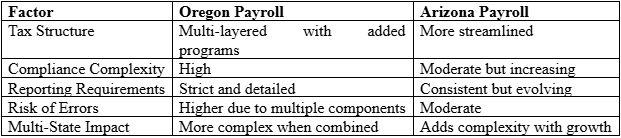
Oregon vs Arizona Payroll Comparison
How to Simplify Payroll for Small Businesses
Though your payroll has become complex over time, there is no need for you to let it take over the operations of your business. All that you need to do is embrace automation and more effective solutions for payroll management.
Some of the practical solutions for dealing with payroll complexity:
- Automating payroll calculations and tax filing
- Stay updated on payroll regulatory changes
- Standardize payroll processes across your business
- Use integrated HR payroll systems
- Plan for multi-state payroll as you grow
Why PayProNext Is the Smarter Way to Run Payroll
At PayProNext, payroll is designed to be simple, even when the rules aren’t.
Whether you’re dealing with Oregon payroll compliance, Arizona payroll tax requirements, or multi-state payroll issues, PayProNext helps you stay ahead without the stress.
With PayProNext, you can:
- Automatically calculate taxes and deductions
- Stay compliant with constantly changing regulations
- Run payroll in minutes, not hours
- Handle multi-state payroll with ease
- Eliminate payroll errors and compliance risks
Businesses using PayProNext are cutting payroll processing time dramatically while staying fully compliant.
Conclusion: Payroll Complexity Isn’t Going Away, But Your Stress Can
Small business payroll complexity in Oregon and Arizona is no longer a temporary challenge; it’s the new standard. With evolving payroll regulations in the US, increasing compliance requirements, and the rise of multi-state teams, payroll has shifted from a routine task to a high-stakes responsibility.
For small businesses, the risk isn’t just getting payroll wrong; it’s the time, energy, and growth opportunities lost trying to keep up with constant changes. From Oregon’s layered payroll compliance rules to Arizona’s tracking and reporting demands, the margin for error is shrinking fast.
And the best part of all this is the fact that you do not have to put up with payroll complexity through manual efforts.
The companies that thrive in 2026 have stopped putting extra effort into payroll. They are instead focusing their efforts on automation and payroll solutions that ensure error-free calculations.
The ultimate idea is to make sure that payroll does not distract your attention from your core objectives.
Ready to Take Payroll Off Your Plate?
Payroll complexity in 2026 isn’t going away, but managing it can get a whole lot easier.
Stop spending hours on spreadsheets and worrying about compliance.
Try PayProNext today and simplify payroll for your Oregon or Arizona business, so you can focus on growing, not calculating.