

Federal Payroll Tax Deadlines Every US Business Should Know in 2026
Date Released
13 March, 2026
Have you ever thought of what would happen to your business if you miss a payroll tax deadline? Any slight delay may result in penalties, interest, and compliance challenges with the Internal Revenue Service. This is the reason why it is important that employers know the federal payroll tax deadlines for 2026. By tracking payroll tax deadlines and deposits, businesses can avoid errors and stay compliant.
In this blog, we will explore the most important federal payroll tax deadlines for 2026, including key filing dates, payroll tax deposit schedules, and practical compliance tips every US employer should know.
Understanding Federal Payroll Taxes for Employers
Federal payroll taxes are taxes that employers are required to collect on the wages of employees and remit to the federal government. The taxes are used to finance such essential programs as Social Security, Medicare, and federal unemployment benefits. It is the legal obligation of all employers in the United States to compute, withhold, deposit, and report these taxes appropriately.
There are various steps of payroll tax compliance in the US. To begin with, employers must withhold federal income tax on the paychecks of the employees on the basis of withholding information. Moreover, the employers also have to pay taxes on Social Security and Medicare and make their corresponding contributions. Such taxes should be in turn submitted to the federal government in compliance with the official payroll tax deposit schedule.
Another important component of the employer payroll tax is accurate reporting. Companies are required to file periodic reports to ensure that the payments made out of the wages, taxes withheld, and deposits are correct. The reports assist the federal tax officials in ensuring that employers are paying their payroll taxes.
Payroll taxes are often complicated when it comes to companies with many workers. Knowing the employer payroll tax dates will make the businesses keep records and will ensure they remain well-organized and in full compliance throughout the year.
Key Federal Payroll Tax Filing Dates for 2026
There are a few payroll tax forms that have to be filed by employers at various times of the year. These forms record the wages of the employees, their tax withholding, and the contributions made to the employer's payroll tax.
The IRS Form 941 is the most popular type of payroll reporting used by employers to report federal income tax withholding, as well as the taxes of social security and Medicare. IRS Form 940 should also be mentioned as the other significant filing that is used to report Federal Unemployment Tax (FUTA).
The table presented below indicates the most significant federal payroll tax filing dates for employers in 2026.
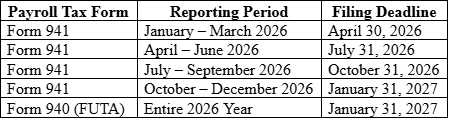
Most businesses with staff members are obliged to file the IRS payroll tax filing. Although there may be instances when a company enters the payroll tax during the quarter, the IRS still expects the employers to submit these reports to determine whether the payroll tax has been properly reported.
One of the most crucial steps in ensuring the compliance of tax obligations of the employer is the monitoring of federal payroll tax forms deadlines.
Payroll Tax Deposit Schedule for Employers
Employers are also required to pay payroll taxes at periodic times throughout the month, on top of submitting payroll tax forms. Such deposits consist of the unclaimed federal income tax, Social Security, and Medicare taxes.
Depending on the amount of their total payroll tax, the IRS will give the employers a payroll tax deposit schedule. Businesses are usually placed on either a monthly deposit schedule or a semi-weekly deposit schedule.
Where the monthly deposit is used, the employers are required to remit payroll taxes by the 15 th day of the next month after compensation of wages. As an example, withheld taxes on employee wages in May should be paid by June 15.
Employers who owe more than $50,000 in payroll taxes during a lookback period must deposit semiweekly: payments are due within 3 business days after wages are paid, depending on the payroll day. The specific deadline will be determined by the day on which the wages were paid.
Submission of payroll taxes to the government is done on time by following the relevant federal tax deposit schedule. Companies that pay taxes on time as per their schedule are able to escape penalties and practice good payroll compliance.
Employer Payroll Tax Responsibilities
It has a number of payroll-related tax obligations that employers have to meet on a year-round basis. These are not just limited to making tax payments.
Companies should make sure that the wages of the employees are properly documented, taxes are not paid inaccurately, and payroll records are kept in case they are needed in the future. In case of an audit or compliance inspection, the IRS can demand payroll records, and proper recordkeeping is necessary.
In general, the employer payroll tax liabilities cover the following responsibilities:
They include:
- Withholding federal income tax from employee wages
- Withholding Social Security and Medicare taxes
- Paying the employer portion of payroll taxes
- Depositing payroll taxes according to the assigned schedule
- Filing quarterly payroll tax reports
- Filing annual unemployment tax reports
Adherence to such employer tax compliance requirements assists companies in ensuring that payroll reporting remains proper and prevents regulatory problems.
Payroll Tax Compliance for Small Businesses
In the management of payroll tax compliance, small businesses tend to experience special challenges. The small number of staff and administration may complicate the process of monitoring various tax deadlines and reporting.
The IRS, however, anticipates every employer, irrespective of the size of the business, to comply with the same payroll tax regulations. The owners of small businesses are obliged to ensure that the payroll taxes are deducted properly and paid on schedule as required.
Most small businesses use payroll software or third-party payroll services to make it easier to manage payroll taxes. These systems have the capability of automatically computing payroll taxes, keeping records of due dates for filing, and producing payroll reports.
Some of the common payroll management practices that are undertaken by small businesses are:
- Monitoring quarterly payroll tax requirements.
- Surveillance of payroll tax reporting policies.
- Keeping of orderly payroll files.
- Reviewing tax withholding details on a regular basis.
These practices would assist small businesses in preventing errors in filing payroll tax and remaining in compliance in the long term.
Small businesses can simplify this process with PayProNext, which automatically tracks deadlines and prepares filings to reduce errors.”
Payroll Tax Penalties for Late Filing
Late payments of payroll taxes may lead to serious fines. IRS imposes penalties in cases where payroll taxes are not deposited in time, where there is failure by individuals to submit required forms in time, and where tax amounts are reported incorrectly.
The penalty levied on payroll taxes usually goes up in accordance with the lateness of the payment or filing. Even a minor delay would attract extra charges and interest.
Some of the most popular payroll tax penalties are:
- Late payroll tax deposit penalties
- Failure-to-file penalties
- Interest charges on unpaid payroll taxes
- Penalties for inaccurate payroll reporting
Since the payroll taxes are based on the money that is withheld from the wages of the employees, the IRS is strict on imposing such penalties. Companies that monitor payroll tax payment dates in 2026 and adhere to the proper deposit schedule have much lower chances of experiencing compliance issues.
Common Payroll Tax Filing Mistakes Employers Should Avoid
Errors in payroll tax are common, particularly for businesses that are paying manually. Reporting can be problematic or risky to compliance, even with small administrative errors.
A common error is the inability to meet the deadlines for employer payroll taxes. The companies can miss filing quarterly reports or making timely tax deposits, thus leading to penalties. Reporting false wage details or false tax values is another problem that is common.
Other payroll tax filing mistakes include:
- Depositing payroll taxes after the deadline
- Filing incorrect payroll tax forms
- Misclassifying employees as independent contractors
- Reporting incorrect tax withholding amounts
- Failing to maintain payroll documentation
These errors are to be avoided because they assist businesses in enhancing their payroll tax reports and keeping the payroll valid.
Payroll Tax Compliance Checklist for 2026
When the businesses adhere to a systematic compliance list, it is easier to keep track of payroll tax due dates. A checklist is useful in keeping the employer in order and making sure that the payroll tax obligations are met during the year.
The following may be a basic payroll tax compliance checklist:
- Track all federal payroll tax deadlines for 2026
- Follow the assigned payroll tax deposit schedule
- File payroll tax forms on time
- Maintain accurate payroll records
- Review employee tax withholding information
- Monitor payroll tax reporting requirements regularly
A checklist can ensure the businesses continue to have a regular payroll process and minimize the chances of error in compliance.
Final Thoughts
Understanding the federal payroll tax deadlines for businesses in 2026 is essential for maintaining accurate payroll operations. Employers must follow strict filing schedules, deposit rules, and payroll reporting requirements throughout the year.
By tracking payroll tax deadlines, following the correct deposit schedule, and maintaining detailed payroll records, businesses can avoid penalties and maintain full compliance with federal payroll regulations. Staying organized and proactive with payroll tax management ensures that companies meet their employer tax responsibilities while supporting smooth payroll operations.
Let PayProNext handle your payroll tax calculations, filings, and deadlines so you can focus on growing your business.