

Why Small Business Payroll Errors Are Rising in States Like Nebraska, Maine, and Idaho
Date Released
14 April, 2026
Did you know that many small businesses face payroll penalties each year due to simple errors? What was once a routine administrative task has now become one of the most complex challenges in small business operations across the U.S. Payroll today goes far beyond issuing paychecks; it requires a deep understanding of tax regulations, compliance requirements, and employee classification. As these demands continue to grow, small businesses in states like Nebraska, Maine, and Idaho are experiencing a noticeable rise in payroll errors.
The truth is that while some mistakes are indeed made out of negligence, many others have a different cause behind them. In fact, the reason many small business owners find themselves making payroll mistakes is that there are simply too many complications involved. It is critical to understand why mistakes are common to figure out how to avoid them.
The Growing Complexity of Payroll in the US
It’s not just about issuing the salary anymore in terms of payroll. The process is much more complicated today, considering the multiple levels of compliance such as federal tax compliance, state laws, and employee deductions. The problem of keeping up with all the compliance issues becomes increasingly difficult for small companies due to a lack of financial means.
When businesses change their organizational structure or adopt new approaches to working, payroll problems tend to escalate because of existing old payroll practices, which cannot cope with emerging needs, resulting in various payroll errors and inefficiencies in the process.
The main reasons why payroll errors happen in small US businesses today are:
- Growing payroll compliance needs
- State payroll complexities
- Consecutive changes in tax laws
- Insufficient payroll expertise
- Dependency on manual payroll methods
Why Nebraska, Maine, and Idaho Are Seeing More Payroll Errors
Although payroll challenges exist all across the country, there are certain local factors that make it harder for small businesses to comply with payroll requirements in those states. Every region has its own taxation policy, guidelines regarding reporting, and different trends among its workforce.
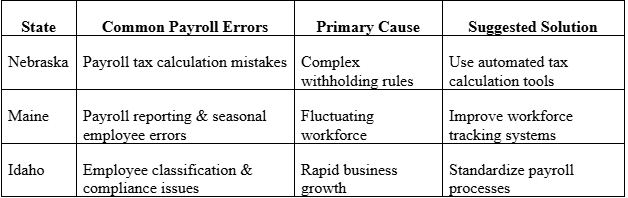
For example, tax withholdings in the state of Nebraska are very challenging because even the slightest mistake can bring up problems with payroll taxes. Seasonal changes in the workforce affect many employers in Maine and cause some difficulties in reporting and paying their taxes. The fast-growing number of businesses in Idaho causes problems with payroll systems for numerous companies.
Therefore, payroll mistakes made by small business owners are usually caused not by lack of effort but by the complicated situation with local laws.
Common Payroll Mistakes Small Businesses Make
With increasing payroll complexities, some errors tend to arise in the same pattern in small organizations. While they may seem minor at first, they can develop into significant non-compliance issues over time.
- Misclassification of employees or independent contractors
- Incorrect computation of payroll taxes
- Ignoring payroll tax payment deadlines
- Errors when calculating overtime pay and benefits
- Payroll reporting inaccuracies
- Lack of updating the payroll management system with recent changes
- Sloppy record-keeping processes
Such payroll accuracy concerns are some of the typical mistakes in payroll that small firms need to avoid.
The Role of Workforce Changes in Payroll Errors
The contemporary labor force is more flexible than before, as independent workers, remote workers, and partial workers are becoming the norm. Although this flexibility is advantageous to the company, it brings new payroll problems.
Misclassification of an employee is among the most common causes of payroll compliance issues. Misclassified employees may incur tax liabilities or benefit from perks that should not be granted to them. In the state of Maine, where seasonal work is typical, misclassification can become a headache for the employer.
Moreover, companies looking to expand their operations in various states have to meet payroll obligations in multiple jurisdictions. This makes payroll errors likely, especially in companies that do not utilize automation software.
How Outdated Systems Are Increasing Payroll Problems
Another one of the most understated causes of payroll errors is that of old and outdated technology. There are many small companies that make use of tools like spreadsheets, which lack any kind of automated functionality.
This increases the probability of:
- Error in data entry
- Errors in calculations
- Lack of updates about compliance
- Delays in payroll processing
All of these factors are the reasons behind the increasing number of payroll processing errors and solutions in 2026.
Impact of Payroll Errors on Small Businesses
Payroll mistakes not only affect numbers but also the whole business environment. From a financial perspective, there can be fees, fines, and other expenses. Compliance-wise, a series of payroll errors can attract an audit from relevant authorities.
Operationally, payroll challenges that businesses may encounter can create inefficiencies in work processes and more work for administrative personnel. Mistreated employees who receive their money late or incorrectly may also lose trust in the company.
The top consequences of payroll mistakes are:
- Payroll penalties from the IRS
- Burdened administration
- Employee dissatisfaction
- Audit risk
How to Reduce Payroll Errors in Small Businesses
Preventing payroll mistakes calls for an active and systematic method. Companies must go beyond reactive solutions and look at ways to prevent them.
- Use payroll software to minimize manual mistakes
- Become familiar with federal and state payroll laws
- Create a standardized payroll process
- Conduct payroll audit checks
- Educate employees about payroll compliance rules
- Ensure integration of HR and payroll systems
These measures will ensure that companies deal with payroll compliance issues effectively.
Payroll Challenges Comparison: Nebraska, Maine, and Idaho
Knowing about the specific payroll problems faced by the states can prove helpful when planning your strategy. The table below shows a comparison of the major payroll problems in these states:
Payroll Errors and How to Fix Them
If there are any payroll errors, they must be addressed immediately. If not, then there will be more problems later on that can be avoided.
To address any payroll error, one must know the cause of the mistake and make corrections, update tax calculations, and file an amended report whenever applicable. Additionally, one must always communicate with their employees effectively.
Most importantly, companies must look into ways to prevent future payroll errors. This becomes more important for businesses that are expanding rapidly, since payroll becomes increasingly complex.
The Future of Payroll for Small Businesses
As payroll systems advance, businesses that take advantage of new technologies will find themselves well ahead of their competition. The use of automation, artificial intelligence-based software, and instant payroll services will assist companies in minimizing payroll errors and being more compliant.
On top of that, regulatory demands will only keep increasing. As such, businesses will need to be proactive because the role of payroll management is evolving and affecting the success of organizations.
Final Thoughts
An increase in the number of small business payroll errors in states such as Nebraska, Maine, and Idaho shows how complicated payroll management can become. Various reasons, from increased compliance issues, changing workforce dynamics, and legacy systems, contribute to this problem.
Nonetheless, all these factors are manageable. With an understanding of the reasons for payroll errors and proper measures in place, businesses can significantly minimize errors and stay compliant.
If your business has been suffering from payroll errors, now is the time to streamline the process. PayProNext is the ultimate solution for simplifying payroll, ensuring compliance, and avoiding payroll errors, among other benefits, for small businesses.