


Understanding Form 940: Employer’s Guide to FUTA Tax Filing (2026)
Date Released
31 March, 2026
Payroll taxes for U.S. employers not only involve employees' earnings and withholdings but also include those that support the national unemployment system. One of the most significant forms to be filed in this area is Form 940, where you will report your business's annual liability under the Federal Unemployment Tax Act.
Whether you're a small business owner or a payroll manager at a large company, understanding IRS Form 940 is a necessity for compliance, accurate filing, and avoiding penalties. This is a comprehensive 2026 guide to Form 940, covering topics such as what Form 940 is, how to calculate FUTA tax, and more.
What Is Form 940?
Form 940 is an annual IRS form filed by employers to report and pay federal unemployment taxes (FUTA). When you wonder what Form 940 is, think of it as a form that reports how much unemployment tax an employer owes for a year.
Unlike other payroll taxes:
- FUTA is only required of employers
- It is not withheld from employee pay
- It supports federal programs for the unemployed during periods of transition
👉 You can find the official IRS form here: 🔗 https://www.irs.gov/forms-pubs/about-form-940
This is the official source for downloading the form and finding the latest Form 940 instructions for 2026.
What Is FUTA Tax? (FUTA Tax Explained)
The Federal Unemployment Tax Act (FUTA) requires employers to make contributions to unemployment insurance programs. This insurance offers temporary financial support to employees who have lost their jobs.
FUTA Tax Rates and Limits (2026)
- Standard FUTA rate: 6.0%
- Wage base limit: First $7,000 per employee
- Maximum credit: 5.4% (for state unemployment taxes paid on time)
- Effective rate: Typically 0.6%
This means employers only have to pay $42 per employee.
Understanding FUTA tax rates and limits is important to correctly compute the tax and efficiently comply with FUTA.
What Is Form 940 and Who Must File It?
One of the most common long-tail questions we get is: What is Form 940, and who must file it?
You must file Form 940 if your business meets either of the two following requirements:
- Paid $1,500 or more in wages in one or more calendar quarters of the year.
- Had one or more employees for part of the day in 20 or more weeks.
This applies to:
- Small businesses
- Corporations
- Partnerships
- Nonprofits (in most cases)
Even seasonal employers may need to file if they meet these thresholds.
Form 940 Filing Requirements (2026)
To efficiently comply with Form 940 filing requirements, employers must follow these steps:
- Maintain accurate records of your employees’ payroll.
- Calculate the FUTA taxes owed for each employee.
- Calculate your employer FUTA tax.
- Calculate any state tax credits.
- Calculate total FUTA tax and deposits.
- Annually file Form 940.
These requirements form part of a larger set of payroll compliance requirements and IRS tax forms for employers.
Form 940 Filing Deadlines 2026
Filing on time is important to avoid penalties.
Key Deadlines:
- January 31, 2027 – Standard filing deadline for 2026
- February 10, 2027 – Extended deadline if all FUTA deposits were made on time
Deposit Rules:
- If you owe more than $500, you will be required to deposit money quarterly
- If you owe less than $500, you can carry forward to the next quarter
Failure to meet these filing deadlines will attract penalties and interest, making it important to comply.
How to Calculate FUTA Tax for Employers
Knowing how to calculate FUTA tax for employers is important.
Step-by-Step FUTA Tax Calculation:
- Calculate total wages for each employee
- Calculate the 6.0% tax on the first $7,000 of wages
- Calculate the 5.4% state tax credit on the first $7,000 of wages
- Calculate total tax liability
- Calculate net tax liability
Example:
- Employee wages: $7,000
- FUTA (6.0%): $420
- State credit (5.4%): $378
- Final FUTA tax: $42
This simple procedure will guide you on how to calculate FUTA tax for employers, ensuring you meet tax reporting requirements and avoid over- or under-payment.
How to File Form 940 Step by Step (2026)
If you're looking for a step-by-step guide on how to file Form 940 for 2026, here's a complete guide to assist you:
Step 1: Gather Required Information
You will need to gather the following information to fill out Form 940:
- Employer Identification Number (EIN)
- Total employee wages
- FUTA taxable wages
- Records of tax deposits
Step 2: Calculate Your FUTA Liability
Here, you will need to calculate your liability using the appropriate tax rates and applying state unemployment taxes.
Step 3: Fill Out IRS Form 940
The form will include different sections where you will need to fill in information such as:
- Employer details
- Total payments
- Adjustments
- FUTA tax liability
- Deposits made
Step 4: Review IRS Form 940 Instructions
Always cross-check your information using the guidelines provided.
Step 5: File the Form
You can choose to e-file, which will be quicker, or mail the form to the IRS.
Step 6: Pay Any Remaining Balance
If you still owe money, you will need to pay it on time to avoid penalties.
Form 940 vs 941: Differences Explained
Many employers confuse these two forms.
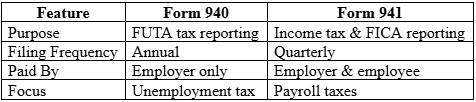
Understanding the Form 940 vs 941 differences can help in proper filing and compliance.
Common Form 940 Mistakes
Avoiding mistakes in Form 940 filing is essential to ensure smooth filing of FUTA taxes.
Frequent Errors:
- Miscalculating taxable wages
- Failing to consider state unemployment tax credits
- Missing deadlines
- Misstating EIN and business information
- Mismanaging payroll records
Learning to avoid mistakes in Form 940 filing can help save time and money.
Employer Unemployment Tax Rules
Federal regulations have set the following employer unemployment tax rules:
- Pay FUTA taxes on time
- Maintain payroll records for at least 4 years
- Ensure accurate reporting of wages and taxes
- Comply with both federal and state unemployment taxes
The above are the essential employer unemployment tax rules under the Federal Unemployment Tax Act (FUTA).
FUTA Tax Compliance Checklist for Employers
To make it easier to comply, use the following checklist:
- Keep track of your employee data and wages
- Ensure correct application of FUTA wage limits
- Compute your tax liability correctly
- Make timely deposits
- File Form 940 before the due date
- Keep proper documentation
By doing so, filing of business tax will be smooth and without any risk of facing penalties from the IRS.
Small Business Guide to Form 940 Filing
Filing Form 940 for small businesses may seem like a complex process. But if done the right way:
- Make use of payroll software for an easier process
- Keep yourself updated about the latest IRS announcements
- Keep your financial records in order
- File Form 940 online for greater accuracy
By doing so, filing of Form 940 will become an easier process and will not cause any problems for small businesses.
Penalties for Non-Compliance
Non-compliance with Form 940 reporting requirements may cause:
- Late filing penalties
- Late payment penalties
- Interest charges
- Increased risk of IRS audits
By knowing the Form 940 due date and penalties explained above, businesses will be able to take a proactive role in filing Form 940.
Final Thoughts
Filing Form 940 is an important task for employers. From knowing what Form 940 is to knowing the FUTA tax calculation process, every step is important in the process.
By following the guidelines provided by the IRS, employers can easily handle the process of federal unemployment tax reporting.
Simplify Your FUTA Tax Filing with PayProNext
FUTA tax filing, calculation, and compliance can be overwhelming for many businesses.
As your business grows, the process can get complicated.
With PayProNext, you can easily handle the process with the following benefits:
- Automate Form 940 filing requirements
- Accurate FUTA tax calculation
- Stay compliant with the latest IRS regulations
- Avoid costly penalties
- Streamline your entire payroll tax process
Remove the complexity from your FUTA tax Form 940 process with PayProNext.