

What Washington’s Minimum Wage Changes Mean for Small Business Payroll Costs
Date Released
13 April, 2026
A $1 increase in minimum wage might not sound like much, until it quietly adds thousands to your annual payroll. The impact is felt throughout all facets of business operations and planning, as one thing leads to another when it comes to payroll management, staffing, compliance, and sustainability. The true challenge for some employers lies in balancing not only rising wages but all of the costs that come along with them.
As Washington's minimum wage changes continue to evolve, small businesses are being forced to rethink their entire cost structure. Labor is already the biggest expense for most employers, and even small adjustments in wage levels can significantly impact Washington payroll costs for small businesses planning. The challenge is not just absorbing these costs, but staying competitive while doing it.
How Wage Changes Reshape Payroll Costs in Washington
When minimum wages rise, the immediate effect is obvious: higher hourly pay. But beneath that surface, the financial impact spreads across multiple layers of business operations. Payroll is not isolated; it connects directly to taxes, benefits, staffing, and scheduling.
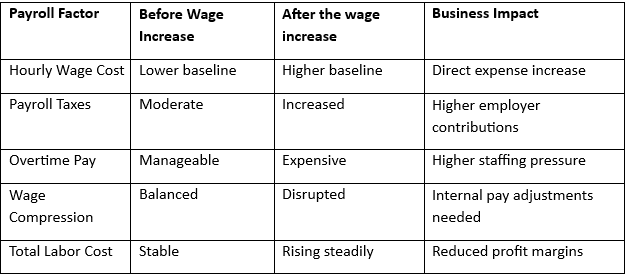
For example, a small increase per hour may seem manageable for a single employee, but when applied across an entire workforce, it multiplies quickly. This is where payroll cost increases; Washington becomes a real concern for small businesses operating with tight margins.
Higher wages also increase employer contributions to payroll taxes, which are calculated as a percentage of total earnings. That means businesses automatically pay more in Washington state payroll taxes, even if nothing else changes in their operations. On top of that, overtime costs rise sharply, making scheduling efficiency more important than ever.
Table: Real Impact of Wage Increase on Small Business Payroll
Why Small Businesses Feel the Pressure More
Whereas larger companies may have room for maneuvering when it comes to incorporating increased costs into different divisions, small businesses must pay the exact sum in order to make a profit. This means that each dollar increase in wages will have a considerable effect on the bottom line.
There are other factors that limit an organization’s capacity to adapt swiftly to the situation by changing its pricing strategy. As a consequence, the cost of higher wages is frequently deducted from profits. In time, this trend exerts pressure on all other aspects of business activity, such as recruitment and growth.
The Hidden Layers of Payroll Cost Growth
Whereas the cost of wages is the obvious part of this story, the underlying expenses are much more significant. The payroll system is intricate, and any fluctuations affect the entire network of components.
As wages go up, employers incur higher taxes associated with payroll. Additionally, there are more expenses related to benefits, which include unemployment insurance and workers’ compensation insurance.
The issue of wage compression cannot be overlooked. In many cases, higher entry-level wages result in higher wages for veteran staff members. This creates additional payroll expansion that is not always planned in advance.
Compliance Challenges Are Increasing Alongside Costs
As the cost of wages increases, there is more emphasis on labor compliance. It is crucial that payroll taxes be accurately tracked, and workers are correctly classified. Any error in this area can result in fines and auditing.
In Washington state, there are specific guidelines regarding the use of minimum wage, overtime, and paid time off contributions. This means that Washington payroll compliance 2026 is one of the most important considerations an employer should make.
Not only does noncompliance put you at risk for legal issues, but it also comes with unanticipated costs due to fines.
Common Payroll Challenges Faced by Small Businesses
Small businesses that face increasing wage structures often experience common challenges:
- Difficulty maintaining profit margins
- Increased pressure on pricing strategies
- Higher overtime costs during peak seasons
- Wage imbalance between roles
- Limited flexibility in hiring decisions
These challenges highlight why small business payroll management in Washington requires more strategic planning than ever before.
Labor Cost Management Strategies That Actually Work
As opposed to merely responding to wage hikes, companies that thrive seek to be efficient in the long run. It goes beyond mere savings; it is all about maximizing productivity from each dollar invested.
One such way would be through scheduling optimizations. Through minimizing excessive working hours and improving shift schedules, businesses will be able to manage labor costs effectively. Another good example would be cross-training of staff members. They would be able to perform several functions without necessarily increasing staffing numbers.
Another area that comes in handy is automation. Payroll software can assist companies in saving money by improving their labor cost management and compliance accuracy.
Key Strategies (Quick View)
- Improve workforce scheduling efficiency
- Reduce overtime dependency
- Cross-train employees across roles
- Use payroll automation tools
- Balance full-time and part-time staffing
- Monitor labor cost as a percentage of revenue
Payroll Budgeting in a High-Wage Environment
Payroll budgeting is no longer a static annual exercise. Companies have to regularly update their forecasts, taking into consideration wage trends, hiring requirements, and seasonality.
An effective payroll approach will involve monitoring labor cost trends on a monthly basis, projecting future wage increments, and synchronizing pricing policies with escalating costs. That way, firms can sustain stability despite the ongoing increase in Washington labor costs.
In the absence of adequate budgeting, even profitable firms may face unforeseen financial difficulties due to increasing payroll responsibilities.
The Long-Term Business Impact
With time, increasing wages change the way businesses function on an operational level. A lot of businesses adopt a more productive approach and invest in automation as well as restructuring jobs to increase their efficiency. While this results in an optimized labor force, it makes it crucial for businesses to plan strategically.
Those who fail to adjust find their profits falling, while those who adjust early maintain steady operations despite having to incur higher expenses. The trick is to manage payroll as a process that affects every aspect of the business, rather than viewing it as merely an expense.
Conclusion
An increase in the minimum wage in Washington is not only a new policy for labor; it is a change in the entire approach to business cost management, staffing, and planning. Every aspect of taxation, over time, from compliance to budgeting, and more, is affected by the payroll changes.
What the employer faces with such a change in the labor market conditions is not merely an increase in the salary payments, but it also affects many other aspects of the business operation. Those who will be able to adopt modern techniques in payroll management and staffing will enjoy the benefits of such a policy.
Streamline Payroll Management with PayProNext
Higher salaries should not lead to increased stress. By using payroll software, small businesses can simplify their payroll calculation process, comply with new wage regulations, and lessen their administrative burdens.
PayProNext makes it easier for companies to streamline their payroll by automating their wage calculation, keeping up with any changes in compliance regulations, and organizing employee wage structures within one system. Regardless of whether you work with an hourly team, an overtime-filled schedule, or need to adapt to new wage laws, PayProNext is made to do that.
👉 PayProNext is one of the smarter payroll management software. Visit the site www.paypronext.com before your payroll costs start dictating your business strategy.