

Top Strategies to Streamline Multi-State Payroll Processing
Date Released
10 March, 2026
Multi-State Payroll Processing is becoming more complicated as the business is growing all around the United States. Every state has its tax laws, employment laws, and payroll reporting. In the case of companies whose employees are based in various states, payroll departments should take care to ensure that there is correct withholding of tax, the documentation is correct, and that there is complete adherence to state-regulated conditions.
This challenge has been increased by the emergence of remote work. With headquarters in a different state, employees can also reside and work in another location, leading to additional payroll expenses. Failure to have the right systems and strategies can make businesses subject to compliance, payroll mistakes, and expensive fines.
In order to effectively streamline interstate payroll, companies must have clear approaches that integrate compliance knowledge, automation, and systematic payroll transactions. The subsequent measures may assist companies in handling payroll compliance across several states.
Strategy 1: Understand Nexus Rules Before Expanding
Among the initial processes of multi-state payroll processing management is the learning of Nexus Rules. For example, an employee working remotely in another state can trigger Nexus, requiring the company to register for taxes there. Nexus defines the existence of a business in a particular state in the form of the taxable presence. An employee also may create nexus on the part of an employer even when the employee is working remotely in a different state.
As soon as the nexus has been reached, the company can be obliged to register with the tax authority of that state, pay state income taxes, and follow local labor laws. Companies that fail to consider nexus requirements are subject to unforeseen tax or compliance charges.
Tracking the location of employee work and knowing the presence of nexus assists organizations in ensuring proper payroll tax localization and ensuring they are in compliance with state laws.
Strategy 2: Implement Automated Tax Calculation
Manually processing payroll taxes in various states poses a higher probability of error. The tax rates, deductions, and filing requirements among the different states differ and thus complicate the payroll processing in growing businesses.
Payroll teams use automated tax calculation systems to implement the appropriate tax rules depending on the location of employees. Automated payroll systems also keep pace with the changes in tax regulations, thus minimizing the administrative cost to payroll departments.
Automation allows businesses to be more accurate and utilize efficient multi-state tax filing solutions, which guarantee that the payroll taxes are calculated and reported appropriately.
Strategy 3: Manage State Unemployment Insurance Taxes Properly
SUI (State Unemployment Insurance) tax management is also another important aspect of multi-state payroll processing. The states have various wage bases, tax rates, and reporting requirements, which are used by the individual states to run their unemployment insurance programs.
Companies that have workers in more than one state have to register with the unemployment insurance programs of the states and report the wages of the employees to the states. Because the tax rates of SUI can vary every year, payroll departments need to remain informed to make sure they file their tax returns correctly.
One of the most widely used payroll compliance errors in multi-state activities is failure to properly manage unemployment taxes, usually resulting in penalties or an audit.
Strategy 4: Leverage Reciprocity Agreements
Certain adjacent states have Reciprocity Agreements that make it easier to withhold taxes on employees who reside in one state, but who work in another State. In such an agreement, employees are usually required to pay income tax in the state in which they reside and not in both states.
This minimizes the workload of handling payroll in companies that have employees in more than one state. Nevertheless, the labor force should provide the relevant withholding certificates to prove their right to reciprocal treatment in regard to taxes.
Payroll departments are supposed to follow the right documentation so that tax deduction is done properly under such agreements.
Strategy 5: Maintain Accurate Payroll Tax Localization
Payroll tax localization is what makes sure that employees get taxed in accordance with the respective state and local jurisdiction. This is critical in cases where workers work in different locations or even move throughout the year.
When the payroll taxes are in an inaccurate jurisdiction, then the business risks of compliance problems or being mandated to amend the tax filings in the future exist. These risks are addressed by proper employee location tracking and central payroll systems.
Cloud-based payroll infrastructure is used by many organizations to automatically assign tax rules based on the work location of the employee, thus enhancing the efficiency and accuracy of compliance.
Strategy 6: Support Remote Work Payroll Compliance
Remote employment has greatly transformed payroll management within companies. Employees are often recruited in other states, and it is important to pay attention to the compliance of remote work payroll.
Companies have to identify the physical location where employees work and use the right tax regulations there. This may impact on the withholding of taxes, compliance with labor laws, and end-of-year reporting.
When it comes to payroll teams, the question of how to handle payroll of remote employees in other states is one of the most popular questions today. The solution usually includes the introduction of automated payroll systems such as PayProNext, where the location of employees can be monitored, and the tax regulations by state can be handled.
Strategy 7: Ensure Accurate W-2 Reporting for Multiple States
The multi-state workers (employees working across two or more states in a particular tax year) need a multi-state W-2 filing. The employers are required to declare the amount of wages earned in respective states, and the right amount of tax withholdings should be recorded.
Wrong W-2 reporting may present problems both to the employees and the employers during tax season. Payroll staff are required to monitor the amount of time that employees have worked during the year and compensate them accordingly.
Centralized payroll systems are known to keep the records accurate, and also, the end of year reports are easy to do.
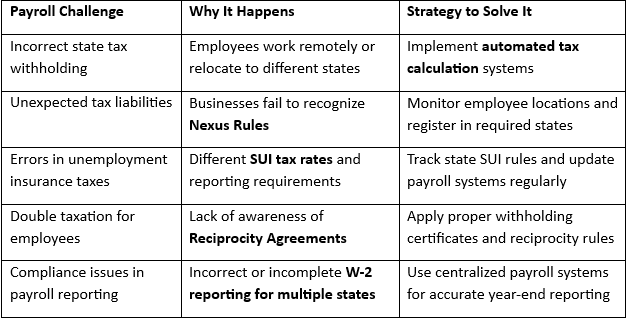
Key Multi-State Payroll Challenges and Solutions
Conclusion
Managing multi-state payroll goes beyond issuing paychecks. Businesses must navigate different tax rules, SUI programs, and labor laws while ensuring accurate payroll and compliance.
With strategies like understanding Nexus Rules, using automated tax calculation, and maintaining proper payroll tax localization, companies can streamline payroll across states and reduce compliance risks.
Platforms like PayProNext make this easier by automating payroll, managing multi-state tax filing, and supporting remote workforce compliance. Businesses can rely on PayProNext to keep payroll accurate, efficient, and fully compliant as their teams grow.