


The Employer's Guide to Balancing Compliance and Employee Experience
Date Released
17 June, 2026
Every employer faces the same invisible tug-of-war: stay compliant with federal and state regulations, or keep employees happy and engaged. Most business owners assume those two goals pull in opposite directions. The reality? When done right, compliance and employee experience reinforce each other, and the companies that figure this out win on both fronts.
This guide breaks down exactly how to balance HR compliance and employee experience, why the two are more connected than you think, and the practical strategies that help U.S. employers build a workplace that is both legally sound and genuinely great to work in.
Why Compliance and Employee Experience Often Clash
At first glance, compliance feels like the enemy of flexibility. Regulations dictate how wages are calculated, how overtime is tracked, which benefits must be offered, and how records must be kept. Employees, on the other hand, want autonomy, flexibility, quick answers, and a sense that their employer trusts them. Here is where the clash typically shows up:
- Compliance feels restrictive: Rigid policies around timekeeping, PTO accruals, or pay structures can feel like red tape to employees who simply want clarity and fairness.
- Employees want flexibility: Especially in a post-pandemic workforce, workers expect adaptive schedules, transparent communication, and responsive HR, all of which can conflict with one-size-fits-all compliance frameworks.
- Businesses struggle to balance both: Many HR teams are caught between keeping lawyers and auditors happy and keeping employees engaged and retained.
The good news is that this tension is largely unnecessary. The problem is not compliance itself; it is how compliance is communicated and implemented.
What Employers Must Understand About Compliance
Before you can balance compliance with employee experience, you need a clear picture of what compliance actually demands from your organization.
Core Legal Requirements for U.S. Employers
- Payroll and Tax Compliance: The IRS requires accurate withholding of federal income tax, Social Security, and Medicare taxes. State agencies add their own payroll tax rules, wage rates, and filing deadlines.
- Labor Laws: The Fair Labor Standards Act (FLSA) governs minimum wage and overtime. The Family and Medical Leave Act (FMLA) mandates unpaid leave rights. Anti-discrimination laws like Title VII and the ADA protect employees from unfair treatment.
- Benefits Regulations: The Affordable Care Act (ACA), ERISA, and COBRA impose notice requirements, coverage minimums, and continuation coverage rules for employers of certain sizes.
- Recordkeeping: OSHA, IRS, and Department of Labor rules require employers to maintain payroll records, injury logs, and I-9 documentation for specific time periods.
| ⚠️ The Cost of Getting It Wrong Non-compliance carries real financial risk. IRS payroll penalties alone can reach 15% of unpaid taxes per deposit. State agencies add their own fines. Beyond money, non-compliance damages your employer brand, making it harder to recruit and retain top talent. |
What Defines a Great Employee Experience
Employee experience is not about perks like ping-pong tables or free lunches. It is the sum of everything an employee encounters throughout their time at your organization, from onboarding to their final day.
The four pillars of a strong employee experience include:
- Timely and Accurate Payroll: Nothing erodes employee trust faster than a missed or incorrect paycheck. Accurate payroll is the baseline of workplace trust.
- Transparent Communication: Employees want to understand their pay stubs, their benefits, and your policies. Clarity reduces anxiety and builds confidence in leadership.
- Fair Policies: Consistent enforcement of workplace rules, whether around scheduling, raises, or discipline, signals fairness and builds loyalty.
- Flexibility and Benefits: Competitive benefits, flexible PTO, and responsive HR teams contribute directly to employee satisfaction and retention.
Notably, three of those four pillars, accurate payroll, transparent communication, and fair policies, are also core components of strong HR compliance. This is the insight most employers miss.
Where Compliance and Employee Experience Intersect
This is the most important section of this guide. Compliance and employee experience are not opposites; they are deeply intertwined. Here is how the key compliance areas directly shape the employee experience:
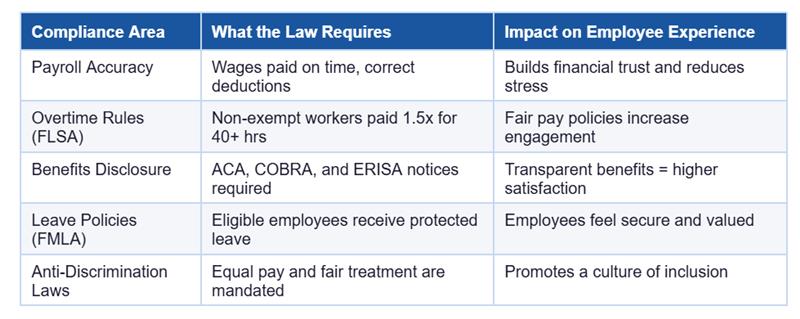
Payroll Accuracy and Timeliness
Payroll compliance, paying employees correctly, on time, and with proper deductions, is also the single most impactful driver of employee trust. The American Payroll Association reports that payroll errors affect approximately 82 million U.S. workers. Employees who experience frequent paycheck mistakes are far more likely to disengage and leave.
When payroll runs accurately every cycle, employees stop worrying about their finances and start focusing on their work. Compliance becomes an invisible foundation rather than a source of stress.
Transparent Policies
FLSA requires you to communicate overtime policies. ACA mandates benefits notices. FMLA requires written leave policies. These legal obligations, when communicated clearly and accessibly, become tools for building employee trust, not just boxes to check for an audit.
Fair Compensation and Benefits
Equal pay laws and benefits regulations ensure baseline fairness. Employers who go beyond the minimum by conducting regular pay equity audits and communicating compensation philosophy clearly turn compliance into a competitive advantage in recruiting.
Clear Communication
From offer letters to termination paperwork, legally required communications create natural touchpoints to reinforce your company values, set expectations, and show employees they are respected. Employers who treat these as compliance chores miss a major opportunity to strengthen the employer-employee relationship.
Common Mistakes Employers Make
Even well-intentioned employers make predictable missteps when trying to manage compliance and employee experience simultaneously:
- Overly Rigid Policies: Blanket policies that leave zero room for nuance, such as inflexible attendance rules with no accommodation process, create legal exposure and drive away good employees.
- Poor Communication: Distributing a policy manual and assuming employees read it is not communication. It is documentation theater.
- Ignoring Employee Feedback: Compliance audits check whether you follow the rules. They do not check whether employees understand or support those rules. Employers who ignore feedback miss early warning signs of disengagement.
- Manual Payroll Errors: Spreadsheet-based payroll processing increases error risk dramatically. A single miscalculation affects real people's financial lives and triggers IRS scrutiny.
- Compliance Without Empathy: Enforcing rules without human context, such as rigidly applying FMLA procedures to a grieving employee, follows the letter of the law while violating its spirit, and destroys morale.
Step-by-Step Strategy to Balance Both
Here is a practical, actionable framework for building a workplace that is both fully compliant and genuinely great for employees:
Step 1:
Automate Payroll and Compliance. Replace manual processes with a payroll platform that automatically calculates taxes, applies updated wage rates, and generates required filings. Automation removes the human error factor from compliance and ensures employees are paid accurately every time.
Step 2:
Simplify Policies for Employees. Rewrite your employee handbook in plain English. Use FAQs, one-page summaries, and brief videos to make complex policies like FMLA or overtime rules genuinely understandable. If employees cannot explain a policy in their own words, simplify it.
Step 3:
Communicate Clearly and Proactively. Do not wait for employees to ask questions. Send proactive communications before open enrollment, before tax season, and after any regulatory changes that affect their pay or benefits. Transparency prevents rumors and builds trust.
Step 4:
Train HR Teams Continuously. Compliance requirements change every year. Minimum wage rates, ACA thresholds, and FLSA interpretations evolve. Regular training ensures your HR team is never caught off guard and can answer employee questions with confidence.
Step 5:
Monitor Employee Feedback. Build formal feedback channels, pulse surveys, stay interviews, and exit interviews that specifically ask about HR processes, pay accuracy, and policy clarity. Use that data to close gaps before they become compliance violations or retention problems.
The Role of Payroll Systems in Bridging the Gap
The single most effective tool for balancing compliance and employee experience is a modern, automated payroll system. Here is what the right platform does for your business:
- Ensures Compliance Automatically: Real-time tax table updates, automated ACA tracking, and state-specific payroll rules are applied without your HR team having to monitor regulatory changes manually.
- Improves Employee Trust: When employees receive accurate, on-time paychecks with clear pay stubs every single time, trust in the employer increases measurably.
- Provides Transparency: Employee self-service portals let workers view their pay history, download tax documents, check PTO balances, and access benefits information on demand, reducing HR inquiries by up to 60%.
- Reduces Errors: Automated systems eliminate the spreadsheet math errors, missed deadlines, and classification mistakes that trigger IRS notices and employee complaints alike.
| PayProNext was built for exactly this challenge. Our platform handles federal and state payroll tax compliance automatically, provides employees with real-time access to their pay and benefits information, and gives HR teams the reporting tools to stay audit-ready year-round without adding administrative burden. |
Compliance + Employee Experience Checklist
Use this checklist to assess where your organization stands today:
✅ Accurate payroll processing, every employee paid correctly and on time, every cycle
✅ Clear HR policies written in plain language, accessible to all employees
✅ Regular compliance audits, quarterly reviews of payroll tax filings, wage classifications, and benefits compliance
✅ Transparent communication, proactive updates on policy changes, benefit deadlines, and pay adjustments
✅ Employee feedback system, formal channels for employees to raise concerns about HR processes and pay accuracy
✅ HR team training ongoing education on federal and state regulatory updates
✅ Payroll automation technology that handles tax calculations, filings, and compliance tracking automatically
✅ Pay equity review annual analysis to ensure compensation is fair across gender, race, and job classification
Real Business Scenarios
Scenario 1: Strict Compliance, Poor Experience
A mid-sized manufacturing company in Ohio ran airtight compliance operations. Payroll filings were always on time, I-9 records were immaculate, and OSHA logs were perfectly maintained. But employees described the HR team as inaccessible, pay stub errors went unaddressed for weeks, and the policy manual was 90 pages of legal jargon.
Result: Despite zero regulatory violations, the company faced a 38% annual turnover rate. Replacement costs consumed more than three times what a payroll modernization project would have cost. Compliance was a shield against auditors, but it offered no protection against disengagement.
Scenario 2: Balanced Approach, High Engagement, and Compliance
A regional logistics company in Texas implemented a modern payroll platform that automated tax calculations and gave employees 24/7 access to their pay information through a mobile app. HR rewrote the employee handbook with an FAQ format and held quarterly 30-minute town halls on benefits and policy updates.
Result: Payroll errors dropped to near zero, HR support tickets fell by 55%, and the company's eNPS (Employee Net Promoter Score) increased by 22 points within 12 months. They passed their first Department of Labor audit without a single citation. Compliance and employee experience improved together because the systems were aligned.
Frequently Asked Questions
Can compliance actually improve employee experience?
Absolutely. When compliance is implemented well with accurate payroll, clear policies, and transparent communication, it directly addresses the foundational needs employees have for fairness and predictability. The challenge is not compliance itself but how it is communicated and administered.
How do payroll systems affect employee satisfaction?
Payroll accuracy is the baseline of workplace trust. Employees who receive correct, on-time paychecks consistently report higher job satisfaction and are significantly less likely to look for new jobs. A modern payroll system ensures this happens automatically, without HR teams manually checking every line item.
What are the most common compliance challenges for U.S. employers?
The most frequent challenges include misclassifying employees as independent contractors, failing to update payroll tax withholding for state law changes, not tracking overtime correctly under FLSA, and missing ACA reporting deadlines. Each carries financial penalties and damages employee trust when payroll is affected.
How can employers balance compliance and employee satisfaction effectively?
The key is integration: use technology to handle compliance automatically, communicate policies in plain language, create feedback channels that surface problems early, and train HR teams to apply rules with empathy and consistency. The employers who succeed treat compliance as a foundation for trust, not a ceiling on the employee experience.
What tools help manage compliance and employee engagement together?
An integrated payroll and HR platform is the most effective tool. Look for solutions that offer automated tax filings, employee self-service portals, benefits administration, compliance reporting, and integration with your existing HR software. PayProNext provides all of these capabilities in a single platform designed for U.S. employers.
Final Thoughts
Compliance and employee experience are not at war with each other. The idea that you have to choose between legal safety and a great workplace is one of the most costly misconceptions in HR management.
The employers who build the best workplaces and the most defensible compliance records understand that payroll accuracy, transparent policies, fair treatment, and clear communication serve both goals simultaneously. Compliance becomes a feature of the employee experience, not an obstacle to it.
The key is using the right systems, communicating with purpose, and treating compliance not as a legal burden but as the structural foundation of a trustworthy organization.
When compliance and employee experience align, you get something most employers only dream about: a team that trusts your processes, a culture built on fairness, and a business that auditors, employees, and investors can all stand behind.
| Ready to Balance Compliance with a Better Employee Experience? PayProNext helps U.S. employers automate payroll, stay fully compliant, and build a workplace culture employees trust, all from one platform. 👉 Get a Free Demo at PayProNext.com |