


How Small Businesses in Kansas and Iowa Can Reduce Payroll Risks
Date Released
16 April, 2026
Payroll may seem like a straightforward task until compliance and taxes come into play, and employee management makes it incredibly complicated. For small businesses based in Kansas and Iowa, payroll risks go beyond being simple administrative blunders, since the errors will translate into audit issues and legal challenges for these companies.
By 2026, when regulatory authorities become even more strict and technology helps detect any mistakes, payroll risks associated with small businesses become too obvious and problematic to ignore. From errors in withholding tax to failing to report payroll information by deadline or employing workers incorrectly, even the smallest mistake will cause great trouble for small businesses.
That's why today, learning about payroll risks and developing appropriate management strategies within their organizations becomes essential.
Why Payroll Has Become a High-Risk Function for Small Businesses
First, the problem may be related to payroll management systems used by small businesses, which cannot be compared with those used by large corporations with dedicated teams responsible for compliance matters.
This creates multiple risk points, such as:
- Incorrect tax calculations
- Missing filing deadlines
- Misclassification of employees
- Inconsistent payroll records
- Lack of updated compliance knowledge
Combining these elements, there are some significant payroll tax concerns that may affect both a company’s cash flow and its reputation.
For companies located in Kansas and Iowa, there is more complexity because state-level legislation and regulations do not always conform to federal-level requirements when it comes to payroll taxes.
Understanding Payroll Compliance in Kansas and Iowa
Kansas Payroll Environment
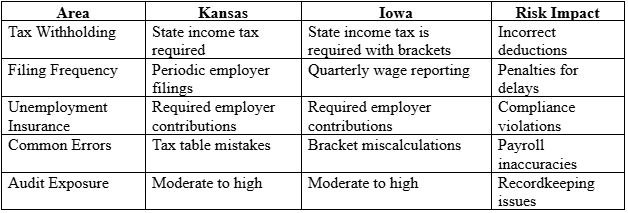
Payroll compliance in Kansas means that employers should be able to withhold state income taxes, provide contributions to unemployment insurance funds, and regularly file reports.
The main problems for Kansas employers relate to using outdated tax tables, filing late payroll taxes, and making mistakes when preparing reports.
Iowa Payroll Environment
Employers in Iowa are also required to make state income tax withholding, report wages quarterly, and contribute to unemployment insurance programs. The structure is slightly different from Kansas, especially in tax bracket application and reporting processes.
Many businesses struggle with:
- Incorrect withholding calculations
- Late filings
- Payroll reconciliation issues
- Employee reporting inconsistencies
This makes Iowa payroll tax compliance a critical focus area for small businesses operating in the state.
Where Payroll Risks Usually Start (Hidden Problem Areas)
Most payroll problems don’t appear suddenly; they build up silently inside daily operations. Some of the most common risk triggers include:
1. Manual Payroll Processing
Spreadsheets and manual entry systems are prone to human error and lack real-time validation.
2. Employee Misclassification
One of the most serious payroll compliance challenges Kansas and Iowa businesses face is incorrectly labeling contractors as employees or vice versa.
3. Lack of Process Standardization
Without a fixed payroll system, each cycle may be handled differently, increasing inconsistency.
4. Poor Recordkeeping
Incomplete payroll records significantly increase payroll audit risks.
5. Outdated Tax Information
Tax laws change frequently, and outdated systems often fail to reflect those updates.
Payroll Risk Reduction Starts With System Thinking
Reducing payroll risks is not about fixing one error; it’s about redesigning the entire payroll system.
Businesses that successfully reduce payroll risks, small business challenges usually focus on structure, automation, and consistency.
Instead of reacting to errors, they build systems that prevent them.
This shift from reactive payroll handling to proactive payroll risk management strategies is what separates compliant businesses from high-risk ones.
Smart Payroll Risk Reduction Strategies That Work
A strong payroll system is built on repeatable, controlled processes. Here are proven approaches businesses use:
Automated Payroll Systems
Automation reduces manual calculation errors and ensures compliance updates are applied instantly.
Compliance Monitoring
Regular checks help businesses stay aligned with changing Kansas payroll tax requirements and Iowa regulations.
Internal Payroll Audits
Frequent audits help detect discrepancies before they become costly problems.
Standard Payroll Workflow
A fixed payroll cycle ensures consistency and reduces human error.
Employee Classification Reviews
Periodic reviews help prevent legal and tax issues related to misclassification.
Payroll Reconciliation
Matching payroll data with bank transactions ensures financial accuracy.
Payroll Compliance Checklist for Small Businesses
A structured checklist is one of the simplest yet most effective tools for reducing payroll risks.
- Verify employee classification before each payroll cycle
- Ensure correct tax withholding calculations
- Maintain updated employee records
- Process payroll on fixed schedules
- File state and federal taxes on time
- Reconcile payroll accounts monthly
- Document all payroll adjustments
- Conduct quarterly compliance reviews
- Track overtime and deductions accurately
- Store payroll records securely for audits
This payroll compliance checklist that US businesses rely on helps reduce errors and improve consistency.
Kansas vs Iowa Payroll Risk Snapshot
Payroll Audit Risks You Should Not Ignore
Payroll audits often happen when inconsistencies appear in tax filings or employee reports. The risk increases when businesses lack proper documentation.
To reduce payroll audit risks, businesses should:
- Maintain at least 3–5 years of payroll records
- Reconcile payroll data monthly
- Keep tax filings organized and accessible
- Ensure employee classification is documented
- Review payroll reports before submission
Audit readiness is not a reaction; it is a habit built into payroll systems.
Final Takeaway: Payroll Risk Is a System Problem, Not a One-Time Issue
Small businesses in Kansas and Iowa need to have payroll risk management measures that not only involve preventing any error occurrence but also ensuring that the error does not occur again.
When businesses invest in structured payroll risk management strategies for small businesses in 2026, they reduce penalties, improve financial clarity, and create smoother operations across the board.
Payroll compliance is not optional anymore; it is a core business function.
If you desire to get rid of payroll problems within small businesses in Kansas and Iowa, decrease compliance pressures, and increase payroll accuracy, then using a payroll solution should be your next move.
PayProNext provides an efficient solution for small businesses to ensure that payroll is automated, multi-state compliance is handled, and payroll risk is minimized.