

Payroll vs. HR: Who Is Responsible for What?
Date Released
07 August, 2026
It's 4:45 on a Friday. An employee messages you: their direct deposit didn't land, and separately, they want to know if their unused PTO rolls over into next year. Who do you forward that message to? If you hesitated even for a second, you're not alone; payroll and HR responsibilities get blurred at businesses of every size, and that confusion costs time, morale, and sometimes compliance.
Here's the short version: payroll pays people accurately and on time, and keeps you compliant with tax law. HR manages the people themselves, hiring them, developing them, and setting the policies they work under. Both departments touch the same employees, often the same forms, and even the same software, but they answer to different rules and different risks. Get the line wrong, and you'll either duplicate work or drop something important.
This guide breaks down payroll vs. HR responsibilities in plain terms, shows you exactly where the two overlap, and gives you a framework for building a payroll and HR workflow that doesn't leave gaps.
Payroll vs. HR: The Quick Breakdown
Think of it this way: HR builds the employment relationship. Payroll executes the financial side of it.
- Payroll department responsibilities: calculating wages, withholding taxes, processing payroll runs, filing payroll taxes, and issuing pay-related tax forms.
- HR department responsibilities: recruiting, onboarding culture and policy, benefits strategy, performance management, and employee relations.
Payroll is transactional and deadline-driven. Miss a payroll tax deadline, and you're looking at IRS penalties. HR is relational and policy-driven. Get onboarding or employee relations wrong, and you're looking at turnover, disengagement, or legal exposure. Different risks, same employee, which is exactly why the two functions need to stay in sync.
What Does Payroll Handle?
If it involves money moving to or from an employee's paycheck, it's payroll's job. That includes:
- Payroll processing: calculating gross pay, overtime, and deductions each pay period
- Tax withholding: federal, state, and local payroll taxes
- Direct deposit and pay disbursement
- Payroll compliance: staying current with wage and hour law, multi-state requirements, and filing deadlines
- Payroll reporting: quarterly filings, year-end reconciliation
- Issuing Form W-2 for employees and Form 1099-NEC for contractors
- Employee deductions: garnishments, retirement contributions, benefits premiums
Payroll administration is precise by nature. There's no partial credit for a tax filing that's close enough, which is why most growing businesses eventually move payroll processing onto dedicated payroll management software rather than running it manually.
What Does HR Handle?
HR owns the employee experience from the first job posting to the exit interview. That includes:
- Recruitment and hiring
- Employee onboarding — culture, expectations, and role setup
- Employee benefits strategy and enrollment
- Leave management and PTO policy
- Performance management and reviews
- Employee relations — conflict resolution, workplace investigations
- Workplace policies and the employee handbook
- Maintaining core employee records
HR compliance runs alongside all of this: think anti-discrimination law, workplace safety, and required workplace postings. Where payroll compliance is about money and tax code, HR compliance is about how people are treated and managed.
Where Payroll and HR Actually Overlap
Most of the friction between payroll and HR happens in a handful of shared processes, not in the clearly separate ones:
- Employee classification: HR typically determines whether a worker is a W-2 employee or 1099 contractor, but payroll has to execute that classification correctly every single pay period.
- Benefits deductions: HR negotiates and enrolls employees in benefits; payroll deducts the premiums accurately from every paycheck.
- Time and attendance: HR sets the policy on hours, overtime eligibility, and leave; payroll converts those hours into pay.
- Onboarding paperwork: HR collects the new-hire packet; payroll needs that same data (W-4, direct deposit details, tax elections) to run the employee's first paycheck correctly.
When payroll and HR use disconnected systems, this handoff is where errors creep in: a classification change that never reaches payroll, or a benefits update that doesn't sync to deductions.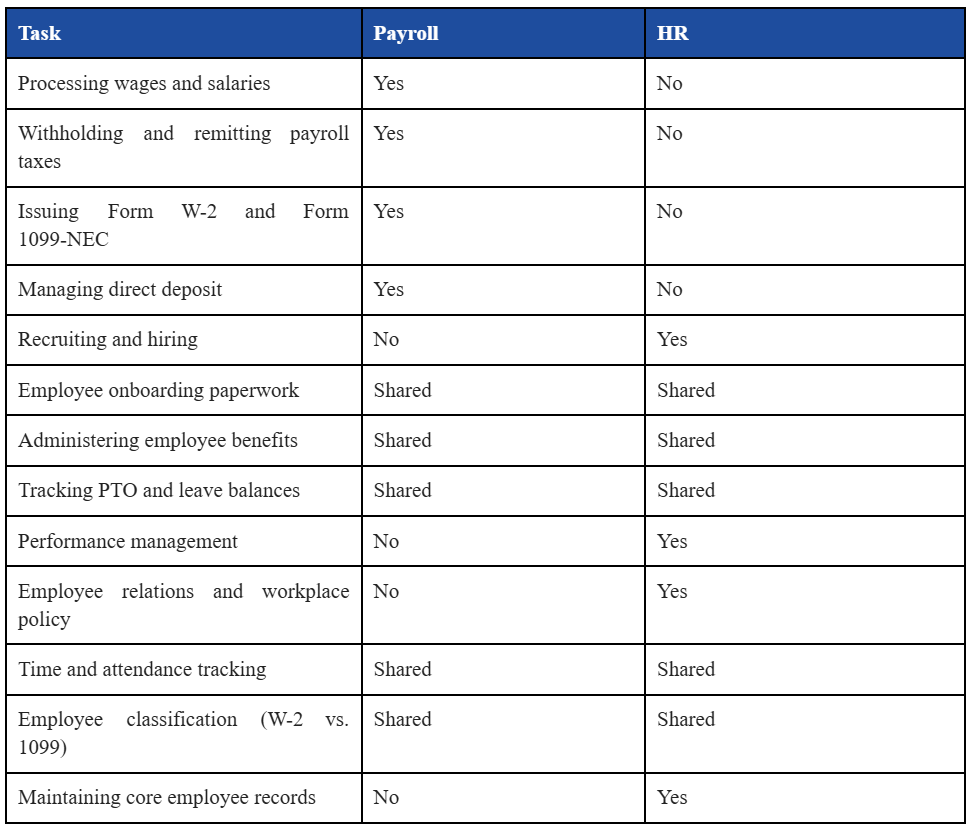
Should HR or Payroll Handle Employee Issues?
This depends on the nature of the problem. For example, an issue regarding the calculation of a paycheck amount, an under-withheld tax, or any other calculation issue goes to the payroll department; it is a factual matter with a definite answer. However, if an issue pertains to the treatment of an individual, a policy issue, or a benefits eligibility problem, it should go to the HR department.
What small organizations usually do wrong is direct all issues pertaining to employees to whatever department answers the telephone first. Having an established written procedure on how issues should escalate will save both parties from answering questions out of their expertise.
Can a Small Business Combine HR and Payroll?
Yes, and most small businesses do exactly this by necessity. In a company with fewer than 50 employees, it's common for one person, or one small team, to own both payroll administration and HR administration. That's workable as long as two things are true: the responsibilities are still clearly divided on paper, and the underlying systems talk to each other.
The risk isn't combining the roles; it's combining them without structure. A single spreadsheet tracking everything from tax withholding to performance reviews is where payroll compliance and HR compliance both start to slip.
How HR and Payroll Should Work Together
The businesses that get this right treat payroll and HR as connected functions with a shared data source, not two departments that occasionally email each other a spreadsheet. That looks like:
- A single source of truth for employee data, so a change in one system, like a pay rate increase or a benefits election, automatically reflects in the other
- A documented handoff for onboarding, so new-hire paperwork flows directly into the first payroll run
- Regular reconciliation between HR-reported hours and payroll-processed hours
- Joint ownership of employee classification decisions, reviewed on a set schedule rather than left to chance
Why Getting Payroll and HR Compliance Right Matters
Payroll and HR compliance failures rarely announce themselves in advance. A missed payroll tax deposit becomes an IRS penalty notice months later. A misclassified contractor becomes back taxes and interest. A skipped required workplace posting becomes a finding during an audit. None of these show up the week they happen; they show up when it's expensive to fix.
That's the real argument for integrated HR and payroll software over manual processes or disconnected tools: it's not about convenience, it's about closing the gap where compliance risk actually lives.
How PayProNext Helps You Manage Payroll and HR Together
PayProNext was built for U.S. businesses that need payroll and HR working from the same set of facts, not two systems that happen to both mention the same employee. With PayProNext, you get:
- Automated payroll processing with built-in federal, state, and local tax withholding
- Payroll compliance monitoring that flags filing deadlines before they're missed
- Employee records, classification, and onboarding data that sync directly into every payroll run
- Time and attendance, PTO tracking, and benefits deductions handled in one connected workflow
- Automatic generation of Form W-2 and Form 1099-NEC at year-end
You don't have to choose between hiring a full HR department and running payroll manually. PayProNext gives U.S. businesses the payroll automation and HR-payroll integration to handle both accurately, on schedule, and without the spreadsheet gaps that turn into compliance problems.
Ready to see how PayProNext keeps your payroll and HR responsibilities in sync? Talk to our team and get a walkthrough built around your team size and your state's requirements.
Frequently Asked Questions
What is the difference between HR and payroll?
HR manages the employee relationship: hiring, onboarding, benefits, performance, and workplace policy. Payroll manages the financial side of employment, calculating wages, withholding taxes, and issuing pay. HR decides how employees are managed; payroll executes how they're paid.
Is payroll part of HR?
Not exactly. Payroll is often housed inside the HR department, especially at small businesses, but the two are distinct functions with separate compliance requirements. Payroll answers to tax law and wage regulations; HR answers to employment law and company policy.
Who is responsible for payroll, HR or accounting?
Payroll typically sits between HR and accounting. HR supplies the employee data that determines pay, accounting owns the general ledger and financial reporting, and payroll sits in the middle, calculating and processing the actual paychecks and tax filings.
Does HR handle payroll?
At many small businesses, yes, the same person or team often owns both. At larger companies, payroll is usually a separate department or is outsourced, working closely with HR but reporting through finance.
Who handles employee benefits?
HR typically selects benefits plans, manages open enrollment, and handles eligibility questions. Payroll then deducts the correct premium amounts from each paycheck based on HR's enrollment data.
Who is responsible for payroll compliance?
Payroll is directly responsible for payroll compliance: accurate tax withholding, timely filings, and adherence to wage and hour law. HR supports this indirectly by ensuring employee classification and hours data are accurate.
Who manages employee records?
HR generally owns core employee records: personal information, employment history, performance data, and policy acknowledgments. Payroll maintains its own related records for tax withholding, pay history, and deductions.