

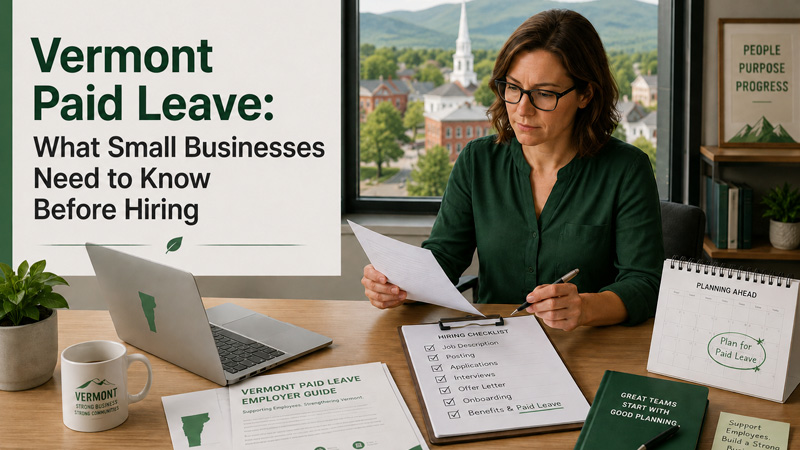
Vermont Paid Leave: What Small Businesses Need to Know Before Hiring
Date Released
03 September, 2026
Hiring your first employee in Vermont, or your tenth, brings a stack of legal questions, and Vermont paid leave sits near the top of the list. Unlike most states, Vermont requires nearly every employer, regardless of size, to provide some form of paid sick leave from day one. Get it wrong, and you're looking at a Department of Labor complaint, back pay, and a fine before your new hire finishes onboarding. Get it right, and paid leave becomes just another line item your payroll system tracks automatically.
This guide breaks down exactly what Vermont paid leave requires, how it differs from the state's separate unpaid family leave law, and what small business owners need to have in place before extending a job offer.
Is Paid Leave Mandatory in Vermont?
Yes, paid sick leave is mandatory for nearly every employer operating in Vermont. Under the state's Earned Sick Time Act (21 V.S.A. §§ 481–486), there's no minimum employee count. A sole proprietor with one part-time worker is covered the same as a company with two hundred employees. The one notable exception is brand-new businesses, which are exempt from the paid sick leave requirement for one year after hiring their first employee. Beyond that, a short list of worker-category exemptions applies, including per diem healthcare staff, short-term seasonal workers, and certain substitute educators.
Paid family leave works differently. Vermont doesn't operate a mandatory, state-funded paid family leave program the way a handful of other states do. Instead, the state layers three separate laws on top of federal protections, and which ones apply to your business depends on your headcount.
The Three Layers of Vermont
Leave Law
Before you post a job listing, it helps to understand how Vermont's leave requirements stack:
- Earned Sick Time Act, paid sick leave, required of virtually all employers.
- Vermont Parental and Family Leave Act (VPFLA), unpaid, job-protected leave for larger small businesses.
- Vermont Family and Medical Leave Insurance (VT-FMLI), a voluntary paid leave insurance program.
- Federal Family and Medical Leave Act (FMLA), unpaid, job-protected leave for larger employers.
Each law has its own employer-size threshold, its own accrual or eligibility rules, and its own paperwork. Missing even one, especially the universal sick leave requirement, is one of the most common compliance gaps for small Vermont employers.
Vermont Paid Sick Leave: The
Earned Sick Time Act
Under the Earned Sick Time Act, employees accrue one hour of paid sick time for every 52 hours worked, starting on their first day. Employers may cap total accrual at 40 hours in a 12-month period and may frontload the full 40 hours at the start of the year instead of tracking accrual week by week.
Employers can also require a waiting period of up to one year before a new hire is allowed to use accrued sick time, even though the time continues to accrue during that period. Sick time must be paid at the employee's normal hourly rate or the state minimum wage, whichever is higher, and group health insurance benefits must continue uninterrupted while an employee is using earned sick time.
How Much Sick Time Is Required in Vermont?
Employees are entitled to accrue up to 40 hours of paid sick time per year, at a rate of one hour for every 52 hours worked. Unused time generally isn't required to be paid out when an employee leaves the company, though state rules on carryover and waiting periods still apply.
Vermont Parental and Family
Leave Act (VPFLA): Unpaid but Job-Protected
The VPFLA provides up to 12 weeks of unpaid, job-protected leave, but eligibility depends on why the employee is taking leave and how many people your business employs. Employers with 10 or more employees must provide leave for parental bonding, bereavement, safe leave, and qualifying military exigencies. Employers with 15 or more employees must additionally provide leave for an employee's own serious health condition or that of a family member.
Act 32, effective July 1, 2025, expanded the VPFLA significantly, adding bereavement leave (up to two weeks, taken in blocks of up to five consecutive days) and safe leave as protected categories within the existing 12-week entitlement. If your business is approaching either the 10- or 15-employee mark, this is a threshold worth tracking closely before you hire.
Does Vermont Require Paid Family
Leave? Inside VT-FMLI
Not yet, on a mandatory basis. The Vermont Family and Medical Leave Insurance program (VT-FMLI) is a voluntary insurance product, not a compulsory payroll tax like the paid family leave programs in some other states. State employees gained coverage first, in July 2023; private employers with two or more employees were able to opt in starting July 2024; and as of July 2025, the program expanded to employers with a single employee and to eligible self-employed individuals who want to purchase coverage on their own. As of early 2026, no legislation has converted VT-FMLI into a mandatory, state-funded program, though this is worth monitoring if you're planning workforce growth in Vermont.
Vermont Leave Laws at a Glance
|
Law |
Paid / Unpaid |
Employer Size Threshold |
Max Duration |
Administered By |
|
Earned Sick Time Act |
Paid |
All employers (1+) |
40 hrs / 12 mo. |
Employer directly |
|
VPFLA – parental, bereavement, safe leave |
Unpaid, job-protected |
10+ employees |
12 weeks |
Employer directly |
|
VPFLA – family (serious health condition) |
Unpaid, job-protected |
15+ employees |
12 weeks |
Employer directly |
|
VT-FMLI |
Paid (voluntary insurance) |
Voluntary opt-in, 1+ |
Varies by plan |
State-administered insurer |
|
Federal FMLA |
Unpaid, job-protected |
50+ employees, 75-mi. radius |
12 weeks |
Federal law |
What Leave Must Vermont
Employers Provide Before Hiring? A Compliance Checklist
Before your first Vermont hire starts work, confirm you have the following in place:
- A written sick leave policy that meets or exceeds the Earned Sick Time Act's accrual and usage rules.
- A system for tracking accrual at one hour per 52 hours worked, including any waiting period you apply to new hires.
- Required workplace postings and written notice of employees' earned sick time rights.
- Payroll records showing accrual, usage, and payment at the correct hourly rate for every employee.
- A plan for the VPFLA thresholds (10 and 15 employees) if you expect to grow past them this year.
- A decision on whether to opt into VT-FMLI coverage as a voluntary benefit.
Are Small Businesses Required to
Provide Paid Leave?
Yes, for sick leave, Vermont’s Earned Sick Time Act applies to employers of every size, including businesses with a single employee. It's one of the more employee-protective sick leave laws in New England precisely because it doesn't carve out small businesses the way many other states do. Paid vacation and general PTO, by contrast, are not required under Vermont law at all; if you offer them, accrual and payout are governed entirely by your own company policy. And unpaid, job-protected family leave under the VPFLA only kicks in once you cross the 10- or 15-employee threshold.
|
Watch the 10-employee mark. Many small Vermont employers comply with paid sick leave from day one but overlook the VPFLA the moment they cross 10 employees. Build a headcount alert into your hiring plan so parental, bereavement, and safe leave obligations don't catch you mid-growth. |
How Payroll Software Simplifies
Vermont Leave Compliance
Tracking sick time accrual by hand, one hour for every 52 worked, capped at 40, with a possible one-year waiting period layered on top, gets error-prone fast, especially once you're juggling part-time, seasonal, and full-time staff on different schedules. Payroll software built for U.S. compliance can calculate accrual automatically with every pay run, flag employees still inside their waiting period, and apply the correct “normal hourly rate” when sick time is used, so you're not doing that math by hand.
PayProNext is built for exactly this kind of state-by-state complexity. It tracks Vermont sick time accrual alongside your regular payroll, maintains the recordkeeping the Department of Labor expects to see in an audit, and can flag your business as it approaches the VPFLA's 10- and 15-employee thresholds, so leave obligations don't sneak up on you between hires.
Frequently Asked Questions
Is paid leave mandatory in Vermont?
Paid sick leave is mandatory for virtually all Vermont employers under the Earned Sick Time Act, regardless of company size. Paid family leave, through VT-FMLI, remains voluntary rather than mandatory.
Does Vermont require paid family leave?
No. Vermont's family leave protections under the VPFLA are unpaid but job-protected. The state's paid family leave option, VT-FMLI, is a voluntary insurance program employers and individuals can choose to join.
How much sick time is required in Vermont?
Employees accrue one hour of paid sick time for every 52 hours worked, up to a cap of 40 hours in a 12-month period, which employers may also choose to frontload at the start of the year.
What leave must Vermont employers provide?
At minimum, employers must provide paid sick leave under the Earned Sick Time Act. Employers with 10 or more employees must also provide unpaid, job-protected leave under the VPFLA for parental, bereavement, and safe leave reasons; that expands to serious health conditions at 15 or more employees.
Are small businesses required to provide paid leave?
Yes, for sick leave specifically, there’s no small business exemption under the Earned Sick Time Act, aside from a one-year grace period for brand-new employers. Paid vacation and PTO remain optional and governed by company policy.
|
Planning to hire in Vermont? See how PayProNext keeps sick time accrual, waiting periods, and headcount-based leave thresholds in sync with your payroll, without extra spreadsheets. Talk to a PayProNext specialist about Vermont payroll compliance → |