

Payroll for CPA Firms: A Complete Guide to Managing Employees and Partners
Date Released
29 July, 2026
Run payroll at a CPA firm, and you already know it isn't like running payroll anywhere else. You've got hourly staff during busy season, salaried associates, benefits-eligible managers, and partners who technically aren't "employees" at all, at least not on paper. One misstep and you're looking at a guaranteed payment miscoded as a W-2 wage, a missed multi-state filing for a remote associate, or a partner draw that throws off the whole K-1 season.
This guide walks through exactly how CPA and accounting firms should structure payroll for both employees and partners, the records you're required to keep, the mistakes that show up most often during audits, and how to pick payroll software that actually understands the difference between a staff accountant and an equity partner.
Why CPA Firm Payroll Works Differently Than Standard Business Payroll
Most payroll software is built for a simple W-2 workforce. Accounting firm payroll rarely stays that simple. A single firm might need to manage:
- W-2 employees, staff accountants, bookkeepers, administrative support, and paraprofessionals
- Salaried and hourly staff, often with overtime rules that shift during tax season
- Equity and non-equity partners, who are typically paid through guaranteed payments and draws, not payroll wages
- Multi-state employees, especially at firms that added remote associates after 2020
- Seasonal or contract preparers brought on for tax season
That mix is exactly why a generic payroll processing tool built for a five-person retail shop tends to fall apart at a CPA firm. The workflows, the tax treatment, and the reporting all need to flex around a partnership structure, not the other way around.
How Do CPA Firms Manage Payroll?
In practice, most CPA firms manage payroll through a combination of three things: a defined compensation structure that separates partners from employees, a payroll system that can run W-2 wages accurately on a set schedule, and a documented process for handling partner draws and guaranteed payments outside that payroll run.
The firms that get this right typically centralize payroll under one system of record instead of splitting it across a spreadsheet for partner draws and separate software for staff wages. That single source of truth is what makes payroll tax compliance and year-end reporting manageable instead of a scramble every March and April.
Should CPA Firm Partners Be on Payroll?
This is one of the most common questions accounting firm owners ask, and the short answer is: generally, no, not as W-2 wages. Under IRS rules, a partner in a partnership (including most CPA firms structured as partnerships or LLCs taxed as partnerships) is treated as self-employed, not as an employee. That means:
- Partners are typically paid through guaranteed payments or profit distributions, not payroll wages
- Partners pay self-employment tax on their share of income rather than having FICA withheld through payroll
- Partner income is reported on Schedule K-1, not a W-2
- Putting a partner on standard W-2 payroll can trigger IRS scrutiny and create compliance headaches for the whole firm
Firms structured as an S corporation are the exception; shareholder-employees who work in the business are generally required to take reasonable W-2 compensation in addition to distributions. If your firm's legal structure has changed recently, this is worth confirming with your CPA or tax counsel before your next pay cycle.
How Should CPA Firms Handle Partner Compensation?
Partner compensation usually runs on a separate track from employee payroll, but it still needs the same level of documentation and consistency. A workable approach includes:
- A written partner compensation agreement outlining draw schedules, profit-sharing percentages, and any performance-based adjustments
- Monthly or biweekly draws set below projected annual profit share, to avoid overpayment
- A year-end true-up once actual firm profit is finalized
- Clear separation between partner distributions and any W-2 wages paid to non-equity or income partners who may still be classified as employees
Firms that skip the written agreement tend to run into the same problem every year: disagreements over what a partner "should" have been paid, discovered right as K-1s are due.
Payroll Tax Compliance for CPA Firms
Payroll tax compliance gets more complicated the moment a firm has staff in more than one state, which describes a growing share of accounting firms post-pandemic. At minimum, firms need to stay current on:
- Federal withholding, FICA, and FUTA for all W-2 employees
- State income tax withholding and SUTA in every state where an employee physically works
- Local or municipal payroll taxes, which apply in several major metro areas
- Quarterly Form 941 filings and annual Form 940
- Correct classification of guaranteed payments versus wages, since misclassifying either is one of the fastest ways to draw an IRS notice
Payroll automation helps here in a very specific way: it applies the right withholding and filing rules automatically as employees move or as tax rates change, instead of relying on someone in the office remembering to update a rate table every January.
What Payroll Records Should CPA Firms Keep?
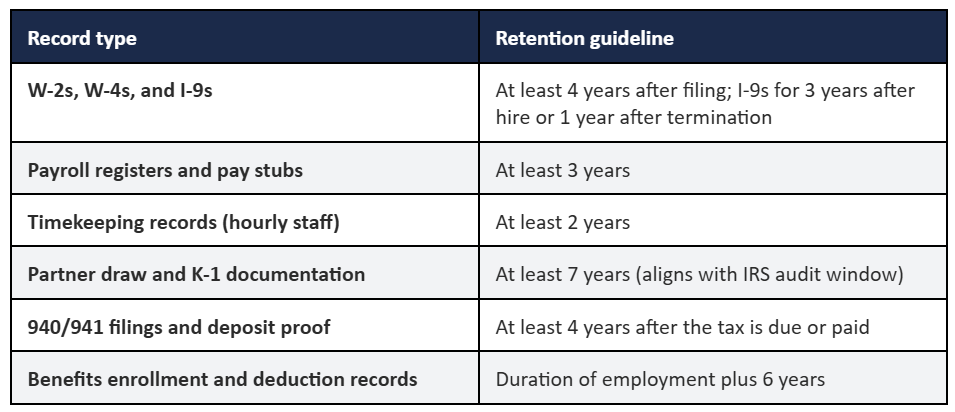
As professionals who advise their own clients on recordkeeping, CPA firms are held to a high standard here, and the IRS and DOL don't make exceptions for accountants. Here's what to keep on file and for how long:
What Payroll Mistakes Do CPA Firms Commonly Make?
A few payroll mistakes come up again and again in accounting firms, and most of them are preventable with the right process in place:
- Putting equity partners on W-2 payroll instead of paying them through draws and K-1s
- Missing state withholding registration for a new remote hire
- Treating overtime-exempt staff as non-exempt (or vice versa) without a proper classification review
- Manually recalculating partner draws in a spreadsheet, then forgetting to reconcile them against actual profit at year-end
- Inconsistent benefits deductions between pay periods, which creates a mess for HR compliance and open enrollment
- Late or missed quarterly tax filings during the firm's own busiest season, when payroll admin gets deprioritized
Every one of these mistakes traces back to the same root cause: payroll accuracy depends on manual attention during exactly the weeks a CPA firm has the least attention to give it.
What Payroll Software Is Best for CPA Firms?
The right payroll software for a CPA firm isn't necessarily the one with the most name recognition it's the one built to separate partner compensation from employee payroll, handle multi-state tax compliance without extra add-ons, and stay usable during the exact weeks your team is buried in returns. Look for a platform that offers:
- Native support for guaranteed payments and partner draws, separate from standard payroll runs
- Automatic multi-state tax registration and filing
- Built-in payroll reporting that maps cleanly to what your own audit and review teams expect to see
- A benefits administration layer that doesn't require a second login and a second reconciliation
- A pricing structure that doesn't punish a firm for having a mixed employee-and-partner headcount
| Payroll shouldn't need a therapist. PayProNext runs partner draws, employee wages, and multi-state tax filings on one clean dashboard built for U.S. accounting and CPA firms that don't have time for payroll guesswork. See how PayProNext handles CPA firm payroll. |
Frequently Asked Questions
How do CPA firms manage payroll?
Most CPA firms manage payroll by keeping employee wages and partner compensation on two separate tracks. W-2 employees go through a standard payroll run with tax withholding, while partners are typically paid through guaranteed payments or draws that get reconciled against profit share at year-end. Centralizing both under one payroll system, rather than splitting the process across spreadsheets and software, is what keeps compliance and reporting manageable.
Should CPA firm partners be on payroll?
In most partnership or LLC structures, partners should not be on standard W-2 payroll. They're treated as self-employed and paid through guaranteed payments or distributions reported on a K-1. The main exception is firms structured as an S corporation, where shareholder-employees are generally required to take reasonable W-2 compensation.
What payroll software is best for CPA firms?
The best payroll software for a CPA firm supports both standard employee payroll and separate partner draw tracking, automates multi-state tax filing, and produces reporting your firm can use internally without extra manual reconciliation. Generic small-business payroll tools often lack the partner-compensation and multi-state features accounting firms need.
How can accounting firms improve payroll compliance?
Accounting firms improve payroll compliance by automating tax withholding and filings instead of tracking rate changes manually, maintaining a written partner compensation policy, running periodic classification reviews for exempt versus non-exempt staff, and keeping payroll records organized and retained for the required time periods.
What payroll records should CPA firms keep?
CPA firms should retain W-4s and W-2s, I-9 forms, payroll registers, timekeeping records, 941 and 940 filings, benefits enrollment documentation, and partner draw or K-1 records. Retention periods range from about three years for basic payroll registers up to seven years for partner compensation documentation, since that aligns with the IRS audit window.
What payroll mistakes do CPA firms commonly make?
The most common mistakes include misclassifying partners as W-2 employees, missing state tax registration for remote hires, inconsistent benefits deductions, manual partner draw tracking that doesn't reconcile at year-end, and late quarterly filings during the firm's own busy season.
How should CPA firms handle partner compensation?
Partner compensation works best with a written agreement covering draw schedules and profit-sharing percentages, regular draws set conservatively below projected profit share, and a year-end true-up once actual firm profit is known. This keeps partner pay separate from employee payroll while still staying documented and consistent.