

Payroll Tax Deposits vs. Tax Filings: What’s the Difference?
Date Released
02 October, 2026
Payroll just ran. You’ve withheld federal income tax, Social Security, and Medicare taxes from employee paychecks, and your business owes its own share, too. Now the question: “Do I pay the IRS now, or do I file a form first?”
The answer is that payroll tax deposits and payroll tax filings are two different responsibilities. They follow separate rules, and they often land on different dates.
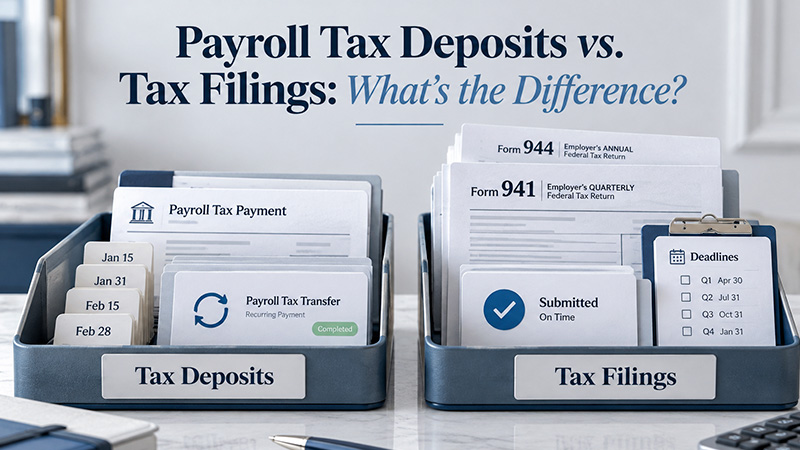
Payroll Tax Deposits vs. Tax Filings: The Simple Difference
A payroll tax deposit is a payment. You send withheld taxes and the employer’s share of payroll taxes to the IRS on the deposit schedule the IRS requires of you.
A payroll tax filing is a report. You submit a return, most often Form 941, showing the wages you paid and the taxes withheld and owed.
Here’s a simple example. A monthly depositor pays wages in March. Those taxes are generally due for deposit by April 15, while the first-quarter Form 941 is generally due by the end of April. Same payroll, two tasks, two dates.
Deposit schedules vary by employer, and filing deadlines are separate. Depositing alone doesn’t satisfy the filing requirement.
What Are Payroll Tax Deposits?
Payroll tax deposits are the payments that cover your employment taxes. In general, employers deposit:
- Federal income tax withheld from employees’ wages
- Social Security and Medicare taxes withheld from employees (plus Additional Medicare Tax, where it applies)
- The employer’s matching share of Social Security and Medicare taxes (FICA)
Federal tax deposits must be made electronically, such as through your IRS business tax account, Direct Pay, or EFTPS. Timing follows an IRS-assigned deposit schedule, and not every employer has the same one.
What Are Payroll Tax Filings?
Payroll tax filings are the returns that tell the IRS what happened in your payroll. They generally report:
- Wages, tips, and other compensation paid
- Federal income tax withheld
- Social Security and Medicare taxes
- Adjustments, such as corrections to earlier periods
- Total tax for the period, reconciled against your deposits
Filing tells the IRS what was reported. Depositing is about sending the money.
Payroll Tax Deposits vs. Tax Filings: Side-by-Side
|
|
Payroll Tax Deposit |
Payroll Tax Filing |
|
What is it? |
Payment of payroll taxes |
Submission of payroll tax information |
|
Main purpose |
Pay tax liability |
Report payroll and tax information |
|
Example |
Federal tax deposit |
Form 941 |
|
Timing |
Based on the employer’s deposit schedule |
Based on the applicable filing deadline |
|
Can one replace the other? |
No |
No |
When Do Employers Need to Deposit Payroll Taxes?
Deposit timing depends on your IRS deposit schedule, either monthly or semiweekly. It isn’t a personal choice. The IRS determines it from your reported tax liability, and you confirm which one applies before each calendar year begins.
One rule applies to everyone: if you accumulate $100,000 or more in taxes on any day, the deposit is due the next business day.
What Is the Difference Between Monthly and Semiweekly Tax Deposits?
What Is the Difference Between Monthly and Semiweekly Tax Deposits?
Semiweekly depositors have more frequent deadlines tied to pay dates. Taxes on wages paid Wednesday through Friday are generally due the following Wednesday. Taxes on wages paid Saturday through Tuesday are generally due the following Friday.
Your lookback period decides which one applies. For Form 941 filers, that’s the four quarters ending June 30 of the prior year. A total of $50,000 or less means monthly; more than $50,000 means semiweekly. Form 944 filers use a different lookback period.
When Are Payroll Tax Returns Due?
Return deadlines are separate from deposit deadlines. Most employers who withhold income tax, Social Security, or Medicare file Form 941 quarterly, generally by the last day of the month after the quarter ends. If you deposited all taxes on time, you get 10 extra calendar days.
Some employers file differently. Small employers the IRS has approved may file Form 944 annually, and agricultural employers file Form 943.
What Is Form 941 Used For?
Form 941 is the Employer’s Quarterly Federal Tax Return. Employers generally use it to report wages, federal income tax withheld, Social Security and Medicare taxes, applicable adjustments, and total taxes due for the quarter.
Filing Form 941 doesn’t mean you can wait until the filing date to make payroll tax deposits. Deposits generally follow their own schedule.
What Is Form 940 Used For?
Form 940 reports an employer’s federal unemployment tax under FUTA. It’s an annual return, generally due January 31. Employers pay FUTA themselves; it isn’t withheld from employee wages, so it’s separate from FICA. FUTA has its own deposit rule: once a quarter’s liability, including any carryover, passes $500, the deposit is generally due by the last day of the month after the quarter ends.
Can Payroll Taxes Be Paid When Filing Form 941?
Generally, no. Employers should make required deposits on their assigned schedule rather than waiting for Form 941. The return reports the liability; it doesn’t make the whole obligation due on the filing date.
There’s a narrow exception. If your Form 941 liability for the current or preceding quarter is under $2,500, you didn’t trigger the $100,000 next-day rule in the current quarter, and you pay in full with a timely filed return, you can pay with the return. Outside that exception, paying with the return doesn’t automatically fix a late deposit, and penalties may apply.
What Happens If Payroll Taxes Are Deposited Late?
Late deposits can bring IRS penalties and interest. Penalties can also apply for depositing too little or mailing payments instead of depositing electronically. The amount depends on your circumstances, so check current IRS rules rather than a rule of thumb.
Beyond the cost, a late deposit means compliance questions, administrative cleanup, and possible IRS notices.
How Payroll Software Can Help With Tax Deposits and Filings
Software supports your payroll tax work. It doesn’t transfer your legal responsibility. Depending on the product, payroll software may help you:
- Calculate payroll taxes on each pay run
- Organize payroll records and track tax obligations
- Prepare tax information for returns
- Support or make tax deposits, where the product offers that feature
- Cut down on manual data entry
Not every product does all of this. If you’re comparing payroll software with tax filing, ask which returns it files, whether it handles deposits, and which plan includes them. Automation reduces busywork, but you should still know your deposit schedule.
How PayProNext Handles Payroll Tax Filing
PayProNext’s approach is Payroll Made Simple: payroll processing, direct deposit, and tax services on one platform. Its website lists the tax features under the Full Service Payroll plan, including payroll tax calculations, payroll tax deposits, federal, state, and local tax filing, W-2 and 1099 filing, and tax compliance support. The Basic Payroll plan lists payroll calculation, records, and reports, but not tax filing or deposits.
Plan details can change, so review the pricing page and the payroll services page, and confirm with the team how deposits and filings work for your business. As with any software, PayProNext doesn’t remove your responsibility to understand your tax obligations and review your payroll.
A Simple Payroll Tax Compliance Workflow
Run payroll → Calculate payroll taxes → Determine deposit requirement → Make required tax deposit → Track payroll records → File required return → Reconcile records.
The exact workflow varies by employer. Your deposit schedule, state and local taxes, and whether you file Form 941 or 944 all change the details.
Frequently Asked Questions
What is the difference between a payroll tax deposit and a payroll tax
filing?
A deposit is a payment of withheld and employer payroll taxes to the IRS. A filing is a return, usually Form 941, reporting wages and taxes. Deposits follow an assigned schedule; filings follow return due dates. Doing one doesn’t satisfy the other.
Are payroll tax deposits the same as payroll tax filings?
No. Deposits move money to the IRS, while filings report what you paid in wages and owe in taxes. They often fall on different dates, and the IRS is clear that depositing alone doesn’t remove the requirement to file a return.
When do employers need to deposit payroll taxes?
It depends on your IRS deposit schedule, either monthly or semiweekly, based on your lookback-period liability. Accumulating $100,000 in tax on any day triggers a next-business-day deposit. Confirm which schedule applies to you in IRS Publication 15 before each calendar year.
When are payroll tax returns due?
Form 941 is generally due by the last day of the month after each quarter ends. Form 940 is generally due January 31. Employers who deposited all taxes on time typically get 10 extra calendar days for either form, and weekend deadlines move to the next business day.
What is Form 941 used for?
Form 941 is the Employer’s Quarterly Federal Tax Return. Employers use it to report wages paid, taxes withheld, Social Security and Medicare taxes, adjustments, and total tax for the quarter. It reports the liability but doesn’t replace the deposits themselves.
What is Form 940 used for?
Form 940 is the Employer’s Annual Federal Unemployment (FUTA) Tax Return. It reports wages subject to FUTA and calculates the tax. Employers pay FUTA; it isn’t withheld from paychecks, so it’s separate from FICA. A quarterly deposit may be required once liability passes $500.
Can payroll taxes be paid when filing Form 941?
Only in a narrow exception. If your Form 941 liability for the current or preceding quarter is under $2,500 and you didn’t hit the $100,000 next-day rule, you can pay with a timely return. Otherwise, deposit on schedule, because paying with the return may bring penalties.
What happens if payroll taxes are deposited late?
Late deposits can trigger IRS penalties and interest. Penalties may also apply for depositing too little or mailing payments instead of depositing electronically. The amount depends on the circumstances, and the IRS may waive penalties in some cases. A tax professional can help if you’ve missed one.
What is the difference between monthly and semiweekly tax deposits?
Monthly depositors send a month’s taxes by the 15th of the next month. Semiweekly depositors deposit within days of each payday, by Wednesday or Friday depending on the pay date. A lookback liability of $50,000 or less means monthly; above that, semiweekly.
The Bottom Line
Payroll tax
deposits send the money. Payroll tax filings report the numbers. Businesses may
need to handle both on different schedules.
Understanding payroll tax deposits vs. filings helps you avoid missed deadlines and unnecessary payroll administration problems. Keeping both tasks organized is a big part of making payroll simple, and that’s the idea behind Payroll Made Simple.