


Good News for Small Businesses: IRS Simplifies Penalty Relief in 2026
Date Released
20 July, 2026
If you've ever paid an IRS penalty for a late payroll tax deposit or a missed filing deadline, even after years of doing everything right, 2026 brings a welcome change. The IRS has introduced a simplified, automatic approach to penalty relief that could save small and mid-sized employers real money without a single phone call or letter.
Here's what changed, who qualifies, and how to make sure your business doesn't leave relief on the table.
What's Changing at the IRS in 2026
On July 8, 2026, the IRS announced a new program called the Automatic Exemption from Penalty, or AEP. It's a systemic administrative relief measure, which means it's built directly into how the IRS processes returns rather than something a business has to request. AEP is rolling out over the summer of 2026 and applies to eligible original returns starting with tax year 2025 and 2026 quarterly returns, along with future filing periods.
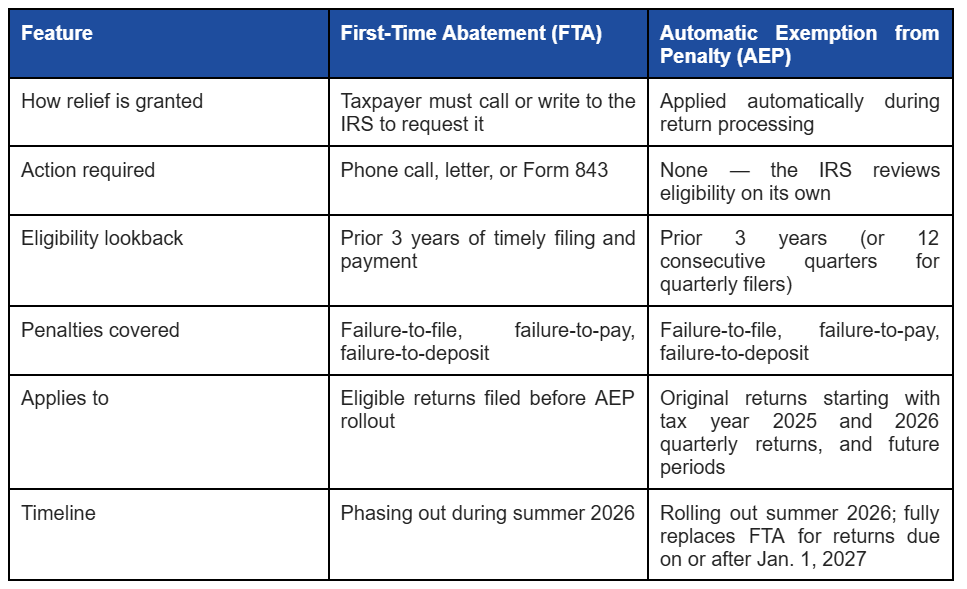
Under the old system, a compliant employer who slipped up once- maybe a payroll tax deposit posted a day late during a cash-flow crunch- had to proactively contact the IRS and ask for relief through a process called First-Time Penalty Abatement (FTA). Many eligible businesses simply didn't know the option existed, didn't have time to call, or didn't have someone on staff dedicated to tax administration. AEP flips that model: if you qualify, the IRS applies the relief automatically and mails you a notice confirming it.
Which Penalties Does AEP Cover?
When a business qualifies, the IRS will not assess the following penalties during return processing:
- Failure-to-file penalty — for missing a filing deadline, such as Form 941
- Failure-to-pay penalty — for tax owed that wasn't paid on time
- Failure-to-deposit penalty — for payroll tax deposits that weren't made correctly or on schedule
These are exactly the penalties that trip up growing businesses juggling payroll, quarterly filings, and employment tax deposits across multiple states or locations.
Who Qualifies for IRS Penalty Relief in 2026
Eligibility for AEP mirrors the long-standing FTA rules, with one meaningful improvement: no request is required. To qualify, a business generally needs a track record of timely filing and payment for the three prior years (or 12 consecutive quarters, for employers who file quarterly returns like Form 941).
In practical terms, that means:
- You filed your federal employment tax returns on time for the past three years, or the past 12 quarters.
- You paid any tax due by the applicable deadlines during that same lookback period.
- Your current-year lapse, a late filing, late payment, or late deposit, is an isolated incident rather than a pattern.
If the IRS's records show you meet these conditions, penalties simply won't be assessed during processing, and you'll receive a notice confirming the relief. There's no form to file, no reasonable-cause explanation to write, and no need to specify that you're seeking First-Time Abatement.
What If You Don't Qualify Automatically?
Not every situation fits neatly into AEP. Information returns and filings tied to one-off transactions or infrequent events are generally excluded. And during the transition period through the rest of 2026, some employers who should qualify may still receive a penalty notice while the IRS phases out the older FTA process. If that happens, you can still contact the IRS directly and request First-Time Abatement, or pursue relief under the long-standing reasonable cause standard, which allows the IRS to waive penalties when circumstances like a natural disaster, serious illness, or reliance on incorrect professional advice caused the delay.
FTA vs. AEP: A Side-by-Side Comparison
Why This Matters for Payroll Tax Compliance
Payroll tax penalties are among the most common, and most avoidable, costs small businesses face. A missed deposit deadline during a busy season, a payroll system misconfiguration after opening a new location, or a simple oversight during a staffing transition can all trigger failure-to-deposit penalties that add up quickly. AEP won't erase the importance of accurate, on-time payroll tax deposits and filings, but it does mean that a business with a genuinely strong compliance history has a real safety net when an honest mistake happens.
That said, AEP only protects businesses that already have three years (or 12 quarters) of clean compliance behind them. Businesses that are newer, that have had past filing gaps, or that operate across multiple states with varying deposit schedules are exactly the ones who benefit most from getting payroll tax compliance right the first time, since they may not have the lookback history to fall back on.
How PayProNext Helps You Stay Ahead of IRS Compliance
Automatic penalty relief is good news, but the businesses that benefit most are the ones with clean, consistent payroll tax compliance behind them. That's exactly where PayProNext comes in. Our payroll management software and payroll tax filing services are built to keep employment tax deposits, Form 941 filings, and payroll documentation accurate and on schedule, so your business builds and protects the compliance history that IRS relief programs like AEP are designed to reward.
Whether you're managing payroll across one location or several, PayProNext's payroll automation software calculates, files, and deposits your payroll taxes on time, every time, and keeps a complete audit trail ready in case the IRS ever has questions. For growing businesses that can't afford a payroll tax penalty, or the administrative headache of untangling one, that kind of reliability is the difference between a stressful notice and simple peace of mind.
Ready to make payroll tax compliance one less thing to worry about? Talk to the PayPronext team today and see how our payroll compliance solutions can help your business stay penalty-free in 2026 and beyond.
Frequently Asked Questions
What is IRS penalty relief?
IRS penalty relief refers to programs that reduce or eliminate penalties for failing to file a return, pay taxes owed, or make required tax deposits on time. Relief can be granted automatically, as with the new AEP program, or upon request, as with reasonable cause relief.
Who qualifies for IRS penalty relief?
Businesses and individuals with a history of timely filing and paying taxes for the prior three years, or 12 consecutive quarters for quarterly filers, generally qualify for automatic relief under AEP. Others may still qualify for relief by requesting it and demonstrating reasonable cause.
How can employers request penalty abatement?
If an employer doesn't qualify automatically, they can call the IRS using the number on their notice, submit a written statement, or file Form 843, Claim for Refund and Request for Abatement. Employers don't need to specifically cite First-Time Abatement; the IRS reviews account history to determine eligibility.
What payroll tax penalties can be reduced?
Failure-to-file, failure-to-pay, and failure-to-deposit penalties, the three most common penalties tied to payroll tax obligations like Form 941, are all eligible for relief under both AEP and First-Time Abatement.
What is First-Time Penalty Abatement (FTA)?
First-Time Penalty Abatement is the IRS's existing administrative relief program for taxpayers with a clean compliance history. It requires a phone call or written request. The IRS is phasing FTA out during the summer of 2026 as AEP becomes the standard process for eligible returns.
How long does IRS penalty relief take?
Under AEP, relief is applied automatically during return processing, and the IRS issues a confirmation notice once it's granted. Requests for First-Time Abatement or reasonable cause relief typically take longer, since the IRS must review the account and respond to the request.
Can small businesses qualify for IRS penalty relief?
Yes. Small businesses that have consistently filed and paid their federal employment taxes on time are exactly the taxpayers AEP is designed for. A single missed deadline, caused by a cash-flow issue, staffing change, or payroll system error, doesn't have to result in a lasting penalty if the business otherwise has a strong compliance record.