


From Chaos to Control: How Automated Payroll Reduces Stress for Owners and CFOs
Date Released
19 March, 2026
Payroll should not be treated like an emergency drill, but too many business owners and CFOs still treat it that way. Each pay period is accompanied by very strict deadlines, complicated calculations, compliance issues, and a fear of making an expensive error. What is supposed to be a routine activity usually becomes a stressful one, and it drains mental energy.
The origin of this issue is in the legacy of manual systems. With the increasing number of businesses and complexity of regulations, the conventional payroll approaches are no longer able to cope. This is the point where the automated payroll comes in, not as a tool, but as a total revolution of payroll management.
Through the adoption of the payroll automation software, the organizations will be in a position to simplify operations, eliminate errors, and, most importantly, realize real payroll stress reduction. Leaders become more in control, clear, and confident instead of fighting fires on a monthly basis.
The Hidden Stress of Manual Payroll
Manual payroll processes are never taken seriously until something goes wrong. A late deadline, wrong tax calculation, or a late payment might easily develop into a severe problem for both the staff and compliance.
Most of the traditional systems have several steps that are not interconnected, thereby raising the probability of human error and inefficiencies.
Common challenges in manual payroll include:
Heavy reliance on spreadsheets
Repetitive data entry tasks
High risk of calculation errors
Difficulty keeping up with compliance changes
Lack of real-time visibility
The comparison of manual and automated payroll shows the difference. A manual system has to be supervised every minute, but the automated payroll system is accurate and consistent.
What Is Automated Payroll and Why Does It Matter?
Payroll automation refers to a technology that supports the processing of salaries, taxation, and compliance with minimum manual involvement. The current payroll automation platforms are compatible with HR and accounting systems and will provide a streamlined flow of data within the respective departments.
This integration removes silos and a single workflow where all is updated in real time. What comes out of it is not only a time-saving system, but also better accuracy and a decision-making mechanism.
Core functions of an automated payroll system:
Automatic salary and deduction calculations
Tax filing and compliance tracking
Payslip generation and distribution
Integration with HR and finance systems
Real-time reporting and analytics
Together, these capabilities make payroll automation essential for modern businesses.
How Payroll Automation Reduces Stress for Owners
To business owners, payroll is not just an administrative issue; it is a liability that will affect employee trust and business credibility. Much of the pressure is eliminated through automation, which simplifies complex processes.
Owners can trust the systems that are automated and do their calculations and compliance reviews automatically instead of spending hours reviewing the spreadsheet. The change enables them to concentrate on strategic priorities instead of operational headaches.
How automated payroll reduces stress for business owners:
Eliminates repetitive and time-consuming tasks
Ensures accurate and timely salary processing
Reduces dependency on manual checks
Minimizes compliance-related risks
Provides real-time insights for better decisions
Small business payroll can now be automated, so the lean teams can handle the payroll effectively without straining.
Why CFOs Are Turning to Payroll Automation
In the case of CFOs, payroll is highly related to financial accuracy, reporting, and compliance. Payroll mistakes may upset the financial plan and cause expensive fines.
Through automating payroll by the CFOs, organizations are in a better position to have control over financial workflows. Automated systems also make sure that data is correct, clear, and can be reported anytime.
The major advantages of payroll automation to finance departments and CFOs:
Improved financial accuracy and audit readiness
Better cash flow visibility and forecasting
Seamless financial workflow automation
Reduced compliance risks and penalties
Data-driven decision-making
These benefits render payroll automation tools advantageous to the CFOs in terms of both operations and strategy.
Manual vs Automated Payroll: A Clear Comparison
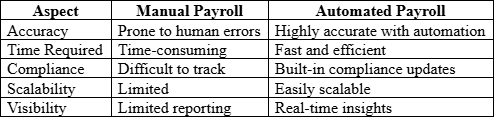
This comparison illustrates the reason why an increasing number of businesses are implementing payroll automation solutions to automate their old systems.
Improving Efficiency Through Payroll Automation
One of the largest reasons for the transition to automation is efficiency. Automation offers businesses quicker processes without losing their accuracy, and that is what they need today.
Through automation of payroll workflow, all the processes of the complete payroll workflow, such as data entry to payment of salaries, are streamlined. Systems interact with other systems, thus eliminating delays and duplication.
Ways payroll automation improves efficiency and accuracy:
Real-time data synchronization across systems
Automated calculations to reduce errors
Standardized workflows for consistency
Faster payroll cycles
Reduced administrative workload
These enhancements will help improve the general payroll efficiency and facilitate operations.
Payroll Automation as a Growth Strategy
Beyond efficiency and stress reduction, automation plays a critical role in business growth. As companies scale, payroll complexity increases with more employees, varying salaries, and compliance requirements.
Automation ensures that payroll doesn’t become a bottleneck. Instead, it supports expansion by handling increased workload without additional resources.
Payroll automation strategies for growing companies:
Implement scalable payroll systems early
Integrate payroll with HR and accounting tools
Use analytics for workforce cost planning
Adopt cloud-based payroll solutions
Continuously optimize payroll processes
All these make the businesses efficiently use the payroll automation solutions in their business growth.
Why Switching to Automated Payroll Is No Longer Optional
In the modern world, where things move at a blazing speed, the use of manual systems may be a setback to businesses. Mistakes, ineffective work, and compliance issues not only add to stress but also affect the performance in general.
A better way forward would be to switch to automated payroll systems. It is correlated with the wider tendencies in the automation of business processes and the digital transformation, which assist companies in remaining competitive.
Some of the reasons to change to automated payroll include:
Reduce payroll errors with automation tools
Ensure compliance with changing regulations
Save time and operational costs
Improve employee satisfaction
Gain better financial control
These benefits make automation a necessity rather than a choice.
Final Thoughts
Payroll does not necessarily have to be a cause of stress. By having the correct automated payroll system, businesses are able to leave the state of chaos to control, accuracy, efficiency, and peace of mind.
To the owners of businesses, this translates to less time being spent on numbers. In the case of CFOs, it implies trust in financial information and adherence. And in the case of the organization, in general, it establishes a platform of sustainable growth.
Take Control of Your Payroll with PayProNext
When you are willing to get rid of payroll pressure and enhance efficiency, it is time to upgrade your system.
PayProNext provides high-performance payroll automation systems that ensure it makes your processes easier, helps to minimize mistakes, and helps you to remain in compliance, hence allowing you to concentrate on developing your business.
Switch today and have a smarter, stress-free approach to payroll with PayProNext.