


Payroll Secrets That Only Successful Small Businesses Know (2026 Guide)
Date Released
18 March, 2026
Payroll is not only about paying the employees, but it also directly affects your efficiency, compliance, and growth potential. Payroll can be considered a routine activity by many small business owners, yet effective business owners use it to save money, reduce mistakes, and enhance business operations. In 2026, being a master of payroll will require automation, compliance and data to make better decisions. This guide includes tips and tricks on how to transform payroll into a competitive edge.
Why Payroll Matters for Small Businesses
Payroll is much more than an administrative task. When it is handled improperly, it may result in the inefficiency of finances, tax fines, staff dissatisfaction, and cost-saving opportunities. This is why it is necessary to master payroll management for a small business. Payroll, when used effectively, becomes a strategic business tool to manage payroll effectively, and the business helps save on costs, ensures compliance, and builds employee morale.
Key reasons payroll matters:
- Maintains employee trust and satisfaction
- Prevents costly tax penalties
- Provides insight into workforce costs
- Supports strategic financial planning
1. Leverage Payroll Automation
Automation is one of the largest payroll secrets that small business owners employ. Automating the payroll process of a small business saves time and is error-free, leading to accurate payments and free time to concentrate on business expansion. Automated payroll systems take care of the calculation, filing, and benefits processing of taxes, and it is a bit easier to prevent some of the errors that small businesses usually make in their payroll. They also enable easy integration of HR payroll and management of employee salaries to provide a smooth experience for both the management and employees.
Automation tips:
- Set up direct deposit to speed up payments
- Enable automatic tax filings to avoid penalties
- Use self-service portals for employees to access pay stubs
- Integrate payroll with time-tracking systems
2. Follow a Small Business Payroll Checklist
A small business payroll checklist will make sure that everything important is done regularly: the establishment of the salaries of the employees, the verification of tax withholding, the deductions of benefits, the authorization of the payroll, and record keeping. A checklist is also one of the major best practices of payroll among small businesses, and it avoids the mistakes that might result in fines or employee dissatisfaction by the employees.
Checklist items to include:
- Employee classification review (full-time, part-time, contractor)
- Payroll schedule setup and adherence
- Benefit and deduction management
- Regular audits and compliance reviews
3. Optimize Payroll for Cost Savings
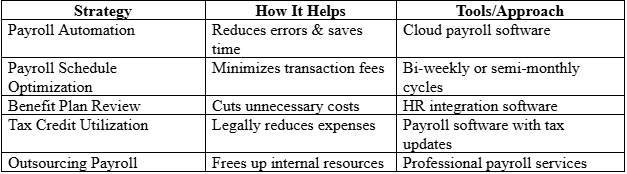
Payroll is not just a process; it’s a powerful cost-control tool. Some tips that can be applied by small businesses to save costs on payroll include reviewing overtime benefits, simplifying benefits, and ensuring that there are minimal unwarranted bonuses. Another smart move is to reduce payroll costs legally by taking advantage of available tax credits. Implementing payroll efficiency measures like outsourcing repetitive duties or using a cloud-based payroll software application will enable business owners to save money and time. These payroll optimization approaches are directly related to profitability and job satisfaction.
Cost-saving strategies include:
- Consolidating payroll cycles to lower transaction fees
- Reviewing overtime policies to reduce extra payouts
- Using software to optimize tax deductions
- Outsourcing payroll processing for smaller teams
Table: Payroll Optimization Strategies for Small Businesses
4. Avoid Common Payroll Mistakes
Even a small payroll error is expensive. Some of the pitfalls are misclassification of employees, tax rates that are too old, poor record keeping, and poor payment. Companies that succeed in their ventures manage these risks through a small business payroll compliance checklist so that they do not violate the rules and still retain the confidence of the staff. Learning about payroll errors that should be avoided when working with small businesses is essential to the efficient performance over time.
Top mistakes to avoid:
- Missing payroll deadlines
- Incorrectly calculating overtime
- Ignoring updates in tax law
- Not keeping proper payroll records
5. Ensure Payroll Compliance
A very important aspect of payroll management is compliance. Little business payroll compliance tips will help to keep up to date with federal, state, and local taxes, reporting, and benefits provisions. Accurate recordkeeping and timely filings prevent penalties and audits. The advantages of modern small business payroll software are automatic tax rate updates, which are easy to implement to increase compliance and decrease human error.
Compliance best practices:
- Conduct quarterly payroll audits
- Stay updated with federal and state payroll tax rates
- Use software that alerts you to discrepancies
- Train staff to handle payroll queries correctly
6. Treat Payroll as a Strategic Tool
Smart business owners treat payroll as more than a cost center. The payroll data analysis allows the companies to find the chances to optimize business costs, to manage the salaries of the employees in accordance with the growth, as well as to enhance the efficiency of the workforce. Payroll also provides management with information that helps to make better hiring and compensation planning, and is a significant component of the overall business strategy.
Ways to use payroll strategically:
- Analyze payroll reports for cost reduction opportunities
- Forecast labor costs for scaling operations
- Align compensation with business goals
- Identify trends in workforce productivity
7. Select the Right Payroll Solutions
The selection of the appropriate payroll solutions for small businesses can either break or improve your payroll process. Search for platforms that are automated in calculating and submitting filings, including compliance updates, offer reporting, and analytics, and are integrated with accounting and HR systems. The correct solution simplifies how to administer a small business payroll and is easy to scale, as it helps to manage payroll tips for small business entrepreneurs.
Selection tips:
- Ensure software provides cloud access
- Check for real-time compliance updates
- Look for integration with HR and accounting systems
- Compare pricing for scalability
8. Streamline Employee Payroll Management
Effective employee payroll management tips include having several payroll methods, such as paying through a number of methods, keeping straightforward payroll policies, automating payroll benefits, and lastly ensuring that payroll is audited regularly to ensure accuracy. Efficient processes contribute to the minimization of mistakes as well as improve transparency, trust among employees, and overall satisfaction.
Employee-focused practices:
- Provide self-service portals for paychecks and tax forms
- Clearly communicate payroll policies
- Automate deductions and benefits
- Conduct regular payroll training sessions
9. Continuously Review Payroll Strategies
Effective small businesses update and polish their small business payroll plans on a regular basis. Regular audits may reveal chances of using payroll cost reduction business plans by a startup company, inefficiency of the payroll processing system, and also opportunities to streamline the payroll efficiency business plans. The ability to be adaptable makes businesses stay within the compliance and competitiveness of the evolving environment.
Review practices:
- Conduct semi-annual payroll audits
- Analyze payroll reports for savings opportunities
- Keep policies updated with changing regulations
- Solicit employee feedback on payroll clarity
10. Additional Payroll Tips
More tips to save money in payroll that are most useful to small businesses are: consolidating payroll cycles to save transaction costs, using automation to save on manual errors, maximizing employee benefits in terms of taxation, and training staff. Adhering to a small business payroll optimization guide would guarantee seamless operations, cost savings in the long term, and satisfied employees.
Final Thoughts
Learning how to handle payroll is the key to success in small businesses. With payroll best practices applicable to small businesses, the use of automation, attention to compliance, and continuous optimization of strategies, the owners can cut expenses, enhance efficiency, and increase employee satisfaction. Knowing the payroll secrets of successful small businesses will enable you to consider payroll as a strategic growth driver rather than a routine aspect of your business.
When it comes to small business payroll software, invest in the advantage and focus on efficient management of the payroll, and payroll will be one of the pillars of long-term success of your company.
Simplify your payroll today! Maximize your small business payroll with PayProNext, an advanced payroll software. Automate, optimize, and streamline your payroll system to achieve the maximum with it.