


Maximizing Pre-Tax Deductions: A Complete 2026 Payroll Guide for US Businesses
Date Released
11 March, 2026
Payroll management in 2026 goes far beyond processing employee paychecks. Companies also have to deal with changing tax policies, benefits packages, and compliance. Pre-tax deductions payroll strategies are one of the best methods that a company can use to streamline its payroll processes and, at the same time, benefit the workers financially.
Pre-tax deductions enable the workers to save part of their income for some benefits prior to the calculation of taxes. This lowers their tax income and, in most cases, leads to an increase in the amount of take-home pay. In the case of the employer, appropriately organized pre-tax payroll deductions may also lower the payroll taxes and add value to the compensation packages.
Knowing how to optimize pre-tax deductions for payroll can enable businesses to cut back on tax expenses, enhance employee benefits programmes, and enhance long-term payroll efficiency. This payroll deductions guide 2026 covers how pre-tax deductions function, the best and most common types of deductions that US businesses can have, and the practical ways of maximizing tax savings.
What Are Pre-Tax Deductions in Payroll?
Firstly, to comprehend what pre-tax deductions in payroll are, it is necessary to consider the way in which payroll taxes are computed. The employees are usually subject to being taxed on gross wages, but some deductions may be made prior to taxation being charged.
Pre-tax deductions are portions that are deducted from the paycheck of an employee, before hitting the federal income tax and, in some cases, the Social Security and Medicare tax. Since the deductions cause a decrease in the taxable income, the total tax that the employees pay is lowered, and yet they still get meaningful benefits.
To the businesses, this is an opportunity to use the payroll tax saving strategy on businesses and also provide competitive benefits to attract and retain employees. Effective management of employee pre-tax deductions is a key factor in the current payroll practice and employee compensation strategy.
Ordinary pre-tax benefits payroll plans enable workers to prepare for healthcare, pension, and transportation costs as their taxable pay is reduced.
The most typical pre-tax deductions made by employees consist of:
- Health insurance premiums
- 401 (k) payroll deductions
- HSA payroll deductions
- FSA payroll deductions
- Commuter benefits payroll programs
- Dental and vision insurance contributions
Such deductions have been the basis of numerous employer-sponsored benefits plans and have become common in US businesses.
How Pre-Tax Deductions Reduce Taxable Income
The pre-tax payroll deductions are among the primary reasons why companies are interested in them, since they reduce the taxable income of the employees. In case the deductions are made before tax is paid, this reduces the amount taxed.
As an example, a worker with a monthly income of $5,000 can make payments to health insurance and retirement savings based on payroll deductions. Since these contributions are deducted, the taxable income of the employee is considerably reduced.
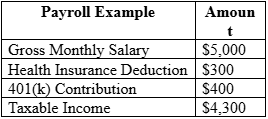
Instead of paying taxes on $5,000, the employee pays them on $4,300. This is an example of how pre-tax deductions are reducing taxable income and forming tax savings.
To the employer, less taxable payroll may also translate into decreased payroll taxes based on the wages the employees receive, and these deductions can be a significant element of employer payroll tax savings plans.
Types of Payroll Deductions for Employees
It is very necessary in efficient payroll management and compliance to know the kinds of payroll deductions to employees. Payroll deductions can be broadly divided into two categories, i.e., pre-tax deduction and post-tax deduction.
Pre-tax deductions have the effect of reducing taxable income, followed by the calculation of taxes, whereas post-tax deductions are made after withholding of taxes.
Typical pre-tax payroll deductions are:
- Health insurance that is sponsored by the employer.
- Contributions to retirement plans including 401(k) plans.
- Health Savings Accounts (HSAs)
- Flexible Spending Accounts (FSAs)
- Commuter transportation benefits
Post-tax deductions, on the other hand, do not reduce taxable income.
Examples of post-tax deductions include:
- Wage garnishments
- Union dues
- Roth retirement contributions
- Charitable contributions
- Certain disability insurance premiums
In the case of businesses using payroll deductions, it is important to ensure that the deductions are classified appropriately to ensure payroll tax is not violated and there is no risk of being subject to regulations.
Common Pre-Tax Payroll Deductions in the US
The US businesses tend to use several payroll benefits programs to give employees tax advantages and enhance their compensation packages.
Health Insurance Premiums
One of the most prevalent pre-tax benefits that is offered to employees is employer-sponsored health insurance. When employees make the premiums by way of payroll deductions, it is generally deductible in advance of taxes.
This not only lowers the taxable income but also assists employees in taking care of their health expenses.
401(k) Retirement Contributions
The 401 (k) payroll deductions are those that enable employees to save towards retirement using pre-tax earnings. These contributions accumulate tax-deferred until one retires and thus, they are an excellent tool in financial planning.
A lot of employers also match the contributions, which also adds more value to these benefits.
Health Savings Accounts (HSAs)
Employees who have high-deductible health plans are eligible to receive HSA payroll deductions. These plans enable employees to save tax-free money to utilize in case of qualified medical expenses.
Money deposited into the HSAs is also able to roll over annually and, therefore, is a flexible tool for saving in long-term healthcare.
Flexible Spending Accounts (FSAs)
The FSA payroll deductions enable employees to set aside pre-tax income to meet medical or dependency treatment costs. This assists the employees to pay less in terms of healthcare expenses as their taxable income is reduced.
Commuter Benefits
The commuter benefits payroll programs are also offered by many companies, and this implies that workers can use the income before taxes, covering transport costs.
These programs commonly cover:
- Public transportation passes
- Parking expenses
- Qualified commuting costs
Commuter benefits are more commonly used by businesses within large urban metropolitan regions.
Benefits of Pre-Tax Payroll Deductions
The well-structured pre-tax benefits payroll schemes have both benefits to employees and employers.
To the employees, such deductions give them substantial financial returns besides enhancing their compensation packages. Due to deductions that are made before taxation is paid, the employees tend to have increased take-home pay than post-tax benefits.
Employee payroll benefits include:
- Lower taxable income
- Increased take-home pay
- The healthcare and retirement benefits.
- Better financial planning in the long term.
- Decreased out-of-pocket healthcare expenses.
Another key benefit to employers of providing pre-tax payroll deductions is also gained.
These include:
- Reduced payroll tax obligations
- More competitive benefits packages
- Higher employee retention
- Improved workforce satisfaction
- Stronger employee compensation planning
The pre-tax deductions usually generate long-term financial efficiencies for businesses that specialize in payroll tax planning on behalf of the employer.
Payroll Tax Saving Strategies for US Companies
Companies in the US intending to apply the best strategies in saving payroll tax should take an active role in the management of payroll deductions and benefits schemes.
Instead of merely providing the standard benefits, organizations ought to plan the payroll systems strategically to maximize the value of employees as well as the tax efficiency.
Strategies to consider regarding payroll deductions are:
- Offering multiple pre-tax benefit options for employees
- Encouraging participation in retirement savings programs
- Using payroll automation tools for accurate deductions
- Reviewing payroll structures annually
- Integrating benefits management with payroll systems
In small business payroll operations, there is an increasing importance of automation in modern operations of the payroll management operations. Payroll software is able to make deductions automatically, keep benefit records, and keep proper records of taxes.
This will minimize the administration efforts and maintain conformance to the changing payroll compliance US 2026 regulations.
Payroll Deduction Mistakes Businesses Should Avoid
Payroll deductions can also be a challenge even for a well-established business. Errors may cause a tax penalty, compliance problems, or payroll mistakes, which may have an impact on employees.
Knowing the most frequent payroll deduction errors that companies must avoid might assist organizations in enhancing payroll accuracy and compliance.
There are various common payroll deduction mistakes, and they include:
- Misclassifying pre-tax and post-tax deductions
- Failing to update payroll systems for new tax rules
- Missing employee authorization documentation
- Incorrect deduction calculations
- Poor recordkeeping practices
The businesses can prevent such problems by keeping proper payroll records and periodically examining deduction structures.
Payroll Compliance Tips for US Employers
When handling the deductions of employees, it is necessary to maintain compliance with the payroll tax. The US payroll laws mandate companies to be keen on the deductions, precise reporting, and to keep precise records.
Good payroll compliance tips for US employers would be:
- Keeping clear documentation of employee benefit elections
- Verifying deductions align with IRS guidelines
- Conducting regular payroll audits
- Updating payroll systems for annual tax changes
- Communicating the benefit options to the employees in a clear manner.
Such moves assist in making sure that businesses are compliant, but the benefits of pre-tax deductions are maximized.
How to Maximize Pre-Tax Deductions for Employees
Businesses that want to maximize pre-tax deductions in the form of payroll need to employ a strategic benefits planning and payroll strategy to maximize their benefits.
Companies should not just provide employees with the bare minimum benefits and only that, but can extend the payroll programs to assist workers in cutting down on the taxable income and enhancing the overall compensation packages.
Good ideas on how to maximize pre-tax deductions among employees include:
- Expanding access to retirement and healthcare savings programs
- Offering commuter benefits and dependent care accounts
- Educating employees about available tax-saving benefits
- Automating payroll deductions for accuracy
- Reviewing benefit participation annually
The strategies assist companies in establishing more effective payroll systems and promoting the financial welfare of employees.
Conclusion
Due to changes in the payroll regulations and expectations among employees, businesses need to be more strategic with regard to payroll management. Correctly introduced pre-tax deductions, payroll systems have great benefits to both employees and employers.
Through knowing the pre-tax payroll deductions that are prevalent in the US, through good payroll deduction plans, and by ensuring proper compliance with payroll tax, the businesses can cut down tax liabilities and enhance employee benefits programs.
Pre-tax deductions are still considered by organizations specializing in payroll tax planning of small businesses as one of the most effective tools with regard to the enhancement of the efficiency of the payroll and long-term workforce satisfaction.
Simplify Payroll and Maximize Tax Savings with PayProNext
The US payroll tax deductions, employee benefits, and compliance requirements are sometimes complicated to administer and to manage within a short time period as businesses become larger. When it comes to dealing with 401k payroll deductions and dealing with HSA and FSA payroll deductions, precision and conformity are of utmost importance.
PayProNext assists companies with the automation and streamlining of payroll, as well as deductions, and ensures complete compliance with changes in payroll policies. Administrative workload can be minimized by the use of high-tech payroll and professional support, and the smarter payroll tax saving plans are implemented by businesses.
Enlist the services of PayProNext today and make it easy to manage payroll and save as much tax as possible for your workforce.