


No Tax on Overtime (2025–2028): What Every Employer Must Track Right Now
Date Released
20 April, 2026
A landmark shift in US wage policy is here. Here’s exactly what it means for your payroll, and how PayProNext keeps you ahead of it.
It’s not often that payroll professionals get genuinely good news. But the overtime tax exemption, effective 2025 through 2028, is exactly that. For employees, it means more take-home pay for every hour worked beyond the standard 40. For employers, it means new compliance obligations, new tracking requirements, and a new opportunity to attract and retain talent.
If you’re still running payroll the old way, you’re already behind. This guide breaks down everything you need to know and shows you how PayProNext makes the entire process seamless.

What the Overtime Tax Exemption Actually Means
Under the new policy, overtime wages earned by eligible employees are exempt from federal income tax. This does not eliminate the employer’s obligation to pay overtime, it means the additional compensation is treated differently at the federal tax level when it comes to employee withholding calculations.
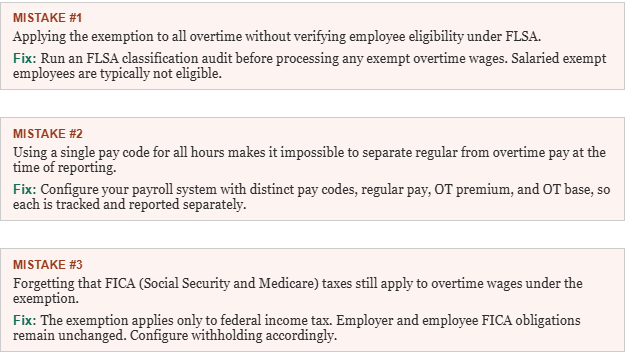
The core mechanics are straightforward: hours worked beyond 40 in a single workweek, paid at the required 1.5× rate (or higher under applicable state law or employment contracts), now qualify for a federal income tax exemption. The exemption applies to the overtime premium, not the entire wage, meaning precise, documented separation of regular and overtime pay is now a compliance necessity, not just a best practice.

Why Employers Can’t Afford Sloppy Tracking Anymore
Here’s the uncomfortable truth: most payroll errors aren’t caught until an audit, a dispute, or a compliance review. Under the old regime, a misclassified hour was an embarrassment. Under the overtime tax exemption, it’s a liability. The IRS and Department of Labor are watching implementation closely, and employers that can’t produce granular documentation of regular versus overtime hours are exposed.
There are three categories of tracking risk that every HR and payroll team must address immediately:
1. Hour Classification Accuracy
Every system that rounds hours, groups shifts, or approximates weekly totals introduces risk. If your payroll platform can’t tell the difference between a 39-hour week and a 41-hour week at the individual employee level, broken down by day and shift, you are already out of compliance with the spirit of the exemption.
2. Multi-State Complexity
State-level overtime rules don’t disappear because federal tax treatment has changed. California, for example, counts daily overtime after 8 hours in a single day. Alaska and Nevada have similar provisions. Your payroll system must layer state overtime thresholds on top of federal rules and apply the correct tax treatment at each level.
3. Mixed-Pay Workforces
Employees with variable pay structures, tipped workers, commission earners, workers with shift differentials, or bonuses have more complex regular rate calculations. The overtime premium, and therefore the exempt amount, can shift week to week. Without a system that automatically recalculates the regular rate when pay components change, manual errors are inevitable.
The Employer Compliance Checklist for 2025–2028
- Update payroll software to segment regular and overtime wages as distinct pay types
- Confirm time-tracking systems capture daily and weekly hours at the individual employee level
- Audit employee classifications, FLSA exemptions still apply; non-exempt status must be verified
- Review multi-state overtime rules and confirm your payroll platform applies the correct thresholds by worksite
- Recalculate regular rate methodology for mixed-pay employees (tipped, commissioned, bonus-eligible)
- Train HR and managers on documentation requirements for overtime authorization
- Update employee handbooks and pay notices to reflect the new tax treatment
- Establish an audit trail: records of hours, rates, and overtime calculations must be retained
- Verify W-2 and payroll reporting codes for exempt overtime are correctly configured
- Schedule a mid-year compliance review; rules may be clarified by IRS guidance during 2025
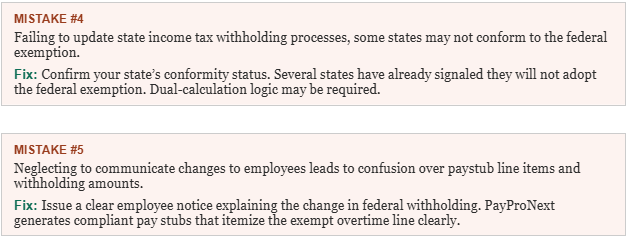
Common Payroll Mistakes, and How to Avoid Them
How PayProNext Makes Overtime Compliance Effortless
PayProNext was built for exactly the kind of regulatory complexity that the overtime tax exemption introduces. Our payroll engine doesn’t just process hours, it understands them. Here’s what that means in practice for your business:
Automated Hour Segmentation
PayProNext automatically separates regular and overtime hours at the employee level, by workweek, with full daily drill-down. Every calculation is documented in real time, no end-of-period scrambling, no manual reconciliation.
Multi-State Overtime Intelligence
Our platform carries a continuously updated library of state overtime thresholds. When an employee works in California, Colorado, or any other state with daily overtime provisions, PayProNext applies the correct rule automatically. No configuration required on your end.
Exemption-Aware Withholding Engine
PayProNext’s federal withholding calculations are already updated for the 2025 overtime exemption. Overtime premium wages are correctly excluded from federal income tax withholding, while FICA calculations run in parallel, unaffected. State non-conforming jurisdictions are handled with a separate calculation layer.
Audit-Ready Reporting
Every payroll run with PayProNext produces a complete, timestamped audit trail, hours worked, regular rate, overtime premium, tax treatment applied, and the regulatory basis for each calculation. If the IRS ever comes calling, you’re ready in minutes, not weeks.
Employee-Facing Transparency
PayProNext pay stubs clearly itemize the overtime premium line, the federal tax exemption applied, and the net impact on take-home pay. When employees understand their paychecks, HR spends less time answering questions and more time on work that matters.
The Strategic Opportunity Employers Are Missing
Here’s something most payroll guides won’t tell you: the overtime tax exemption isn’t just a compliance challenge. It’s a recruiting and retention lever.
Workers are acutely aware of take-home pay. An employee who earns overtime regularly will see a meaningful, recurring increase in their net compensation under the exemption. Employers who proactively communicate this benefit, “when you work overtime here, you keep more of every extra dollar you earn”, have a genuine differentiator in competitive hiring markets, particularly in healthcare, manufacturing, logistics, and hospitality.
PayProNext clients who have already begun communicating the change are reporting stronger employee satisfaction scores and reduced voluntary turnover in overtime-eligible roles. The compliance investment pays dividends beyond the payroll department.

Looking Ahead: 2026, 2027, and the 2028 Sunset
The overtime tax exemption is currently legislated through 2028. What happens after that is uncertain; extension, expansion, modification, or expiration are all plausible outcomes. Smart employers aren’t waiting for Congress to decide. The businesses that build robust overtime tracking infrastructure now will be positioned to adapt quickly regardless of how the policy evolves.
PayProNext is designed to respond to legislative changes without requiring you to rebuild your payroll processes. Our compliance team monitors federal and state developments continuously. When rules change, your configuration updates, not your workflows.
Start Getting It Right Today
The window between “change is coming” and “change is here” has already closed. The overtime tax exemption is in effect now, your employees are filing tax returns based on it, and the IRS expects your payroll records to reflect it accurately.
If you’re managing overtime manually, relying on a generic payroll processor, or running any system that wasn’t updated for 2025 tax law changes, the risk is real, and the cost of getting it wrong, in penalties, back-withholding, and employee trust, is high.
Ready to Make Overtime Compliance Automatic?
See how PayProNext handles the 2025–2028 overtime tax exemption, from hour tracking to IRS-ready reporting, in a free 20-minute demo.
Visit: www.paypronext.com | Book a Free Demo Today