

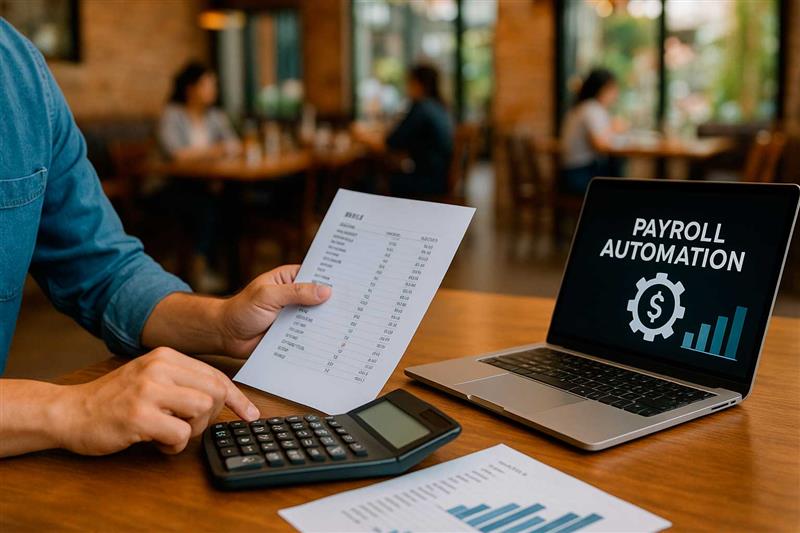
Restaurant Payroll Made Easy: How Automation Helps You Cut Labor Costs in 2025
Date Released
20 November, 2025
In 2025, managing labor costs, complicated schedules, high turnover, and constantly shifting regulations will be just as important to running a restaurant as providing delicious food. Payroll has become one of the most difficult aspects of managing a restaurant, with employees clocking in and out throughout the day, tips passing through several hands, and shifts changing minute by minute.
Payroll automation is no longer optional because of this. It truly is a game-changer.
Automated payroll provides restaurant owners with accuracy, transparency, and control rather than juggling spreadsheets, timecards, and last-minute corrections. It reduces errors, eliminates needless labor expenses, and frees up your time so you can concentrate on what really matters, your guests and your business.
The Hidden Complexity of Restaurant Payroll
The payroll of a restaurant is much more complex than a typical business. You have servers that receive tips, back-of-house cooks with hourly pay, managers with salaries, hosts that share shifts, bartenders that share tips, and seasonal or part-time employees that may work odd hours. Add to it the high turnover, changing the schedule at the last minute, and changing overtime legislation, and payroll is a minefield in a short time.
Many restaurants still handle payroll manually, which is slow, error-prone, and costly for your business. Every incorrect hour, every forgotten break, every miscalculated overtime rate slowly chips away at your margins. And when compliance violations arise and become evident, particularly with regard to tip reporting, Violations, especially around tip reporting, can lead to costly fines and penalties. This is the reason why most restaurants are moving towards automated systems where guesswork is eliminated in payroll.
How Automation Helps Restaurants Control Labor Costs
Restaurant payroll automation changes the whole workflow to proactive and not reactive. You do not correct your mistakes once a week, but you stop them before they occur. Your system registers time, attendance, and tips automatically, instead of having to fill in the hours in different fields consecutively. Your payroll system will warn you about overtime eventually, before it becomes a cost issue.
Automation has three significant cost reduction benefits:
To begin with, it minimizes overstaffing by matching the payroll and scheduling data. Restaurants tend to staff according to custom and not demand. Automation changes that by matching the schedules with the actual customer patterns, which will assist you in saving money spent on unnecessary labor. You end up paying for empty tables and start managing the schedule using the actual customer flow.
Second, time tracking is automated so that you are only paying for the hours that are actually worked. Time theft can be in the form of a premature clock-in, a forgotten clock-out, or buddy punching, and is so prevalent in restaurants. Whenever employees swipe in via POS or secure applications, their hours are recorded in the payroll. You just pay the time that your employees actually worked - nothing more.
Third, automation is easy to deal with tip reporting and tip pooling, and compliance. Restaurants have never been the focus of IRS attention like it is now, and manual recording of tips tends to cause errors. The use of automated systems enables the calculation of tips correctly, their distribution in a fair manner, as well as the production of compliant reports in real time. Your staff gets the correct tips, and you get out of compliance headaches without even lifting a finger.
The Overtime and Compliance Advantage
One of the most expensive restaurant payroll costs is overtime. When employees have multiple positions, split shifts, or a mix of FOH/BOH, it is a formula to make mistakes when an employee is calculated by hand. With automation, all the overtime laws are followed (federal, state, and shift-based), and the managers are notified in real-time when an employee is near overtime limits. No longer have to worry about overtime bills that reduce your weekly earnings.
Another instance of automation saving restaurants thousands of dollars without so much noise is compliance. Labor law modifications to IRS tip reporting, and automated payroll systems are kept up-to-date to make sure that your restaurant does not break the law and get fined on the basis of false accusations. Contributing to the tight margins, in an industry, any penalty avoided is as beneficial as the sales.
Integrating POS, Time Tracking, and Payroll
Restaurants operate through their POS system - the core of their operations. Payroll, when it is directly intertwined with POS, makes the restaurant management smooth. Sales, tips, breaks, attendance, and hours are automatically transferred to payroll without duplication of data. Each and every thing is automated- there is no spreadsheet, no numbers that do not match, no handwriting corrections.
The integration also provides real-time insights to the owners on the cost of labor. Managers can see their sales on an hour-by-hour basis and make changes immediately instead of waiting until the end of the week and finding out that labor is 32% of sales. In an industry where customer volume can spike or drop within minutes, this visibility is invaluable.
Managing High Turnover and Seasonal Staff Efficiently
The restaurant industry has one of the highest turnover rates when it comes to employees. New servers come, seasonal employees come, and team members are characterized by constant rotation. It can be automated so that all these can be stored in profiles of employees, pay rates tracked in real time, and staff boarded online. It is ideal in restaurants that depend on rotating workforces, event employees, and seasonal staff.
Even the restaurants with multiple locations have plenty of advantages. Rather than having individual payroll files, all the locations have a common system. The number of hours, transfers, shifts, and wages remains the same regardless of the location of an employee. Payroll is also made uniform, precise, and worry-free, whether you have one or ten restaurants.
Why Manual Payroll Holds Restaurants Back
If you’re still running payroll manually, here’s what can go wrong:
- Incorrect overtime
- Missed breaks
- Disputes over hours
- Incorrect tip allocation
- Compliance risks
- Hours spent sorting timecards
- Unnecessary labor expenses
Above all, manual payroll makes managers use their time on correcting errors instead of serving their customers better or expanding the business.
Automation does not displace human beings; it gives them strength. Benefit is realized when the payroll becomes accurate, fast, and reliable. Managers have increased time, employees receive the proper payment, and owners obtain better control of expenses.
The Future of Restaurant Payroll in 2025 and Beyond
With the labor costs increasing as well as the complexity of regulations, restaurants will have to act smarter in order to remain profitable. Automated payroll is no longer a luxury; it is starting to become the basis of present-day restaurant management. These are the restaurants that are saving on labor, minimizing errors, and establishing better work environments.
Automation provides owners of restaurants with what they need most: clarity, accuracy, and control. Not an advantage in 2025... a necessity.
Payroll Easily with PayProNext, Make Restaurant Payroll.
Reduce labor expenses, automate tips, eliminate errors, and process payroll in minutes - in a single, easy-to-use platform.
PayProNext takes care of the manual labor, and you can work on your guests.
Ready to simplify your payroll? Get started with PayProNext today.