


How to Pay Leasing Agents, Maintenance Staff, and Office Employees Correctly
Date Released
16 July, 2026
Property management companies run three very different workforces under one roof: leasing agents who sell and earn commissions, maintenance technicians who respond to work orders at all hours, and office administrators who keep the paperwork moving. Each group is paid differently, taxed differently, and governed by different wage and hour rules, which is exactly why property management payroll is one of the most error-prone areas in real estate operations.
Get it wrong, and you're looking at back pay claims, Department of Labor audits, and frustrated employees who leave for a competitor with cleaner paychecks. Get it right, and payroll becomes a quiet operational strength instead of a recurring headache.
This guide breaks down exactly how to pay leasing agents, maintenance staff, and office employees correctly and how the right property management payroll software makes it far easier to stay compliant.
Why Property Management Payroll Is More Complex Than It Looks
Most industries pay one type of employee under one basic structure. Property management payroll for apartment management companies and HOA portfolios has to account for hourly employees, salaried employees, commission-based roles, bonuses, overtime pay, multi-property time tracking, and payroll taxes that can vary by location if a portfolio spans several states or municipalities.
Add employee classification into the mix when deciding who is exempt versus non-exempt under wage and hour laws, and it's easy to see why so many property management companies end up with payroll mistakes that surface only after an employee complaint or an audit. The good news: each role type follows a predictable pattern once you understand it.
How Should Leasing Agents Be Paid?
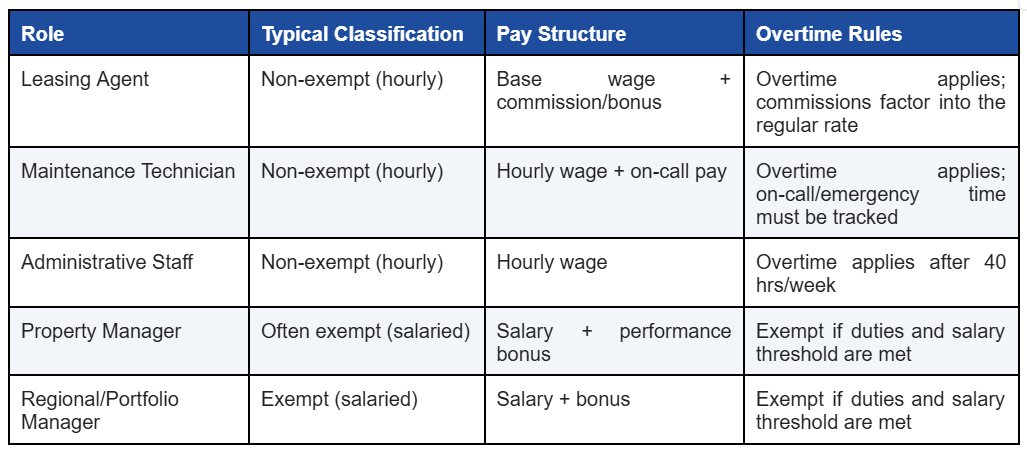
Leasing agents are usually the trickiest group to pay correctly because their compensation often blends a base wage with commissions and bonuses tied to signed leases, renewals, or occupancy targets.
Employee Classification for Leasing Agents
Most leasing agents are classified as non-exempt hourly employees, which means they are entitled to overtime pay for any hours worked beyond 40 in a workweek, even in weeks where commissions push their total earnings well above minimum wage. A common and costly mistake is treating leasing agents as exempt simply because they earn commissions; commission income alone does not create an overtime exemption.
Should Leasing Agents Receive Commissions?
Yes, commissions are standard practice and a strong incentive for lease-up performance, but commissions must be folded into the regular rate of pay used to calculate overtime. This is called a blended or weighted overtime rate, and it's one of the most commonly miscalculated figures in leasing office payroll. Payroll software built for property management payroll can automate this calculation instead of relying on a spreadsheet formula that quietly breaks the first time a pay period looks unusual.
Best practice: pay a documented base hourly rate, track commission-eligible transactions separately, and recalculate the regular rate of pay each pay period before applying overtime.
Are Maintenance Employees Hourly or Salaried?
Maintenance technicians are almost always hourly, non-exempt employees. Their pay structure needs to account for regular hours, overtime, and critical on-call and emergency response time.
How Is Overtime Calculated for Maintenance Staff?
Overtime for maintenance staff is calculated the same way as any non-exempt employee: time and a half for hours worked beyond 40 in a workweek. The complication in multifamily and commercial property payroll is capturing all compensable time, including after-hours emergency calls, time spent traveling between properties in a portfolio, and on-call availability pay where required by policy or agreement.
Time Tracking for Maintenance Teams
Because maintenance staff frequently work across multiple buildings or communities, accurate time tracking is essential. Paper timesheets and verbal reporting are the leading causes of payroll disputes in this role. Digital time tracking tied directly into payroll processing for real estate companies closes that gap and creates a clean audit trail if wage and hour questions ever come up.
How Do Property Management Companies Handle Office Employee Payroll?
Office administrators, property managers, and leasing office support staff are typically a mix of salaried exempt employees (property managers, regional managers) and hourly non-exempt employees (administrative assistants, front-desk staff).
The classification line matters here too: a title like "office manager" does not automatically make someone exempt from overtime. Exempt status depends on actual job duties and a minimum salary threshold, not job title. Property management companies that classify office staff based on title alone are one of the most frequent sources of misclassification claims in real estate office payroll.
Salaried office employees still need accurate payroll records for benefits administration, paid time off accrual, and tax withholding, even though they aren't tracking overtime hours.
Employee Classification at a Glance
Payroll Best Practices for Property Managers
- Classify every role by actual job duties, not job title. Revisit classifications annually as responsibilities change.
- Track all compensable time for hourly staff, including on-call, travel between properties, and after-hours maintenance calls.
- Recalculate the regular rate of pay whenever commissions or bonuses are paid in the same period as overtime hours.
- Keep payroll records, hours worked, pay rates, deductions, and tax withholding organized and accessible for at least the period required by federal and state law.
- Offer direct deposit and clear digital pay stubs to reduce disputes and administrative back-and-forth.
- Centralize payroll across every property in the portfolio instead of running it building by building.
- Review payroll compliance whenever you expand into a new state, city, or municipality with different wage and hour rules.
What Payroll Software Is Best for Property Management Companies?
Manual payroll processing works when a portfolio is small and every employee is paid the same way. It breaks down fast once a company has leasing agents earning commissions, maintenance staff logging on-call hours across several properties, and salaried managers overseeing it all. That's the point where property management payroll software becomes less of a convenience and more of a compliance safeguard.
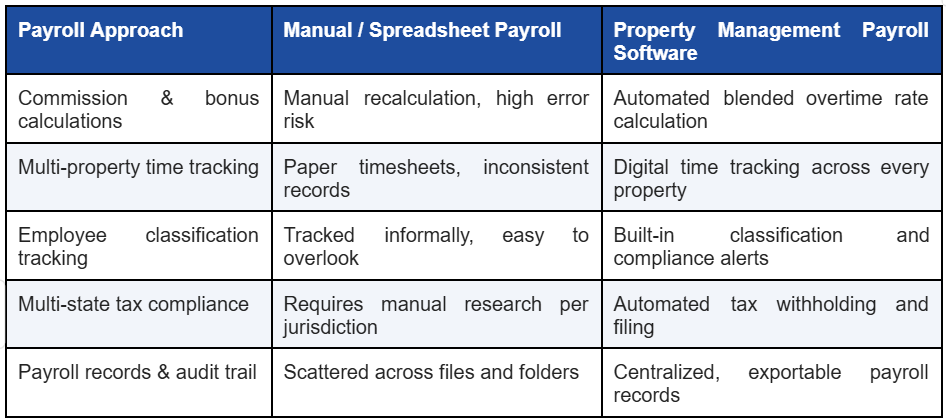
A dedicated payroll solution for property management also makes it far easier to manage direct deposit, employee scheduling data, benefits deductions, and year-end tax documents in one place rather than reconciling numbers across separate systems for leasing, maintenance, and office staff.
Frequently Asked Questions
How do property management companies handle payroll?
Property management companies typically manage payroll for three distinct employee types: leasing agents, maintenance staff, and office employees, each with different classifications and pay structures. Many companies use dedicated property management payroll software to centralize this across every property in a portfolio.
What payroll software is best for property management companies?
The best fit is payroll software built specifically for property management payroll, one that handles commission-based pay, multi-property time tracking, employee classification, and multi-state payroll tax compliance in a single system, such as PayProNext.
How can employers avoid payroll mistakes?
Employers can avoid the most common payroll mistakes by classifying employees based on actual job duties, recalculating overtime rates whenever commissions or bonuses are paid, tracking all compensable hours digitally, and centralizing payroll across their full property portfolio rather than handling it property by property.
| Simplify Payroll Across Your Entire Property Portfolio PayProNext helps property management companies pay leasing agents, maintenance staff, and office employees correctly with automated overtime calculations, multi-property time tracking, and built-in payroll compliance. Talk to our team to see how much time and risk you can take out of payroll this month. Request a Free PayProNext Payroll Consultation →www.paypronext.com |