


How to Handle Commission-Based Payroll for Real Estate Teams
Date Released
14 July, 2026
Commission-based pay is the backbone of the real estate industry, but it's also one of the trickiest payroll structures to manage correctly. Between fluctuating deal sizes, split percentages, broker fees, and the ever-present question of who counts as an employee versus an independent contractor, real estate teams face payroll risks that most other industries never encounter.
Get it wrong, and a brokerage can end up with underpaid agents, IRS penalties, or a wage-and-hour lawsuit. Get it right, and payroll becomes a competitive advantage that helps you recruit and retain top-producing agents.
Understanding Commission-Based Payroll for Real Estate Teams
Unlike a typical hourly or salaried role, real estate compensation is almost entirely tied to performance. Payroll for real estate agents and teams generally involves one or more of the following pay components:
- Commission on closed transactions, calculated as a percentage of the sale price or a flat fee per deal
- Commission splits between the agent and the brokerage, often on a graduated or tiered scale
- Team splits, when agents work under a team lead or in a group commission structure
- Draws against future commission, used to provide agents with a steady income between closings
- Bonuses and incentive pay for hitting sales thresholds or referral goals
Because commission is earned at closing but often reported and paid weeks later, timing is one of the biggest payroll management challenges for real estate agencies. A strong payroll process needs to track each deal from pending to closed, apply the correct split, and post the payment in the right pay period without delaying an agent's income.
W-2 Employees vs. Independent Contractors: Getting Classification Right
Before you can calculate a single commission check, you need to know how each person on your team is classified. This is the single most consequential decision in real estate payroll compliance, and it's an area where the IRS pays close attention.
Most licensed real estate agents qualify for a special IRS category called statutory nonemployee status. To qualify, three conditions generally must be met: the agent must be licensed, substantially all of their pay must be tied to sales output rather than hours worked, and there must be a written agreement stating they will not be treated as an employee for federal tax purposes.
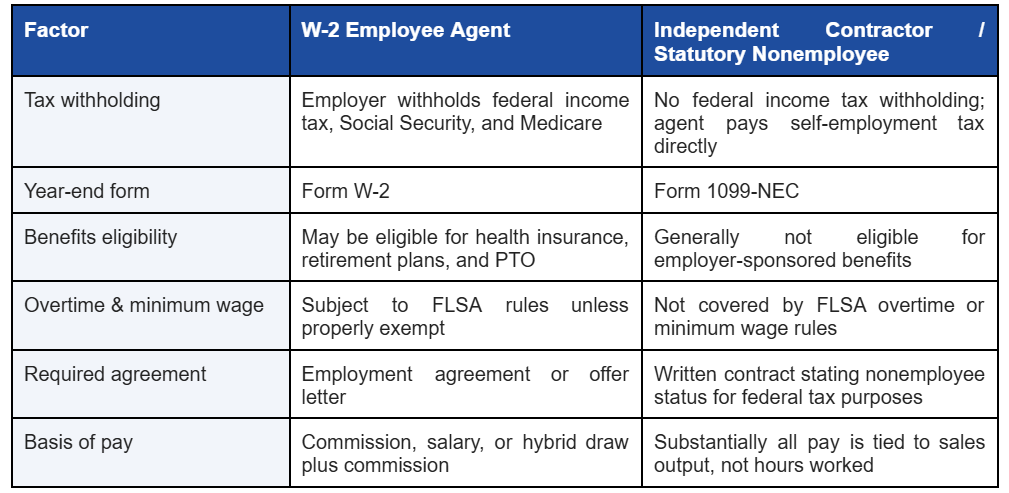
Permitted nonemployees are treated as self-employed for federal income and employment tax purposes, meaning brokerages don't withhold federal income tax, Social Security, or Medicare from their commission checks and instead issue a Form 1099-NEC at year-end.
However, this federal tax treatment does not automatically apply to state tax and labor law purposes, and some states (California among them) apply additional tests, such as the ABC test, that can affect how agents and support staff are classified. Brokerages that also employ administrative staff, transaction coordinators, or salaried team leads still need to run standard W-2 payroll for those roles alongside 1099 payments to agents.
How to Calculate Commission Payroll for Real Estate Agents
Once classification is settled, accurate calculation comes down to a repeatable formula. A typical commission payroll calculation for real estate teams follows these steps:
- Confirm the gross commission income (GCI) from the closed transaction
- Apply the brokerage split (for example, an 80/20 or 70/30 agent-to-broker split)
- Deduct any transaction fees, franchise fees, or E&O insurance charges specified in the agent's commission agreement
- Apply team splits if the deal was sourced or closed under a team structure
- Subtract any outstanding draw balance the agent needs to repay
- Calculate gross pay, apply required deductions, and arrive at net pay
For W-2 team members earning commission alongside a base salary, employers also need to apply the correct overtime treatment. Under the Fair Labor Standards Act, commissions generally must be included when calculating the regular rate of pay for nonexempt employees who are eligible for overtime, which changes the math anytime a commissioned employee works more than 40 hours in a week. This is one of the most common blind spots in real estate office payroll and a frequent source of underpayment claims.
Payroll Taxes on Commissions: What Real Estate Brokerages Need to Know
Commissions are taxable compensation, but how they're taxed depends on classification and, for W-2 employees, how the payment is delivered.
- Statutory nonemployee agents: no federal withholding; agents pay self-employment tax and estimated quarterly taxes on their own
- W-2 employees paid commission with regular wages: taxed at standard withholding rates using the employee's W-4
- W-2 employees paid commission as a separate check: the IRS allows a flat supplemental withholding rate, or employers may use the aggregate method combined with regular wages
- State and local taxes: withholding requirements vary, and states such as California apply their own employment tests independent of federal statutory nonemployee status
Because commission timing rarely lines up neatly with a standard pay period, brokerages should build a clear internal policy for when a commission is considered earned and payable, and put it in writing in each agent's commission agreement. This protects both the brokerage and the agent if a dispute arises over final pay, especially in states with strict final-paycheck laws.
Common Commission Payroll Mistakes Employers Should Avoid
- Misclassifying agents or support staff, or failing to keep a signed nonemployee agreement on file
- Forgetting to include commission in the regular rate of pay when calculating overtime for nonexempt employees
- Inconsistent or undocumented draw repayment terms that create confusion at year-end
- Manually tracking splits and deal stages in spreadsheets, which increases the risk of calculation errors
- Paying commissions late or inconsistently, which violates many state wage payment laws
- Missing 1099-NEC or W-2 filing deadlines because commission and wage data live in separate systems
Each of these mistakes carries real financial risk, from back-pay claims to IRS penalties for misclassification. As brokerages grow and add agents, teams, and support staff, the margin for manual error shrinks quickly.
Payroll Best Practices for Real Estate Brokerages
Brokerages that manage commission payroll well tend to follow the same core practices, regardless of size:
- Maintain a signed, up-to-date independent contractor or nonemployee agreement for every commissioned agent
- Document commission structures, splits, and draw terms clearly in every agent or team agreement
- Track deal status (pending, under contract, closed) in a system connected to payroll processing
- Separate 1099 agent payments from W-2 employee payroll runs, while keeping both on a consistent pay schedule
- Include commission in overtime calculations for any nonexempt W-2 employees
- Reconcile commission payouts against closed transaction records every pay period
- Keep payroll records, agreements, and tax filings organized for at least the length required by federal and state law
- Review classification and pay practices annually, or whenever state labor laws change
Why Real Estate Teams Need Purpose-Built Payroll Software
Spreadsheets and generic payroll tools weren't built for the way real estate teams get paid. Real estate payroll software should be able to handle variable commission splits, multiple pay types in a single run, draw tracking, and dual-classification workforces (1099 agents alongside W-2 staff) without manual workarounds. Payroll automation for real estate reduces the hours spent reconciling closed deals against payouts, minimizes the errors that lead to compliance issues, and gives brokers a clear, audit-ready record of every commission paid.
This is exactly the gap PayProNext was built to close. PayProNext combines payroll processing, commission tracking, and tax compliance in one platform designed for the realities of commission-based businesses, including real estate brokerages, property management companies, and commercial real estate firms. With automated split calculations, built-in support for both 1099 and W-2 workers, direct deposit, and payroll tax filing handled for you, PayProNext lets brokers spend less time on payroll administration and more time growing the business.
Get Commission Payroll Right, Every Pay Period
Commission-based payroll doesn't have to be a constant source of stress for real estate brokers and team leads. With the right classification practices, clear commission agreements, and payroll software built for variable, split-based pay, brokerages can pay agents accurately and on time while staying compliant with federal and state rules.
PayProNext helps real estate brokerages, property management companies, and commission-based teams simplify payroll, automate splits, and stay audit-ready. Ready to see how much time your team could save? Contact PayPronext today for a free payroll consultation and discover a smarter way to pay your agents.