


Consulting Firm Payroll: Salaried vs. Hourly Compensation
Date Released
30 July, 2026
Two consultants sit three desks apart. One is salaried and just pulled a 55-hour week finishing a client deliverable. The other is hourly and billed 45 hours on the same project. Payday comes, and your payroll system needs to know exactly what each of them is owed, not what you assume they're owed.
That gap between assumption and fact is where consulting firms get into trouble. Get the classification wrong, and you're not just fixing a paycheck. You're looking at back pay, penalties, and a Department of Labor auditor asking why your "exempt" analyst has been clocking 60-hour weeks with no overtime for two years.
Here's what your firm needs to know about salaried vs. hourly compensation, exempt vs. non-exempt status, and how to build a payroll process that holds up under scrutiny.
Why This Question Costs Firms More Than They Think
Consulting firms run on a mix of salaried partners, salaried managers, hourly associates, and contract specialists, often on the same engagement. That mix is exactly what makes payroll compliance so easy to get wrong.
Misclassifying even one non-exempt employee as exempt can trigger liability for up to two years of unpaid overtime (three if the violation is found willful), plus liquidated damages equal to the unpaid wages. Multiply that across a bench of associates working overtime during a crunch engagement, and a classification mistake stops being a paperwork issue and becomes a real financial exposure.
The federal salary threshold for overtime exemption sits at $684 per week ($35,568 per year) in 2026, unchanged from 2025. But several states, California among them- with a 2026 exempt threshold of $1,352 per week, set the bar considerably higher. If your firm has consultants working in multiple states, the state's threshold applies whenever it's stricter than the federal one.
Salaried vs. Hourly Compensation: What Actually Separates Them
"Salaried" and "hourly" describe how someone is paid. "Exempt" and "non-exempt" describe whether they're legally entitled to overtime. Consulting firms routinely conflate the two, and that's the mistake that shows up in DOL audits.
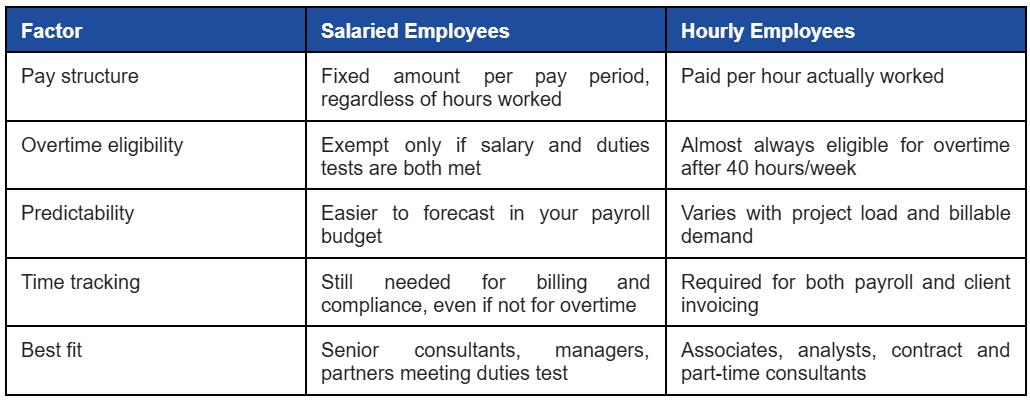
Notice that salaried status alone doesn't decide overtime eligibility. A salaried employee can still be non-exempt and still owed overtime if they don't pass the duties test below.
Exempt vs. Non-Exempt: The Test That Actually Matters
A job title doesn't make someone exempt. Neither does a salary alone. Under the Fair Labor Standards Act (FLSA), an employee only qualifies for the executive, administrative, or professional (EAP) exemption if they pass all three of these tests:
- Salary basis test — the employee is paid a predetermined, fixed amount that doesn't fluctuate based on hours or quality of work.
- Salary level test — the employee earns at least $684 per week federally (higher in states like California), or qualifies as a highly compensated employee at $107,432 or more in total annual compensation.
- Duties test — the employee's actual day-to-day responsibilities involve executive, administrative, or professional-level judgment and discretion, not routine or manual tasks.
This is where consulting firms trip up most often. A first-year analyst with the title "Senior Consultant" who spends most of the week on data entry, formatting decks, or following a strict methodology someone else designed likely fails the duties test regardless of salary. Titles inflate quickly in consulting. Job duties determine exemption. The DOL looks at the second one.
Billable Hours Make Consulting Payroll Its Own Animal
Most industries only need to track hours for payroll. Consulting firms need to track hours for payroll and for client invoicing, and those two purposes don't always align.
An hourly consultant's time entry has to satisfy overtime rules (time-and-a-half after 40 hours in a workweek) and client billing terms at the same time. A salaried exempt consultant may not need time tracking for overtime purposes, but most firms still track their hours anyway for utilization reporting, project profitability, and proof of compliance if a classification is ever challenged.
Add multi-state travel into the mix a common reality for consulting teams working on-site with clients across state lines and you're now managing different overtime rules, different minimum wage floors, and sometimes different exemption thresholds depending on where the work was actually performed that week. Manual spreadsheets fall apart fast under that kind of complexity.
Payroll Mistakes Consulting Firms Keep Making
- Assuming salaried always means exempt. It doesn't. The duties test still applies.
- Skipping time tracking for salaried staff entirely, leaving no record to defend a classification decision later.
- Applying only the federal threshold when consultants work in states with higher exemption minimums.
- Letting billable-hour software and payroll software operate as two disconnected systems, which creates mismatched records at audit time.
- Applying inconsistent classification standards across offices or business units for the same job function.
- Reclassifying an employee only after a complaint, rather than reviewing classifications on a regular schedule.
Building Payroll Compliance That Scales With Your Firm
Consulting firms grow by adding engagements, not by adding payroll headcount. That means your payroll process has to handle a mix of salaried and hourly staff, multi-state work, and shifting overtime rules without a manual recheck every time you staff a new project.
This is exactly the kind of complexity payroll automation is built to absorb: state-by-state threshold monitoring, exemption tracking tied to actual job duties, and payroll reporting that holds up if the Department of Labor ever comes asking. PayProNext handles multi-state payroll compliance, workforce management, and reporting for consulting firms so your team can focus on billable work instead of chasing wage-and-hour rules across every state you operate in.
If your firm is still deciding classifications case-by-case or relying on spreadsheets to reconcile billable hours with payroll, now is the time to build a system that scales before your next growth phase makes the gaps expensive.
Frequently Asked Questions
Should consulting firms pay employees a salary or hourly wage?
It depends on the role, not firm-wide preference. Partners, senior managers, and consultants who exercise real independent judgment are typically better suited to salaried, exempt status. Associates and analysts performing more routine, supervised work are usually classified as hourly and non-exempt, regardless of what a firm might prefer to pay them as.
What is the difference between salaried and hourly employees?
Salaried employees receive a fixed amount each pay period regardless of hours worked. Hourly employees are paid for each hour actually worked and are generally entitled to overtime pay for hours beyond 40 in a workweek. Salaried status alone doesn't determine overtime eligibility; exemption depends on separate salary and duties tests.
Which consulting employees qualify for overtime?
Any employee who doesn't pass all three FLSA exemption tests salary basis, salary level, and duties qualifies for overtime. In consulting firms, this typically includes hourly associates, junior analysts, and any salaried employee earning below the applicable federal or state threshold or performing largely routine work.
How do consulting firms stay payroll compliant?
Firms stay compliant by reviewing job classifications regularly against current duties (not just titles), tracking the correct salary threshold for every state where consultants work, keeping accurate time records for both salaried and hourly staff, and using payroll systems that update automatically as state and federal rules change.
What payroll software is best for consulting firms?
The best fit is payroll software built to handle multi-state compliance, exemption tracking, and integration with time-tracking or billing systems, not a generic small-business payroll tool. Consulting firms need a platform that can flag threshold changes by state and reconcile billable hours with payroll hours automatically.
How should consulting firms track billable hours?
Billable hours should be tracked in a system that feeds directly into both client invoicing and payroll, rather than two separate tools reconciled manually. This reduces discrepancies between what a client is billed and what an employee is paid, and creates a clean audit trail if a classification is ever questioned.
What payroll mistakes should consulting firms avoid?
The most common and costly mistakes are treating salaried staff as automatically exempt, ignoring higher state-level salary thresholds for multi-state consultants, and failing to keep time records for salaried staff that could support a classification decision later. Each of these is a routine fix now and an expensive one after a complaint or audit.
Ready to stop reconciling payroll and billable hours by hand? PayProNext builds multi-state payroll compliance directly into your workflow so every consultant, salaried or hourly, gets paid the first time correctly.