


Payroll Challenges Real Estate Companies Face in 2026 (And How to Solve Them)
Date Released
22 June, 2026
Real estate brokerages run on a payroll model that looks nothing like the standard nine-to-five paycheck. Between commission splits, agent classification rules, and multi-state operations, payroll for real estate companies has become one of the most complicated back-office functions in the industry. As 2026 brings tighter compliance scrutiny and more agents working across state lines, brokerages that still rely on spreadsheets and manual commission tracking are exposed to real financial and legal risk.
This guide breaks down the biggest real estate payroll challenges of 2026, the mistakes that keep costing brokerages money, and the practical steps, including payroll automation, that fix them for good.
Why Payroll Is More Complex in Real Estate Than Other Industries
Most industries pay employees a predictable salary or hourly wage on a fixed schedule. Real estate doesn't work that way. A single brokerage might be running payroll for a mix of in-house staff, salaried managers, and dozens of independent agents, each earning income on a completely different timeline.
- Commission-based earnings: Agent income depends on closed deals, not hours worked, so pay amounts and pay dates vary every cycle.
- Independent agents vs. employees: Brokerages must correctly classify each worker, and getting it wrong creates serious tax exposure.
- Irregular income structures: Splits, tiers, bonuses, and referral fees all have to be calculated correctly before a single check goes out.
This complexity is exactly why real estate payroll compliance has become a bigger conversation in 2026. Regulators are paying closer attention to worker classification across all commission-driven industries, real estate included.
Understanding Real Estate Payroll Structure
Before solving real estate payroll challenges, it helps to understand the different ways brokerages actually pay their people. Most firms are managing several of these structures at once.
- Salaried employees: Office administrators, transaction coordinators, and marketing staff typically receive a fixed salary or hourly wage with standard tax withholding.
- Commission-based agents: Licensed agents are usually paid a percentage of each closed transaction, often structured as independent contractors.
- Hybrid compensation models: Some brokerages offer a small base salary plus commission to attract and retain top-performing agents.
- Bonuses and incentives: Production bonuses, referral fees, and team-lead overrides add another layer of calculation on top of the base commission.
Each of these payment types carries its own tax treatment, reporting requirement, and timing rule. A payroll management real estate firm used to handle salaried staff usually isn't built to also handle commission splits, which is where many of the problems below begin.
Top Payroll Challenges Real Estate Companies Face
Commission-Based Pay Complexity
The commission payroll real estate teams deal with isn't a simple percentage calculation. A single transaction may involve a co-listing agent, a referral source, a team lead's override, and a brokerage split, all before the agent sees a dollar.
- Variable earnings: Pay amounts swing dramatically month to month, making forecasting and budgeting difficult.
- Split commissions: Multiple agents or teams sharing one deal require precise, auditable math.
- Delayed payments: Commissions are often tied to closing dates that shift, creating payment timing disputes.
Contractor vs. Employee Classification
Contractor vs. employee in real estate payroll is one of the most consequential decisions a brokerage makes. Misclassifying agents, even unintentionally, can trigger back taxes, penalties, and lawsuits.
- Legal risks: State and federal agencies use specific behavioral and financial control tests to determine classification, and real estate's hybrid arrangements often blur the lines.
- Tax implications: Misclassified workers can leave a brokerage liable for unpaid payroll taxes, interest, and penalties going back years.
Payroll Tax Compliance
Real estate payroll tax compliance requires juggling federal withholding, state-specific rules, and self-employment tax obligations for contractors, often within the same pay run.
- Federal and state taxes: Withholding, unemployment insurance, and reporting obligations differ for W-2 employees versus 1099 contractors.
- Independent contractor taxes: Agents classified as contractors are responsible for their own self-employment tax, but brokerages still carry reporting and documentation duties.
Multi-State Payroll Issues
As more agents hold licenses in multiple states or work remotely, multi-state payroll has become a real estate payroll problem that firms can no longer ignore.
- Agents working across states: Each state has its own tax registration, withholding, and reporting requirements.
- Compliance differences: Rules around contractor classification, minimum wage, and unemployment insurance vary significantly by state.
Inconsistent Income and Payment Timing
Because commissions are tied to closings rather than calendar dates, payroll scheduling in real estate rarely follows a clean biweekly or semimonthly rhythm.
- Cash flow challenges: Brokerages must manage payouts against unpredictable closing timelines.
- Payroll scheduling issues: Without a defined process, agents are left wondering exactly when and how they'll be paid.
Common Payroll Mistakes in Real Estate
These real estate payroll mistakes show up again and again, and most are preventable with the right systems and processes in place.
- Misclassifying agents as contractors or employees without a documented, consistent standard
- Incorrect commission calculations on splits, tiers, or team overrides
- Delayed payments that erode agent trust and morale
- Missing tax filings for 1099s, W-2s, or state-specific forms
- Poor documentation of commission agreements and classification decisions
The Cost of Payroll Mistakes in Real Estate
Payroll errors in real estate aren't just an inconvenience; they carry measurable financial and reputational costs.
- Legal penalties: Misclassification and tax errors can result in fines, back taxes, and audits from state and federal agencies.
- Agent dissatisfaction: Agents who experience late or incorrect commission payments quickly lose confidence in the brokerage.
- High turnover: Top-producing agents have options. Payroll problems are a common reason they walk to a competing firm.
- Reputation damage: In an industry built on referrals and relationships, word travels fast when a brokerage mishandles agent pay.
| Real-World Cost A mid-sized brokerage delayed a commission payout for three months due to a manual tracking error. The agent involved left for a competitor, and two team members followed shortly after, illustrating how a single payroll mistake can trigger a costly chain reaction. |
Best Practices for Managing Real Estate Payroll
Real estate payroll best practices come down to consistency, documentation, and the right technology. Brokerages that get ahead of these issues spend far less time firefighting payroll problems.
- Standardize commission structures: Use clear, written commission agreements for every split, tier, and override.
- Clearly define agent classification: Apply a consistent, documented standard for every agent and worker type.
- Automate payroll calculations: Remove manual math from commission splits and bonus calculations.
- Maintain accurate records: Keep documentation of classification decisions, commission agreements, and payment history.
- Stay compliant with tax laws: Monitor federal and state requirements, especially for brokerages operating in more than one state.
How Payroll Automation Solves Real Estate Payroll Challenges
A real estate payroll system built for the industry rather than a generic payroll tool directly addresses the challenges outlined above.
- Handles complex commission structures: Automatically calculates splits, tiers, and overrides without manual spreadsheets.
- Ensures tax compliance: Applies the correct withholding and reporting rules for both W-2 employees and 1099 contractors.
- Reduces errors: Eliminates the manual calculation mistakes that lead to disputes and penalties.
- Improves payment transparency: Gives agents clear visibility into how and when they're paid.
| Where PayProNext Fits In PayProNext is built to handle exactly this kind of complexity. From accurate commission calculations and contractor classification support to multi-state tax compliance and on-time payouts, PayProNext gives real estate brokerages a payroll system that keeps pace with how the industry actually pays its people, so owners and brokers can focus on closing deals instead of chasing payroll errors. |
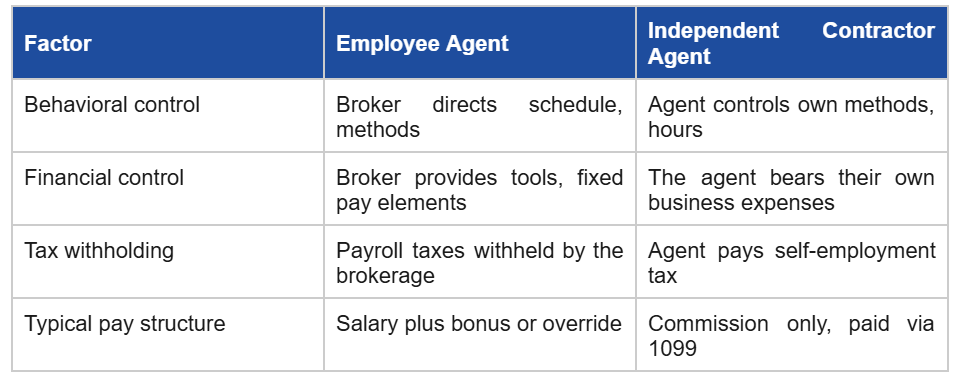
Contractor vs. Employee at a Glance
Real Estate Payroll Checklist (2026)
- Verify agent classification using a documented, consistent standard
- Track commissions accurately, including splits and overrides
- Ensure timely payments aligned with closing schedules
- Maintain compliance with federal, state, and multi-state requirements
- Audit payroll regularly to catch errors before they compound
Real Business Scenarios
Scenario 1: Incorrect Commission Split
A brokerage manually calculated a three-way commission split on a co-listed property. A data entry error shorted one agent by several hundred dollars, leading to a dispute that took weeks to resolve and damaged trust between the agent and the office.
Scenario 2: Misclassification Penalty
A growing brokerage treated a team of agents as independent contractors despite controlling their schedules and providing leads exclusively through the office. A state audit reclassified the workers as employees, resulting in back taxes and penalties.
Scenario 3: Automated Payroll in Action
After switching to an automated, real-estate-specific payroll system, a brokerage eliminated manual commission errors entirely. Agents received accurate, on-time payouts every cycle, and the back office reduced payroll processing time by more than half.
FAQs
How do real estate companies handle payroll?
Most brokerages manage a mix of salaried staff and commission-based agents, calculating pay based on closed transactions, splits, and any applicable bonuses, while applying different tax treatment depending on whether each worker is classified as an employee or independent contractor.
Are real estate agents employees or contractors?
It depends on the brokerage's level of control over the agent's work. Many agents are classified as independent contractors, but brokerages that closely direct an agent's schedule, leads, or methods may be required to classify them as employees under federal and state tests.
How are commissions taxed?
Commissions paid to employees are subject to standard payroll tax withholding, while commissions paid to independent contractors are reported on a 1099, and the contractor is responsible for self-employment tax.
What are common payroll issues in real estate?
The most common issues include agent misclassification, commission calculation errors, delayed payments tied to closing timelines, multi-state tax compliance gaps, and missing or inconsistent documentation.
What tools help manage real estate payroll?
Payroll automation tools built for commission-based industries help brokerages calculate complex splits, apply correct tax treatment, and pay agents on time, reducing the manual work and errors common with spreadsheet-based payroll.
Final Thoughts
Real estate payroll is uniquely complex, blending commission structures, contractor classification, and multi-state compliance in a way few other industries face. The mistakes that come with managing it manually are costly in penalties, agent turnover, and reputation. The brokerages that come out ahead in 2026 are the ones replacing spreadsheets and guesswork with smart, automated payroll systems built for how real estate actually pays its people.
| Ready to simplify your brokerage's payroll? PayPronext helps real estate companies manage commissions, classification, and compliance with confidence so you can focus on growing your business, not untangling payroll errors. Contact PayProNext today to see how we can support your team. |