

Which States Are Most Expensive to Employ In (2026 Data)
Date Released
29 January, 2026
It always seems easy to hire employees in the U.S. An agreement concerning salary is made, benefits are discussed, and the position is filled. However, when the payroll begins to roll, most employers find out that the actual cost of an employee is far beyond salaries.
Each state will include its own employer-paid taxes, insurance mandates, and regulations. These differences can significantly affect the business budgets in 2026 when more remote teams do the work and include more states.
This guide outlines the most expensive states to employ in 2026 based on the actual amount paid to the employers, so that you can make the decision to hire without considering the most expensive states.
What “Employment Cost” Means for Employers
In discussing the cost of employment, many individuals confuse employee deductions and the commitments of the employer. That gives confusion and unrealistic expectations of costs.
In order to make it simple and practical, this paper will limit itself to employer-paid costs. These are the expenses that directly affect your business cash flow and payroll budget.
Employer costs included in this guide:
- State Unemployment Tax (SUTA)
- Family or medical leave is paid by the employer (when it is a requirement).
- Employer-paid disability programs (where applicable)
- Employee's compensation insurance.
- Payroll compliance and regulatory burden
Costs intentionally excluded:
- Employee state income tax
- Deductions on disability or leave payments of employees.
- Any withholding by any employee.
This separation helps to give you a better idea of true employer costs by state in 2026.
Why Employment Costs Vary So Much by State
The cost of employment does not go up randomly. The expensive states to work with are usually similar in a number of ways.
In certain states, employers make much higher payments to unemployment taxes. There are others that require employer payments to paid leave or disability programs. Worse still, the workers' compensation rates and labor law enforcement may be quite different.
Together, these factors create noticeable labor cost differences by state, even when base salaries are similar.
Key factors that drive higher employer costs:
- Higher SUTA rates or wage bases
- High-cost workers' compensation insurance.
- Employer-funded paid leave programs
- Complicated rules of labor and payroll compliance.
- Increased minimum wage levels.
States that integrate several aspects usually find themselves in the list of the highest cost of employment states.
Top 10 Most Expensive States to Employ in 2026
Instead of looking at one tax in isolation, the ranking below reflects overall employer burden, including taxes, insurance, and compliance complexity.
The ranking below does not focus on specific taxes, but on the overall employer burdens, i.e., taxes, insurance, and complexity of compliance.
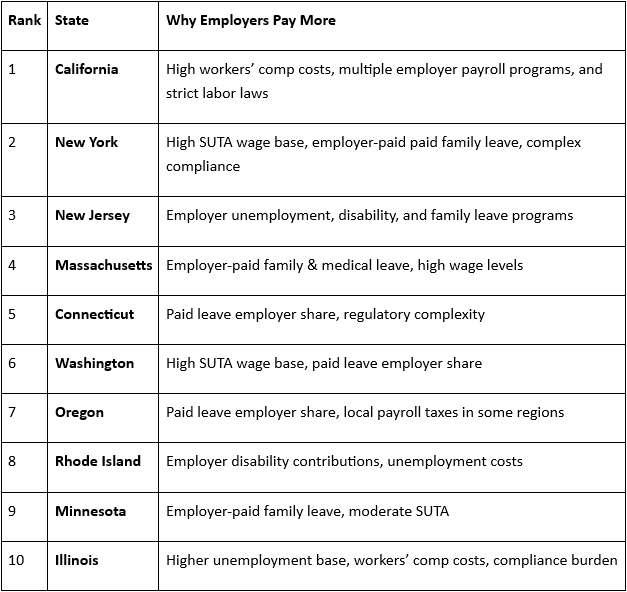
These states are widely considered the most expensive states for employers because costs stack across multiple areas.
Employer Payroll Taxes That Actually Apply in 2026
Payroll taxes are usually misconstrued, and it is better to take things at a slow pace and examine what employers actually pay.
Although all employers are required to remit federal payroll taxes, state-level requirements differ greatly. Some states include paid leave or disability programs, and others do not.
Common employer-paid payroll costs:
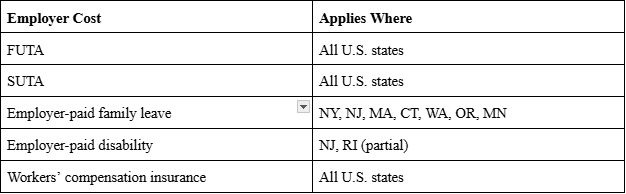
Understanding which of these are applicable will allow employers to predict the costs of the payroll tax by state more precisely.
California vs Texas vs Florida: Why the Gap Is So Big
These three states are the ones that are compared by many employers when determining where to hire. Salaries may appear to be the same on paper, but employer costs are a much different story.
California combines several employer requirements, but Texas and Florida retain payroll requirements comparatively basic. The outcome is a significant variation in the total employment cost.
Employer cost comparison:
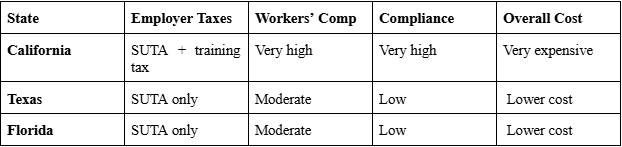
This comparison highlights why the cost of hiring in different states goes far beyond wages.
The Hidden Costs Employers Often Overlook
Not all of the largest employment costs are listed as one. The high-cost states will usually take a longer time, systems, and professional assistance just to remain in compliance. These hidden costs gradually build up.
Common hidden employer costs:
- Frequent labor law updates
- Increased payroll submissions and payments.
- Higher penalties for mistakes
- Compulsory disclosures and reporting.
- Greater HR and legal intervention.
Such elements substantially raise the compliance cost of payroll and HR expenditure.
How Employers Can Control Employment Costs
Employers, even in costly states, have nothing they can do. Intelligent systems and planning can make a difference.
Through the minimization of errors, enhancement of compliance, and regular review of the payroll information, businesses would be in a position to contain the costs without impacting growth.
Practical methods to save on the payroll costs of employers:
- Use payroll automation software
- Outsource payroll for multi-state teams
- Review SUTA rates annually
- Audit workers’ compensation classifications
- Centralize payroll tax filing
These steps help reduce the employer tax burden while keeping operations smooth.
Conclusion
It is not only high-wage states that would be the most expensive to hire in 2026. They are states that are a combination of employer payroll tax funds, insurance mandates, and complicated labor regulations.
California, New York, and New Jersey are always ranked high due to the overlapping employer duties. In the meantime, states such as Texas and Florida are more affordable to employers.
Knowing the employment costs per state will enable businesses to be smarter in planning as well as hiring without fear of expensive surprises.
Maintaining multistate payroll?
Schedule a multi-state payroll consultation free of charge and see how payroll optimization solutions can help to decrease both compliance risk and cost to the employer.
FAQ
What are the most expensive states to hire in 2026?
California, New York, and New Jersey are the leaders because of increased taxes paid by the employers and compliance.
Do employers pay state income tax?
No. State income tax is paid not by employers but by employees.
Is workers’ compensation required everywhere?
Yes. Employers in all states of the U.S. are required to have workers' compensation.
Why does unemployment tax matter so much?
Higher wage bases and rates increase how much employers pay per employee.
Can payroll services actually lower costs?
Yes. They minimize mistakes, fines, and management costs.