


What Payroll Records Should Employers Keep?
Date Released
13 July, 2026
Every business that pays employees is required by federal law to keep specific payroll records, and the rules aren't optional. The Department of Labor (DOL), the Internal Revenue Service (IRS), and the Equal Employment Opportunity Commission (EEOC) all have their own recordkeeping requirements, and each carries real financial and legal consequences if you fall short.
Whether you run a small retail shop, a growing construction firm, or a multi-location healthcare practice, understanding payroll recordkeeping requirements protects your business from penalties, strengthens your position in a wage-and-hour dispute, and keeps your payroll audit-ready year-round.
This guide breaks down exactly what payroll records employers should keep, how long to keep them, and how to build a recordkeeping system that scales with your business.
Why Payroll Recordkeeping Matters
Payroll documentation does more than satisfy a legal checkbox. Accurate payroll records:
- Protect your business in the event of a DOL wage-and-hour investigation or IRS audit.
- Provide the evidence needed to resolve employee disputes over pay, hours, or overtime.
- Support accurate tax filings and reduce the risk of penalties for underpayment or late deposits.
- Create a paper trail for unemployment claims, workers' compensation cases, and litigation.
- Give you the data you need to analyze labor costs and make smarter staffing decisions.
Missing or incomplete payroll records shift the burden of proof onto the employer. If the DOL investigates a wage claim and your records are incomplete, the agency can rely on the employee's own account of hours worked even if it isn't accurate. That alone is reason enough to take payroll documentation seriously.
What Payroll Records Should Employers Keep?
At a minimum, employers should maintain the following categories of payroll records for every employee, current and former.
1. Employee Identification Records
- Full legal name and Social Security number are required for tax reporting and W-2 accuracy.
- Home address, including ZIP code, is required under FLSA recordkeeping rules.
- Date of birth is required for any employee under 19.
- Job title, department, and employee classification exempt vs. non-exempt status under the FLSA.
2. Time and Attendance Records
- Timecards and timesheets, daily and weekly hours worked.
- Workweek start day and time, the fixed point your pay period is calculated from.
- Overtime records, hours worked beyond 40 in a workweek, and the associated pay.
- PTO, sick leave, and vacation records, accrual, usage, and balances.
3. Wage and Pay Records
- Payroll register: a summary of wages paid to all employees for each pay period.
- Pay stubs, itemizing gross pay, deductions, and net pay for each employee.
- Pay rate documentation, hourly rate, salary basis, commission structure, or piece rate.
- Payroll deductions, taxes, benefits contributions, garnishments, and other withholdings.
- Direct deposit authorizations and records, proof of employee consent, and payment routing.
4. Tax Records
- Form W-4, employee withholding elections, is kept on file for the duration of employment plus the retention period.
- Form W-2, annual wage and tax statements issued to employees.
- Form 941, quarterly federal tax returns reporting withheld income and FICA taxes.
- Form 940, annual federal unemployment (FUTA) tax return.
- State tax withholding and unemployment insurance filings and requirements vary by state.
5. Employment and Termination Records
- Offer letters and compensation agreements, documenting agreed pay and terms.
- Form I-9, employment eligibility verification.
- Termination records, final pay calculations, reason for separation, and any severance agreements.
How Long Should Employers Keep Payroll Records?
Retention periods differ depending on which agency's requirements apply. When multiple rules overlap, the safest approach is to follow the longest applicable retention period.
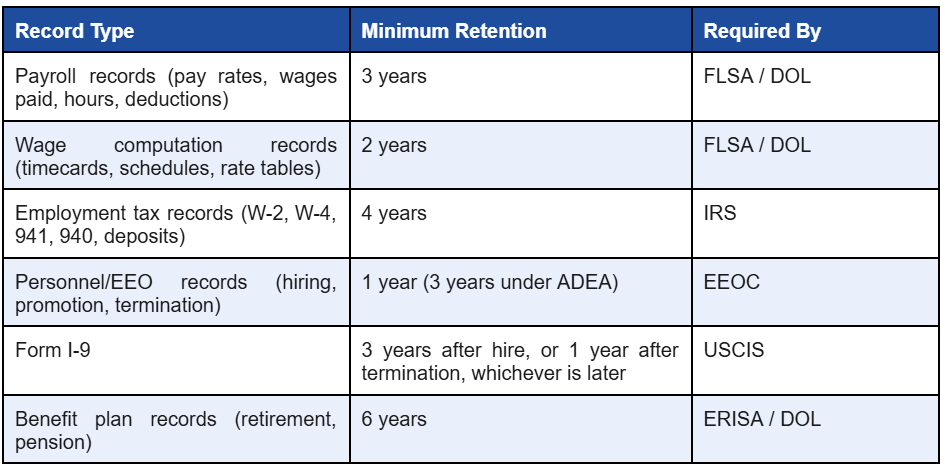
A useful rule of thumb: keep core payroll and tax records for at least four years, and hold onto anything connected to an open claim, audit, or litigation until that matter is fully resolved, regardless of how much time has passed.
Payroll Recordkeeping Checklist for Small Businesses
Use this checklist to evaluate whether your current payroll documentation meets baseline compliance standards.
- Employee name, address, SSN, and date of birth (if under 19) on file
- Job classification (exempt/non-exempt) is documented and reviewed annually
- Timecards or a timekeeping system capturing daily and weekly hours
- Payroll register generated and archived for every pay period
- Pay stubs are retained for all employees, current and terminated
- W-4, W-2, 941, and 940 forms filed and stored securely
- I-9 forms completed and retained per USCIS timelines
- PTO, overtime, and deduction records are reconciled each pay cycle
- Records are stored securely with role-based access and backup
- Retention schedule documented and reviewed for state-specific rules
Industry Considerations for Payroll Documentation
Recordkeeping needs shift depending on how a business operates day-to-day.
- Small businesses often lack a dedicated HR team, making a simple, standardized recordkeeping system essential to avoid gaps.
- Healthcare shift differentials, on-call pay, and credentialing records add complexity to standard payroll files.
- Restaurants' tip credits, tip pooling, and variable schedules require detailed time and wage documentation.
- Construction multi-state and prevailing wage jobs demand certified payroll reports in addition to standard records.
- Retail seasonal staffing and part-time schedules increase the volume of timecards and classification records to track.
- Manufacturing shift differentials, overtime, and union agreements often require additional wage documentation.
- Professional services salaried and exempt staff still require accurate classification and compensation records.
What Happens If Payroll Records Are Missing?
If payroll records are missing or incomplete during a DOL audit, the agency may accept an employee's own estimate of hours worked as fact, putting the employer at a significant disadvantage. Missing tax records can also trigger IRS penalties for failure to file or underpayment, even if the underlying error was unintentional. In wrongful termination or discrimination claims, incomplete personnel files can weaken a company's legal defense considerably.
In short: the absence of a record is treated as if the required action never happened.
How Should Payroll Records Be Stored?
Both paper and electronic formats are acceptable under federal law, provided records are accurate, complete, and readily accessible if requested by the DOL or IRS. Most growing businesses move toward secure, cloud-based payroll systems that centralize records, apply role-based access controls, and automatically flag documents nearing the end of their retention period. This reduces manual filing errors and ensures nothing is deleted prematurely.
| Simplify Payroll Recordkeeping with PayProNext Staying on top of payroll recordkeeping requirements shouldn't fall entirely on your shoulders. PayProNext's payroll and HR platform automatically stores pay stubs, tax forms, timecards, and compliance documentation in one secure, audit-ready system with retention schedules built in. Whether you're a small business owner or managing payroll across multiple locations, our team helps you stay compliant without the manual paperwork. Contact PayPronext today for a free consultation and see how effortless payroll compliance can be. |