


Stay Compliant With 2026 SUTA Rates: What Employers Need to Know
Date Released
02 February, 2026
Payroll management in 2026 does not imply paying employees on time only. To U.S. employers, the State Unemployment Tax Act (SUTA) is an urgent - and not very well-regarded - requirement. Due to the varying rates of state unemployment taxes, the wage base that is subject to taxation, and the regulations of reporting, a small mistake may bring about penalties, interest charges, or an increase in the federal unemployment taxes.
This guide breaks down what employers need to know about 2026 SUTA rates, how they interact with federal unemployment taxes, and how to stay compliant, especially if you operate in multiple states.
What Is SUTA and Why Employers Must Pay Attention
SUTA is a state payroll tax that is paid by employers to provide unemployment insurance benefits to workers who lose their jobs because of no fault of their own. Although the structure is consistent across the nation, the amount of tax and wage base, including each state, determines the compliance regulations.
SUTA is mostly a tax paid by the employer:
- Employees are usually not contributing to SUTA.
- Rates and wage bases fluctuate every year.
- Both the state and federal payroll taxes may be affected by the errors.
A lack of staying compliant may lead to:
- State penalties and interest
- Audits or enforcement notices
- Loss of federal FUTA tax credits
- Increased overall employer payroll costs
Federal vs. State Unemployment Taxes (FUTA vs. SUTA)
Besides the SUTA, employers need to pay Federal Unemployment Tax Act (FUTA) taxes, which are collected by the IRS and provide state unemployment services.
FUTA basics employers should know
Only employers are required to pay FUTA.
- The standard FUTA rate is 6% of the initial 7,000 dollars of the wage of every worker.
- The state unemployment tax, which is paid on time by the employers, could be given a credit of up to 5.4%.
- This will decrease the effective FUTA rate to 0.6 percent.
- FUTA is a form of income that is reported on IRS Form 940 annually.
Important:
Your FUTA credit may be decreased or completely removed by the late or unpaid state unemployment taxes (SUTA) and raising your federal unemployment tax liability.
This is the reason why SUTA compliance has a direct impact on FUTA expenditures rather than the state taxes.
2026 SUTA Wage Bases: Key States Employers Need to Know
Every state sets a taxable wage base, which is the highest level of wages per employee that is taxed under SUTA tax in a year. When an employee earns a salary that is above this threshold, no extra SUTA taxes will be paid by the employee during the same year in that state.
Below are the 2026 SUTA taxable wage bases for commonly requested states:
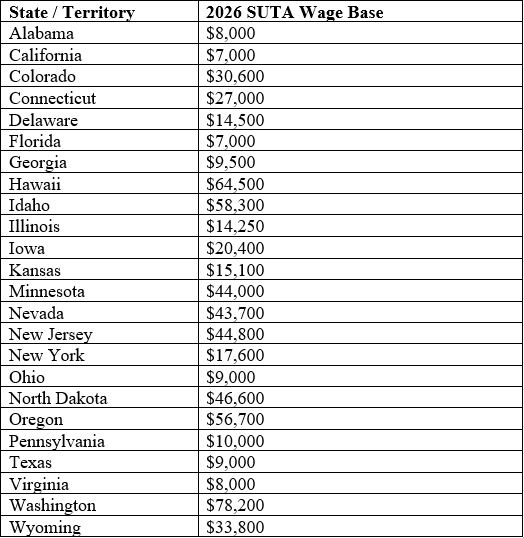
Why these matters
- Such states as Nevada and New York have much higher wage bases, which makes employer payroll costs per employee higher.
- Other states such as Florida and Texas, have a lower wage base but even have stringent quarterly filing regulations.
- Employers who are working in more than one state need to record the basis of wages in individual states.
State unemployment agencies set wage bases and determine tax rates, which could be altered. Last minute figures must never be submitted before employers are sure that there are relevant state authorities or a payroll compliance provider.
How SUTA Tax Rates Are Determined
In contrast to FUTA, SUTA tax rates depend on the employer, and there are a number of factors that affect such rates:
- Unemployment insurance laws at the state level.
- History of unemployment claims (employer experience rating)
- Industry classification
- Length of time in business
- State trust fund health
New employers tend to have a standard rate and existing employers get experience rate percentages depending on their track record in terms of unemployment claims.
SUTA Reporting and Filing Requirements
Quarterly reporting
Most states require:
- Quarterly wage reports
- Quarterly SUTA tax payments
Due dates are usually the last day of the month after every calendar quarter, but this depends on the state.
State registration
Employers must:
- Register with the state unemployment agencies.
- Get the state unemployment tax account number.
- Report the wages of employees correctly by state.
Multi-state employers
In case you have workers in more than one state, you will have to:
- Prepare separate SUTA reports in each state.
- Monitor various wage bases and rates.
- Make sure that there are timely payments in all jurisdictions.
A single failure to make a filing may lead to fines or FUTA liability.
Common SUTA Compliance Mistakes Employers Make
- Payroll systems use obsolete SUTA rates.
- Late quarterly filings.
- Wrongly paying remote workers.
- Failure to be registered in new states.
- Ignoring the changes in experience rate.
- The assumption is that FUTA and SUTA are independent.
These errors will be more promptly detected in 2026 as the automation of work and data transfer between agencies increases.
Best Practices to Stay Compliant in 2026
1. Review SUTA Rates Annually
States update wage bases and rate schedules every year. Employers should confirm updates before the first payroll of the year.
2. Treat FUTA and SUTA as One System
Timely SUTA payments protect your FUTA credit and reduce total payroll tax exposure.
3. Track Multi-State Payroll Carefully
Remote and hybrid workforces make state unemployment compliance more complex than ever.
4. Use Payroll Compliance Technology or Experts
Automation and expert oversight help reduce filing errors, missed deadlines, and audit risk.
How SUTA Rates Affect Employer Payroll Costs
SUTA taxes are part of an employer’s total payroll burden. Higher wage bases and experience rates can significantly increase:
- Cost per employee
- Budget forecasting complexity
- Compliance risk
Understanding how 2026 SUTA rates affect employer payroll costs allows businesses to plan accurately and avoid surprises.
Final Thoughts
Staying compliant with 2026 SUTA tax rules is no longer optional or simple, especially for growing businesses and multi-state employers. Between changing wage bases, experience-rated taxes, and the direct connection to federal FUTA credits, unemployment tax compliance must be handled with precision.
Employers who stay proactive, informed, and organized are far less likely to face penalties, audits, or unexpected tax increases.
Need Help With SUTA Compliance? PayProNext Can Help
PayProNext payroll compliance services support employers by helping them:
- Manage multi-state SUTA reporting
- Track 2026 wage base and rate changes
- File quarterly unemployment tax reports accurately
- Reduce compliance risk and penalties
- Protect FUTA tax credits
Book a free demo with PayProNext and stay ahead of payroll tax changes in 2026.