


Payroll Automation in Texas: How AI & Smart Systems Are Changing SMB Operations
Date Released
08 May, 2026
Manual payroll administration in 2026 is similar to navigating without GPS; it can be done, but it is an inefficient and time-consuming process that involves a higher risk of errors and increases operating costs. As far as small and medium-sized businesses (SMBs) in Texas are concerned, whether it is Austin with its IT industry, Houston with its oil and gas facilities, or Dallas with its thriving retail environment, payroll automation has evolved from being an added advantage to a business necessity.
This blog describes how payroll automation with AI and smart technology solutions is changing the way Texas SMBs deal with their workforce, and why now is the right time to adopt payroll automation in Texas.
1. What Is Payroll Automation, And Why Does It Matter for Texas SMBs?
Payroll automation refers to the utilization of software programs and advanced AI systems to perform various aspects of payroll administration, from wage calculations and tax filing to payment issuance. Contemporary payroll automation systems extend well beyond basic mathematical computations and encompass many other aspects, including timekeeping, HR platforms, accounting software, and compliance tools.
In the case of Texas-based companies, the issues are even more important. There is no income tax in Texas, yet the company is expected to fulfill the federal requirements, deal with local jurisdiction-related complications, and observe industry-specific compliance requirements in such industries as construction, the oil and gas industry, healthcare, and hospitality. It goes without saying that the manual calculation is especially problematic in this case since a simple mistake may lead to penalties on behalf of the IRS, loss of employees' trust, and various other problems.
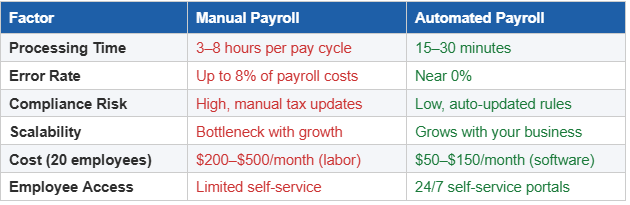
| Quick Stat: Businesses lose up to 1–8% of their payroll costs annually due to processing errors. With automation, this figure becomes close to zero according to the American Payroll Association. |
2. How Payroll Automation Works: A Step-by-Step Overview
- The knowledge about the process will allow a businessman to understand what he stands to gain from payroll automation:
- Data collection and integration: This type of software can collect the required data from time-tracking applications, schedules, etc.
- Compensation & Deduction Calculation: The AI engine ensures accurate calculations of compensation packages, including any overtime calculations based on Texas’s specific FLSA requirements, benefits deductions, and garnishments.
- Filing Taxes & Compliance: Payroll management software automatically calculates federal, state, and local taxes, prepares all necessary forms such as W-2 and 1099s, and submits tax reports and returns to relevant agencies – without errors.
- Direct Deposits & Payments: Payroll systems ensure that employee payments are made using the direct deposit process. More systems allow for Same Day ACH deposits and earned wage access (EWA), which is increasingly popular among Texas hourly employees.
- Reporting & Analysis: Through the AI analytics dashboard, the most important information about payroll expenditures, workforce productivity, and compliance performance becomes easily visible to Texas business owners.
3. Payroll Automation vs. Manual Payroll: The Real Cost Comparison
Many SMB owners assume manual payroll saves money. The data tells a different story.
4. The Top Benefits of AI-Powered Payroll Automation for Texas Businesses
This is how Texas small businesses can speed up the process of implementing AI payroll solutions in 2026:
Avoid Costly Payroll Mistakes
AI payroll processing algorithms compare each step against tax tables, company policies, and employee data. This way, Texas businesses receive error-free reports and payments for each cycle, preserving your budget and your employees' trust.
Compliance With Ease
Businesses in Texas are required to abide by labor laws, IRS policies, and various rules set forth by each specific industry. Payroll management AI adapts in real-time when legislation changes, ensuring that your company is never out of sync with the latest law or tax policy.
Free Up Valuable Time
Payroll automation usually takes only 10% to 30% of the time traditional payroll solutions would take. This means several hours back into your weekly schedule where they can be used to grow your business.
Manage More Employees Seamlessly
Whether you add one more worker in San Antonio or ten in Dallas, cloud-based payroll software will adapt automatically. There is no extra work for your staff, no need to make calculations manually, everything is done in a few clicks.
Enhance Employee Experience
The new generation of AI-powered payroll management systems provides self-service platforms for employees to check their pay stubs, make changes to tax withholding, earn their paychecks early, and even download tax forms, all without interacting with the HR department. This feature holds significant importance in Texas's fiercely competitive job market.
Business Intelligence
In addition to performing its core functions, intelligent payroll management systems provide immediate insights into the company’s labor expenses, overtime rates, expenditures by departments, and turnover costs.
5. Payroll Automation Solutions for Texas Cities: What to Look For
Not all payroll automation solutions are created alike. Regardless of whether you run a restaurant business in Houston, a startup technology firm in Austin, a logistics company in Dallas, or a construction business in San Antonio, consider the following essential features when assessing your options:
- Ability to process taxes in multiple states and jurisdictions
- Efficient integration with top accounting systems (QuickBooks, Xero, Sage)
- Time tracking and scheduling system compatibility
- W-2, 1099, and contractor payment functionality
- Compliance with federal laws as well as state-specific payroll rules in Texas
- Employee self-service portal with mobile capabilities
- Earned wage access feature for hourly employees
- Scale-friendly pricing with growing headcount
- Data encryption and SOC 2 compliance
- Customer support team with HR experience
6. How to Implement Payroll Automation in Your SMB: A Practical Guide
Moving to automated payroll management is a process that does not necessarily mean interruptions. Consider doing the following when transitioning:
Step 1: Analyze Your Existing Payroll Process: Note all stages, hours recording, deduction calculations, filing tax reports, payments to employees, and contractors. Pinpoint the weaknesses and errors.
Step 2: Determine the Features You Need: Take into account your staff number, different kinds of remuneration (hourly, salary), complexity of insurance benefits, and need for integration with other programs.
Step 3: Pick an Appropriate Tool: Ask for demonstrations of 2 or 3 Texas payroll management software companies. Pay special attention to usability, customer service quality, and update rates.
Step 4: Migrate Your Data: It is likely that most companies provide you with assistance during migration. All data, such as employee records and tax identification numbers, should be imported.
Step 5: Implement Parallel Payroll Processing: For the first run of the program, you may calculate the payroll twice, manually and with the help of the software, checking if the results are similar.
Step 6: Training Your Team and Going Live: Conduct a quick training session for the HR team and give access to the employee self-service portal to your workforce. Most payroll software requires minimal training.
Step 7: Monitoring, Optimizing, and Scaling: Analyze payroll data reports once per month. Utilize the analytics dashboard to uncover trends and optimize your labor cost strategy.
7. The Future of Payroll Automation: What Texas SMBs Should Expect
Technology is advancing quickly when it comes to payroll. Below are some features that await in the world of payroll AI technology:
- Predictive Payroll Analytics: AI solutions will anticipate your issues by letting you know about possible overtime trends, tax concerns, or labor costs seasonally increasing.
- Conversational AI Assistants: HR chatbots coupled with payroll platforms will enable your employees to pose questions such as "When do I get paid next?" or "How many hours of PTO do I have?" and get a quick response.
- Compliance Monitoring: In light of changing legislation in the area, compliance engines in the future will track down such changes and apply them to you at once.
- ERP & HR Integration: With time, payroll automation solutions will work as an integral part of your entire enterprise resource planning system.
Conclusion: Texas SMBs Can't Afford to Wait
Texas' SMBs operate in an increasingly competitive environment. Talent pools are strained, compliance rules are constantly shifting, and workers are expecting the same level of digital convenience from their employers as they do from consumer brands. Payroll automation isn't about streamlining processes; it's about laying the foundation for a scalable, adaptable, and competitive company.
Regardless of whether you have 5 employees in Fort Worth or 500 across Texas, intelligent payroll solutions will ensure your payroll is accurate, compliant, and efficient enough for you to concentrate on developing your business.
PayProNext is designed specifically for this purpose, delivering enterprise-level payroll automation to Texas SMBs at prices and with simplicity suited to your size.
| Ready to automate your payroll? Start your free trial with PayProNext today. |