
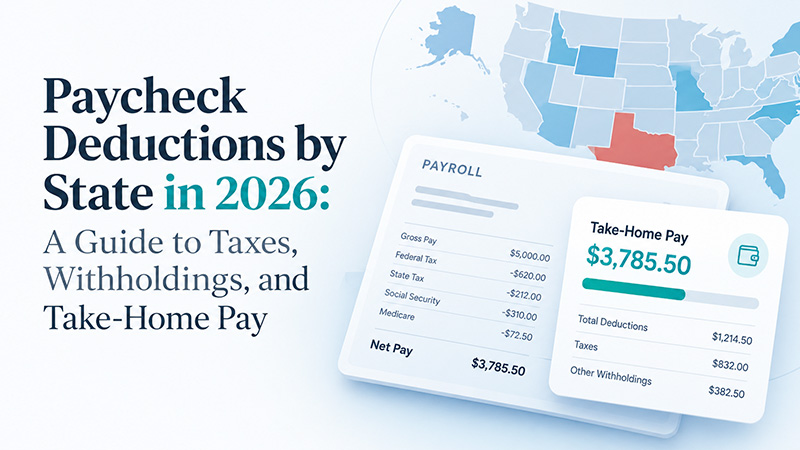
Paycheck Deductions by State in 2026: A Guide to Taxes, Withholdings, and Take-Home Pay
Date Released
20 October, 2026
Why Your
Paycheck Is Smaller Than Your Salary
An employee accepts a job paying $52,000 a year, or $25 an hour, and expects the deposit to match. Then the first pay stub arrives, and the amount in the bank account is noticeably lower.
That gap is normal. Gross pay can be reduced by federal income tax withholding, Social Security and Medicare taxes, state and local taxes where they apply, and other deductions such as health insurance premiums or retirement contributions. Understanding state paycheck deductions starts with one idea: take-home pay depends on earnings, withholding elections, work and residence locations, benefits, and individual circumstances, not just the state where someone lives.
What Are
State Paycheck Deductions?
A paycheck deduction is any amount subtracted from gross pay before the employee is paid. Not every deduction is a tax, and not every employee has every deduction. The main categories are:
- Federal taxes: federal income tax withholding, plus Social Security and Medicare taxes where applicable.
- State and local taxes: state income tax withholding and any local income, wage, or occupational taxes.
- Voluntary deductions: health insurance premiums, retirement contributions, and other authorized benefits.
- Other required deductions: court-ordered garnishments or other legally required withholding, depending on the circumstances.
Some deductions reduce taxable wages for certain taxes, while others are taken after tax. Treatment depends on the deduction type and the applicable rules. It also helps to separate two ideas: tax withholding is a prepayment based on the employee’s information, not necessarily the final tax bill, which is settled when returns are filed.
Federal payroll taxes are the same everywhere. For 2026, the IRS lists the employee Social Security rate at 6.2% on wages up to $184,500 and the employee Medicare rate at 1.45% with no wage cap, plus a 0.9% Additional Medicare Tax on wages above $200,000. Employers match Social Security and Medicare, but that match is an employer cost, not an employee deduction.
Which States
Have No State Income Tax in 2026?
Nine states are generally identified as having no broad-based individual income tax on wages in 2026: Alaska, Florida, Nevada, New Hampshire, South Dakota, Tennessee, Texas, Washington, and Wyoming.
A few details matter. New Hampshire has never taxed wages and has repealed its former interest and dividends tax for 2025 and later. Tennessee’s former investment income tax was phased out earlier. Washington does not tax wages but does tax certain capital gains, so “no income tax” does not mean every type of income is untaxed in every state on this list.
Living in one of these states also does not eliminate federal income tax withholding, Social Security and Medicare taxes, or benefit deductions. Some employees may still face local taxes or other payroll items. And because living costs and other taxes differ, this list is not a ranking of where employees keep the most pay.
How State
Taxes Affect Take-Home Pay
State paycheck deductions can differ for several reasons:
- State income tax rates and brackets.
- The state withholding form and the employee’s elections.
- Taxable wages and state-specific adjustments.
- Residence and work location.
- Local wage or income taxes, where applicable.
- Special rules for remote or cross-state employees.
A state’s top marginal rate is not applied to every dollar. Where brackets apply, different portions of taxable income are taxed at different rates. Where a state uses a flat rate, that rate applies to taxable income as the state defines it, which can differ from federal taxable income.
Residence is also not the only factor. Someone who lives in one state and works in another may have withholding obligations in the work state, the home state, or both, depending on reciprocity agreements and each state’s rules. Remote work adds complexity, and an employer’s location does not automatically decide the answer.
Finally, withholding is an estimate built from the employee’s form and the applicable rules. Final liability is determined when the employee files, so a refund or balance due is possible even when withholding was calculated correctly.
What Is the
Difference Between Gross Pay and Net Pay?
Gross pay is earnings before deductions, including wages, salary, overtime, bonuses, and other compensation. Net pay is what remains after applicable taxes and other paycheck deductions. It is the amount deposited.
The table below uses a hypothetical $2,000 gross paycheck. All figures are illustrative, rounded for simplicity, and do not represent a real employee’s calculation. Only the Social Security and Medicare lines apply the 2026 employee rates, assuming all wages are subject to both.
|
Hypothetical $2,000 paycheck |
Employee A (state wage tax) |
Employee B (no state wage tax) |
|
Gross pay |
$2,000 |
$2,000 |
|
Social Security (6.2%) |
−$124 |
−$124 |
|
Medicare (1.45%) |
−$29 |
−$29 |
|
Federal income tax withholding (hypothetical) |
−$150 |
−$150 |
|
State income tax withholding (hypothetical) |
−$60 |
$0 |
|
Health insurance premium (hypothetical) |
−$75 |
−$75 |
|
Net pay |
$1,562 |
$1,622 |
Real pay stubs differ because some pre-tax deductions reduce taxable wages, and local taxes, retirement contributions, or garnishments may apply. Two employees with identical gross pay can therefore receive different net pay based on location, withholding elections, and benefits.
Can Local
Taxes Also Be Deducted From a Paycheck?
In some places, yes. Certain cities, counties, and school districts impose local income, wage, or occupational taxes, while many jurisdictions have none. Pennsylvania is one example: under Act 32, employers generally withhold local earned income tax, using the higher of the employee’s resident rate or the non-resident rate where the employee works, according to the state’s Department of Community and Economic Development. Philadelphia administers its own wage tax separately.
The takeaway is to check the rules for the specific city, county, or school district. Residence, work location, and reciprocity or special withholding rules can all change the outcome. Not every city charges local income tax, and remote employees do not automatically owe tax to their employer’s location.
How to
Estimate Your Take-Home Pay by State
A short process works for most pay periods:
- Start with gross pay for the pay period.
- Identify the federal withholding information, such as the employee’s Form W-4 and current IRS payroll tax rules.
- Check the state withholding rules and the employee’s state withholding form.
- Determine whether local taxes apply based on work and residence locations.
- Subtract health insurance, retirement contributions, and other payroll deductions.
- Compare the estimate with an actual pay stub and adjust the inputs.
A paycheck calculator by state can give a useful estimate, but accuracy depends on when the tool was last updated, its assumptions, and the information entered. Have pay frequency, gross wages, filing status, withholding elections, work and residence locations, and benefit deductions ready. An estimate does not replace official payroll calculations, tax advice, or a review of an actual pay statement.
Frequently
Asked Questions About Paycheck Deductions by State
What deductions come out of a
paycheck?
Common deductions include federal income tax withholding, Social Security and Medicare taxes, applicable state and local taxes, benefit deductions such as health insurance, and other authorized or legally required deductions like garnishments. The exact combination varies by employee, employer, and location.
Which states have no state income
tax in 2026?
Alaska, Florida, Nevada, New Hampshire, South Dakota, Tennessee, Texas, Washington, and Wyoming have no broad-based individual income tax on wages in 2026. Washington taxes certain capital gains, but it does not levy a broad-based personal income tax on wages.
How do state taxes affect take-home
pay?
State tax rules and withholding can raise or lower net pay depending on rates, brackets, and the employee’s withholding elections. Because withholding is an estimate, the final tax liability can differ from the amount withheld, resulting in a refund or balance due when returns are filed.
Are paycheck deductions different in
every state?
Federal payroll taxes follow federal rules everywhere, but state and local taxes and some employment requirements vary by jurisdiction. Individual withholding elections and benefit choices also change the result, so two employees can see different deductions even within the same state.
What is the difference between gross
pay and net pay?
Gross pay is earnings before any deductions. Net pay, often called take-home pay, is the amount remaining after applicable taxes and other paycheck deductions are subtracted. Two employees with the same gross pay can have different net pay.
Can local taxes also be deducted
from a paycheck?
Yes, in some places. Certain cities, counties, and other local jurisdictions impose taxes that may be withheld from wages, depending on applicable rules. Many areas have no local wage tax, so confirm the rules where the employee lives and works.
How can employees estimate their take-home pay by state?
Use a current paycheck calculator and enter the correct state, work and residence locations, pay frequency, gross pay, withholding information, and benefit deductions. Treat the result as an estimate, and compare it with an actual pay statement.
Simplify
Payroll Calculations With PayProNext
Accurate payroll depends on applying the right rules, keeping employee information current, and accounting for every relevant tax and deduction. PayProNext is a payroll solution for U.S. businesses that need help managing payroll calculations and payroll-related processes.
Managing payroll across different states? Explore PayProNext to simplify payroll management and evaluate a payroll process that fits your business’s needs.