
How HR and Payroll Teams Can Work Together to Improve Employee Retention
Date Released
18 June, 2026
When employees leave, companies lose more than a warm body in a seat. The U.S. Department of Labor estimates that replacing an employee can cost anywhere from 50% to 200% of their annual salary, once you factor in recruiting, onboarding, lost productivity, and team disruption. And yet, many businesses are still missing one of the biggest drivers of preventable turnover: the disconnect between HR and payroll.
Payroll errors, late paychecks, and confusing benefit deductions do not just create administrative headaches. They erode employee trust in a fundamental way. When your people do not feel confident that their compensation and benefits are being handled correctly, they start looking elsewhere.
The good news is that stronger HR and payroll integration is one of the most actionable, measurable steps a business can take to improve employee retention. In this guide, we will walk through why alignment between HR and payroll teams matters, what happens when it breaks down, and exactly how to fix it in 2026.
| Key Stat According to the American Payroll Association, nearly 49% of U.S. workers would begin job hunting after just two payroll errors. Getting payroll right is not a back-office issue. It is a retention strategy. |
Why HR and Payroll Alignment Is a Retention Issue
Most organizations treat HR and payroll as separate functions. HR manages hiring, onboarding, performance, benefits, and culture. Payroll handles compensation processing, tax withholding, compliance, and reporting. But in reality, these two functions are deeply intertwined, and when they are not talking to each other, employees pay the price.
Here is the reality: nearly every HR decision has a payroll consequence.
- A new hire does not make it into the payroll system on time, and their first paycheck is delayed.
- An employee is promoted, but the pay adjustment is not communicated to payroll before the next cycle.
- A benefits election is changed during open enrollment, but payroll continues to deduct the wrong amount.
- A termination is not reported promptly, creating compliance exposure under state law.
Each of these scenarios is preventable. And each one chips away at employee confidence in the organization.
What Breaks Down When HR and Payroll Do Not Communicate
Miscommunication between HR and payroll teams creates a ripple effect that touches every employee in your organization. The table below illustrates some of the most common breakdowns and their downstream impact on the employee experience.
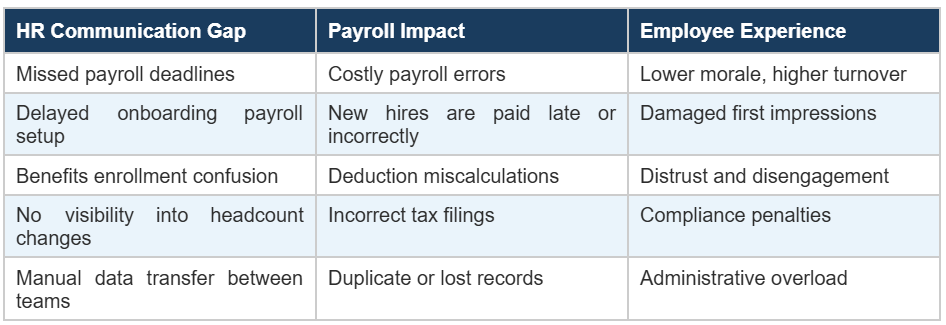
The pattern is consistent: when HR and payroll workflows are siloed, employees notice. The result is frustration, distrust, and ultimately, turnover that could have been avoided.
The Business Case for HR and Payroll Integration
Investing in HR and payroll integration is not just about fixing errors. It is about creating a foundation of trust and efficiency that makes your organization a place people want to stay.
1. Faster Onboarding, Stronger First Impressions
Integrated HR and payroll systems allow new hire data to flow automatically from the offer letter through to the first paycheck. No duplicate data entry, no missed setup steps, and no awkward conversation with a new employee about why their first direct deposit did not come through. A smooth onboarding payroll experience sets the tone for the entire employment relationship.
2. Fewer Payroll Errors, Higher Employee Satisfaction
When HR systems and payroll platforms share data in real time, the risk of errors caused by manual data transfers drops significantly. Employees receive accurate paychecks on time, every time. And when employees trust that their pay is correct, they can focus on their work instead of auditing their pay stubs.
3. Benefits Administration Without the Confusion
Benefits are one of the most powerful retention tools available to employers, but only if employees understand and trust them. HR and payroll alignment ensures that benefits elections are accurately reflected in payroll deductions, eliminating the confusion that leads to disengagement. When employees see that their 401(k) contributions, health premiums, and FSA deductions match what they signed up for, they feel taken care of.
4. Real-Time Visibility for Smarter HR Decisions
When HR teams have visibility into payroll data, they can identify compensation inequities before they become a retention risk. They can see patterns in overtime costs, track headcount against budget, and make data-driven decisions about when to promote, when to hire, and where turnover risk is highest. This kind of strategic visibility is only possible when HR and payroll are working from a shared system.
5. Compliance That Protects the Whole Organization
U.S. payroll compliance is complex and constantly evolving. Federal, state, and local tax requirements, wage and hour laws, leave mandates, and benefits regulations all require coordination between HR policy and payroll execution. When HR and payroll teams are aligned and using integrated systems, compliance is built into the workflow rather than bolted on after the fact.
| PayProNext Advantage PayProNext's unified platform connects HR data and payroll processing in real time, so changes made in HR automatically flow to payroll. No manual handoffs, no data gaps, no compliance surprises. |
HR and Payroll Collaboration Best Practices for 2026
Achieving true HR and payroll alignment requires more than buying the right software. It requires intentional process design, clear ownership, and a culture of communication between teams. Here is how leading U.S. employers are doing it.
Establish a Regular HR-Payroll Sync Cadence
HR and payroll teams should meet at least bi-weekly to review upcoming changes: new hires, terminations, promotions, leave adjustments, and open positions. A structured cadence prevents last-minute surprises and ensures that payroll processing is always based on up-to-date HR data.
Use a Single Source of Truth for Employee Data
One of the most common causes of payroll errors is duplicate or inconsistent employee records across HR and payroll systems. Implementing a unified HRIS that serves as the single source of truth for all employee data eliminates this problem. When a manager updates an employee's job title or salary in the HR system, that change should automatically populate in payroll, not require a separate email or spreadsheet update.
Document Clear Handoff Protocols
Every HR action that affects payroll should have a documented protocol. When does HR notify payroll about a new hire? How much lead time is required before a pay change takes effect? Who is responsible for processing a termination in the payroll system, and by what deadline? Clear written protocols reduce confusion and create accountability on both sides.
Automate Wherever Possible
Manual processes are the enemy of HR and payroll collaboration. Every manual data transfer is a potential error and a delay. Look for opportunities to automate: automated payroll change requests triggered by HR events, electronic I-9 and W-4 collection during onboarding, and automated benefits deduction updates following open enrollment. The less that humans have to manually move data between systems, the more accurate and efficient your HR payroll workflow will be.
Train Both Teams on the Other's Workflow
HR professionals do not need to become payroll experts, and payroll administrators do not need to master HR strategy. But a basic understanding of how the other team's work is impacted by their own decisions goes a long way. Cross-training sessions and shared documentation help both teams recognize when they need to loop in the other, preventing the kind of siloed decision-making that leads to errors.
Build Feedback Loops into the Process
When payroll errors do occur, HR should be part of the post-mortem. When HR makes a policy change that creates a payroll compliance issue, payroll should have a formal way to flag it. Feedback loops between teams create continuous improvement and prevent recurring problems.
How Payroll Accuracy Directly Supports HR Retention Strategies
Your HR team can invest in the best engagement programs, the most generous benefits packages, and the most thoughtful recognition initiatives. But if payroll is getting it wrong, none of it matters.
Payroll accuracy is the foundation that every other retention strategy is built on. Here is why:
- Employees who experience payroll errors are significantly more likely to start a job search, even if they otherwise like their employer.
- Paycheck transparency, including clear breakdowns of gross pay, deductions, and net pay, increases employee trust and reduces payroll-related HR inquiries.
- On-time, accurate pay is consistently ranked in the top three factors in employee satisfaction surveys, often ahead of traditional engagement perks.
- Payroll errors disproportionately affect hourly and lower-wage workers, making accuracy a key element of equitable compensation and retention.
When payroll gets it right, HR's retention efforts get amplified. When payroll gets it wrong, even the best HR programs cannot compensate.
What to Look for in an HR Payroll Integration Platform
If your HR and payroll teams are still operating in separate systems with manual data transfers between them, it is time to evaluate an integrated solution. Here is what to look for:
- Real-time data synchronization between HR and payroll modules
- Automated payroll change requests tied to HR events like hires, terminations, and promotions
- Built-in compliance updates for federal and state payroll tax changes
- Employee self-service for W-4 updates, direct deposit changes, and pay stub access
- Benefits administration integration with automatic payroll deduction updates
- Audit trails and approval workflows for payroll changes
- Reporting that gives HR visibility into compensation data and payroll costs
The right platform does not just reduce administrative burden. It creates the infrastructure for a more cohesive employee experience from day one through the entire employment lifecycle.
| Is Your HR and Payroll Integration Costing You Talent? If your HR and payroll teams are still relying on email, spreadsheets, or disconnected systems to share information, you are carrying unnecessary risk. Every manual handoff is a potential error, and every payroll error is a potential resignation. The question is not whether you can afford to invest in HR and payroll integration. It is whether you can afford not to. |
Final Thoughts: Make HR and Payroll Work as One
Employee retention is one of the most pressing challenges facing U.S. employers in 2026. Competitive compensation, flexible work arrangements, meaningful benefits, and a strong culture all play a role. But the foundation of retention is trust, and trust starts with getting the basics right.
When your HR and payroll teams are aligned, communicating proactively, and working from a shared platform, employees feel it. They notice when their paychecks are accurate.
They notice when their benefits deductions make sense. They notice when a promotion results in an immediate pay adjustment. And they notice when the organization can handle the administrative basics with competence and care.
HR and payroll collaboration is not a back-office concern. It is a front-line retention strategy. And for companies that get it right, the payoff is real: lower turnover, lower replacement costs, higher engagement, and a workforce that trusts its employer.
PayProNext was built to make that alignment seamless. Our integrated HR and payroll platform gives your teams the tools, visibility, and automation they need to work together, stay compliant, and keep your best people.
| Ready to Align Your HR and Payroll Teams? PayProNext gives HR and payroll teams a unified platform to collaborate, stay compliant, and keep their best employees. Schedule a Free Demo Today | www.paypronext.com |