


How Employee Benefits and Leave Policies Affect Retention
Date Released
16 June, 2026
Why Benefits & Leave Policies Matter More in 2026
The American workforce has fundamentally changed. The pandemic reshaped what employees expect from their employers, and those expectations have not reverted. In 2026, benefits and leave policies are no longer perks. They are prerequisites.
Today's employees, especially Millennials and Gen Z, who now make up the majority of the U.S. labor force, evaluate job offers based on the full compensation package, not salary alone. Work-life balance, mental health support, paid parental leave, and flexible schedules rank among the top factors driving job satisfaction and loyalty.
At the same time, the job market remains highly competitive. High-performing employees have options. Companies that fail to offer meaningful benefits and fair leave policies will continue to lose talent to competitors who do. The question is no longer whether you can afford to invest in benefits; it is whether you can afford not to.
The Link Between Employee Benefits and Retention
Research consistently shows that employee benefits are one of the most powerful predictors of retention. According to the Society for Human Resource Management (SHRM), 60% of employees say benefits are a critical factor in their overall job satisfaction. When employees feel financially secure and personally supported, they stay longer, perform better, and become advocates for their organization.
Financial Security: Health Insurance, Life Insurance, and Bonuses
Financial stress is one of the leading causes of employee disengagement and turnover. Employees who worry about medical bills, retirement savings, or unexpected expenses cannot fully focus at work. Benefits that provide financial security, including health insurance, life insurance, disability coverage, and performance bonuses, directly reduce that stress. Employees who feel financially protected by their employer are far more likely to remain loyal, even when competing job offers arrive.
Work-Life Balance PTO and Flexible Leave
Work-life balance is no longer a bonus; it is a baseline expectation. Generous paid time off (PTO) and flexible leave policies tell employees that the company respects their lives outside of work. Employees who can take vacations without guilt, recover from illness without financial penalty, and take parental leave without jeopardizing their careers are significantly more engaged and less likely to leave.
Employee Satisfaction and Loyalty
Satisfied employees are retained. Benefits that address real-life needs, from dental coverage to childcare assistance to mental health support, signal that an employer genuinely cares about its workforce. This creates emotional loyalty that goes beyond paycheck size. Employees who feel cared for are more likely to go above and beyond in their roles, recommend their employer to others, and weather organizational challenges without jumping ship.
Employer Branding
In a digital world, a company's benefits package is public knowledge. Employees share reviews on platforms like Glassdoor and Indeed, and a reputation for poor benefits spreads fast. Conversely, companies known for strong benefits and fair leave policies attract better candidates, spend less on recruitment, and build a workforce that is engaged from day one.
| Real-World Example: A mid-size marketing firm in Austin, Texas, began offering unlimited PTO, monthly mental wellness stipends of $100, and 12 weeks of fully paid parental leave. Within 18 months, voluntary turnover dropped from 22% to just 9%, and employee satisfaction scores rose by 34%. The total cost of the benefit upgrades was less than half the cost of recruiting and onboarding the employees they had previously lost. |
How Leave Policies Directly Impact Employee Retention
Leave policies are often where the disconnect between employer intention and employee experience is most visible. Even companies that offer generous health benefits can lose employees over rigid or punitive time-off policies. Here is how different types of leave affect retention:
Paid Time Off (PTO)
PTO is one of the most valued benefits in the American workplace. Employees who can take paid vacation days to recharge return more productive, more creative, and more engaged. Companies that offer below-average PTO or that create cultures where time off is discouraged experience higher burnout and faster turnover. The national average is 10-15 days per year, but leading employers now offer 15-20+ days to stay competitive.
Sick Leave
Adequate sick leave protects employees and their colleagues. When employees do not have sufficient sick leave, they come to work ill, reducing their own productivity while spreading illness across the team. Worse, employees who exhaust sick days face financial hardship, which fuels resentment and accelerates departure decisions. Paid sick leave is not just a retention tool; it is a public health and productivity investment.
Parental Leave
Parental leave policies have become a major differentiator in the talent market, particularly for employees in their 30s and 40s who are starting or growing families. Companies that offer generous paid parental leave, both maternity and paternity, signal that they support employees through life's most important milestones. Those that offer minimum or no parental leave frequently lose high-performing employees to competitors who do.
Flexible Leave Policies
Flexibility is the defining benefit of the modern era. Employees increasingly value the ability to work remotely, adjust their hours for medical appointments, attend a child's school event, or take a mental health day without burning through their vacation bank. Flexible leave policies reduce employee stress, build trust between employer and employee, and significantly decrease voluntary turnover.
Types of Employee Benefits That Improve Retention
Not all benefits are created equal when it comes to retention. The most impactful are those that address employees' real, daily needs:
- Health Insurance: Comprehensive medical, dental, and vision coverage remains the single most valued employee benefit in the United States. Covering a meaningful portion of premiums for employees and their families is one of the highest-ROI investments an employer can make.
- Retirement Plans: A 401(k) with employer matching signals long-term investment in employees' financial futures. Employees who see their employer contributing to their retirement are more likely to envision a long-term future with the company.
- Performance Bonuses: Tying compensation to performance creates a sense of shared success. Discretionary bonuses, spot awards, and annual performance bonuses keep employees motivated and financially engaged with company outcomes.
- Flexible Work Options: Remote work, hybrid schedules, compressed workweeks, and flexible start times have shifted from perks to baseline expectations. Companies that restrict flexibility without a strong justification face an uphill battle in retention.
- Wellness Programs: Employee Assistance Programs (EAPs), gym memberships, mental health apps, therapy stipends, and mindfulness programs address the holistic well-being of employees. A healthy, mentally well employee is a retained and productive employee.
Common Mistakes Employers Make with Benefits & Leave Policies
Even well-intentioned employers frequently undermine their own retention efforts through avoidable benefits missteps:
- Limited PTO: Offering fewer than 10 days of PTO annually is a red flag for candidates and a frustration for existing employees. It signals that the company does not value recovery and work-life balance.
- Unclear Policies: Vague or inconsistently applied leave policies breed resentment. When employees are unsure what they are entitled to or fear repercussions for taking leave, they disengage or leave.
- No Flexibility: Rigid 9-to-5 requirements without a valid operational necessity signal distrust and disrespect for employees' lives outside the office. Flexibility is one of the lowest-cost, highest-impact retention tools available.
- Poor Communication: Benefits are only valuable if employees know about them and understand how to use them. Many companies invest in strong packages but fail to communicate them effectively during onboarding, open enrollment, or day-to-day management.
- Inequitable Benefits: When benefits differ significantly between employee tiers, particularly between executives and frontline staff, it creates resentment and a sense of being undervalued that drives voluntary turnover.
The Hidden Cost of Poor Benefits & Leave Policies
Companies that underinvest in benefits and leave policies frequently underestimate the financial consequences. The true cost of poor benefits shows up in several places:
- High Employee Turnover: Replacing an employee costs between 50% and 200% of their annual salary when you factor in recruiting, onboarding, training, and lost productivity. Companies with poor benefit packages face chronic, expensive turnover cycles.
- Low Morale and Engagement: Employees who feel undervalued disengage. Disengaged employees are 18% less productive and 37% more likely to call in sick, according to Gallup research. Low morale spreads one disengaged employee can negatively affect an entire team.
- Reduced Productivity: Burned-out employees who cannot take adequate time off work at diminished capacity. Presenteeism, showing up to work while ill or exhausted, costs U.S. employers an estimated $226 billion per year.
- Higher Recruitment Costs: A reputation for poor benefits makes recruiting harder and more expensive. Top candidates will choose competitors with better packages, forcing companies to either pay compensation premiums or settle for lower-quality hires.
Best Practices to Improve Retention Through Benefits
The most effective retention strategies through benefits are both competitive and intentional:
- Offer Competitive Benefits: Benchmark your benefits package against industry peers at least annually. Use resources like the Bureau of Labor Statistics (BLS) Employer Benefits Survey and SHRM data to understand what competing employers offer in your sector and region.
- Provide Flexible Leave Policies: Adopt leave structures that trust employees to manage their time responsibly. Unlimited PTO with clear usage guidelines, flexible scheduling, and mental health days communicates respect and trust.
- Communicate Policies Clearly: Write your benefits and leave policies in plain English. Train managers to discuss benefits confidently with their teams. Include benefits information in onboarding, offer letters, and annual reminders.
- Regularly Review Benefits Packages: Employee needs change. Survey your team annually to understand which benefits they value, which they do not use, and what gaps exist. Adjust your offerings accordingly. Benefits reviews demonstrate that the company is actively listening.
- Personalize Employee Benefits: Consider offering a cafeteria-style benefits plan that lets employees allocate a set dollar amount toward the benefits they value most, whether that is additional PTO, dental coverage, childcare assistance, or student loan repayment.
How Payroll Systems Support Benefits & Leave Management
Even the most thoughtfully designed benefits and leave policies will fail without reliable systems to manage them. This is where payroll technology becomes a retention tool in its own right.
- Track PTO Accurately: Employees need to know exactly how much PTO they have, how much they have used, and how much is accruing. A modern payroll platform like PayProNext provides employees and managers with real-time PTO visibility, eliminating confusion and disputes.
- Manage Deductions Transparently: Health insurance premiums, retirement contributions, and HSA deductions must be accurate and clearly itemized on every paycheck. PayProNext automates deduction management, so employees see exactly where their money is going, building trust and reducing payroll inquiries.
- Ensure Compliance: Leave policies must comply with federal laws (FMLA, ADA), state laws (California CFRA, New York Paid Family Leave), and local ordinances. PayProNext keeps your payroll and leave tracking compliant with current regulations, reducing your risk of costly penalties.
- Improve Transparency: Employees who have 24/7 access to their pay stubs, benefits information, PTO balances, and tax documents feel more in control of their financial lives. PayProNext's employee self-service portal puts that information in every employee's hands, on any device.
| PayProNext Advantage: PayProNext integrates payroll processing, benefits administration, and leave tracking into a single platform so HR teams spend less time managing spreadsheets and more time building the people strategies that drive retention. |
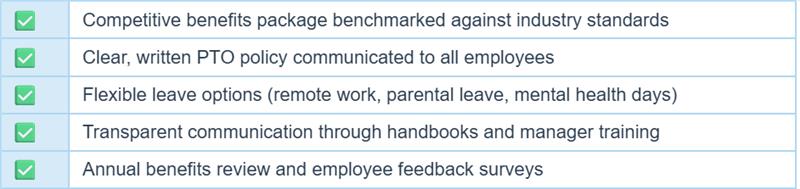
Employee Benefits & Leave Policy Checklist
Use this checklist to evaluate your current offerings and identify gaps:
Real Business Scenarios
These scenarios illustrate how benefits and leave policy decisions play out in real workplaces:
Scenario 1 — Limited PTO Leads to Burnout and Resignation:
A software developer at a 50-person tech company had been delivering strong results for three years. Despite multiple requests, the company maintained a strict 10-day PTO cap with no rollover. After a demanding product launch with no recovery time, the developer burned out, quietly started job searching, and accepted an offer from a competitor offering 20 days PTO and a flexible remote schedule. The company spent $28,000 recruiting, hiring, and training a replacement, more than four times the cost of upgrading the entire team's PTO allowance.
Scenario 2 — Flexible Benefits Drive High Retention:
A regional healthcare staffing firm with 120 employees introduced a flexible benefits package in 2024, allowing employees to choose from enhanced PTO, student loan repayment assistance, a wellness stipend, or additional retirement matching. Voluntary turnover dropped from 31% to 14% in the first year. Employee satisfaction survey scores jumped 28 points. The company attributed the change directly to giving employees autonomy over their own benefits mix.
Frequently Asked Questions
How do employee benefits affect retention?
Benefits directly influence an employee's decision to stay. According to SHRM, 60% of employees cite benefits as a major factor in job satisfaction. Competitive packages reduce turnover and improve morale, productivity, and loyalty.
What leave policies improve retention?
Paid time off (PTO), parental leave, mental health days, and flexible scheduling are the most impactful. Policies that respect employees' personal lives signal that the company values them as people, not just workers.
How much PTO is ideal?
The average U.S. employer offers 10–15 days of PTO after one year of service. However, leading companies now offer 15–20+ days or even unlimited PTO. The key is that time off is genuinely encouraged and not penalized.
Do benefits really reduce turnover?
Yes. Studies consistently show that companies with strong benefits packages experience 30–50% lower voluntary turnover. The cost of replacing an employee can reach 50–200% of their annual salary, making benefits a smart financial investment.
How can small businesses offer better benefits?
Small businesses can compete by offering flexible work arrangements, additional PTO, mental wellness stipends, and transparent career growth paths, even without enterprise-level budgets. Strategic benefits selection matters more than volume.
Final Thoughts
The evidence is clear: employee benefits and leave policies are not administrative line items; they are strategic retention investments. Companies that treat them as costs to minimize will continue to struggle with turnover, disengagement, and the hidden financial consequences that follow.
The most successful employers in 2026 understand that flexibility is a retention driver, not a concession. Competitive benefits are a recruiting advantage. And transparent, well-managed payroll and leave systems are the operational foundation that makes everything else work.
If you are ready to stop losing great employees over preventable benefits and leave policy gaps, the first step is putting the right systems in place.
| Ready to Streamline Your Benefits & Leave Management? PayPronext helps businesses track PTO, automate deductions, ensure compliance, and give employees full visibility into their benefits, all in one platform. Get a Free Demo | Visit www.paypronext.com |