


Georgia Gig Economy Payroll 2026: How to Pay Freelancers Legally
Date Released
08 April, 2026
Hiring freelancers in Georgia is easier than ever, but paying them legally in 2026 is where most businesses slip up. One small mistake in classification or tax reporting can lead to penalties, audits, and compliance headaches. In Georgia, many organizations are looking for opportunities to cooperate with freelance experts, independent contractors, and other gig workers who can help them to stay flexible, cut back on expenses, and find the best experts.
While the gig economy payroll offers many benefits, it also requires careful attention. It is necessary to adhere to the laws and regulations in order to pay gig workers according to the requirements. Otherwise, one risks being involved in audits and facing serious consequences, which makes the need to learn how to pay Georgia freelancers legally essential.
The Growing Importance of Freelancers in 2026
Freelancers have now become a part of the corporate world. They help in scaling up business without entering into any employment agreement. They prove to be beneficial for those businesses where there is a need for temporary workers in the form of projects or during certain seasons.
However, the management of payroll becomes difficult when the business includes freelancers. Since they do not qualify as payroll employees, businesses are supposed to adopt new strategies in Georgia for payroll management of freelancers.
There can be many complications for businesses that ignore the issue, but it becomes easy by treating freelancers as a process.
For example, a small marketing agency can hire freelance designers per project instead of maintaining a full-time team, reducing overhead costs significantly.
Understanding Worker Classification
Classification accuracy is the key to proper payments to contractors. Any person who should be paid by a company needs to be classified as either an independent contractor or an employee before payment.
The IRS classifies workers according to behavior, financial control, and the nature of the relationship. A simple rule: if you control how the work is done, you're likely dealing with an employee, not a freelancer. Where the company controls how, when, and where the work is done, the worker could be regarded as an employee. Freelancers, on the other hand, conduct their business on their own terms, using their own tools, and working according to their schedule.
Incorrect classification is among the most common problems in the independent contractor payroll system in the US. It results in penalties, interest, and possible legal problems. For companies managing gig economy tax rules in Georgia, classification is vital.
Building a Compliant Freelancer Payment System
Once the classification process has been completed, there has to be a system of handling payments. Although freelancers do not get handled like regular employees, they do require some kind of process for payments.
Step 1: Sign a contract: First, there has to be a written contract detailing the nature of the work and payment details. Contracts can help avoid any issues in the future regarding the payments.
Step 2: Collect W-9: Secondly, there has to be a gathering of Form W-9 from freelancers. Form W-9 contains the necessary tax information on the freelancer, such as the Taxpayer Identification Number. Gathering it helps in fulfilling the requirements of the freelance payment laws in the US.
Step 3: Choose payment method: Finally, a method of payment should be selected. Payments should be sent through traceable means to ensure that everything works efficiently and that records of payment are clear and easy to find.
Skipping any of these steps can create compliance risks later.
1099-NEC Filing Requirements Explained
One of the critical things that businesses need to know in 2026 is Form 1099-NEC. You are required to file this form if you make payments of $2,000 or more to a freelancer in a calendar year. This threshold was increased from $600 (for 2025) to $2,000 starting in 2026 under the One Big Beautiful Bill Act and will be adjusted for inflation in future years. This document reports nonemployee compensation. Missing the January 31 deadline can still result in IRS penalties, especially when managing multiple contractors.
Tax Responsibilities in Georgia
Among the major advantages of employing freelancers, lower tax liability stands out. As opposed to employees who receive wages from the company, freelancers bear the burden of taxation by themselves, which includes self-employment tax and income tax.
In other words, employers will be relieved of the necessity to retain taxes and make employer payments. Nevertheless, this does not mean that the employer bears no responsibility. On the contrary, reporting obligations should still be fulfilled according to Georgia payroll taxes for freelancers’ requirements.
Employee vs Freelancer: A Clear Comparison
The knowledge of the distinction between employees and contractors is key to avoiding any complications that might arise.
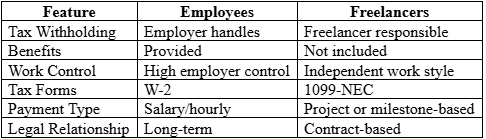
The table serves to bring out the essence of the distinction between payroll employees and contractors.
Common Challenges in Gig Payroll Management
Even with all regulations in place, there still exist some difficulties that companies face in making Georgia gig worker payments. First and foremost, maintaining a consistent documentation process while dealing with several freelancers can be quite challenging.
Another problem lies in the misinterpretation of the amount of control over freelancers that the business owner is permitted. The companies can accidentally classify a gig worker as an employee due to certain actions, such as giving him/her a strict work schedule or overseeing their activities.
Finally, many businesses tend to neglect the importance of meticulous record keeping, which can cause serious complications when the need to conduct an audit arises.
Key Compliance Pointers for Businesses
In order to operate smoothly and in accordance with regulatory requirements, businesses should consider these crucial points:
- Clarify the role of the contractor before employing them
- Always sign written contracts for each job
- Request and validate Form W-9 before making any payments
- Make payments through safe and secure payment channels
- Keep accurate transaction records
- Track payments and issue 1099-NEC forms when a freelancer reaches the $2,000 annual threshold in 2026
- Do not control the process of freelancers' work
- Distinguish between freelancer and employee systems
- Regularly review contracts
- Keep track of the new rules by the IRS regarding independent contractors
Best Practices for Managing Freelancer Payroll
An efficient onboarding process for freelancers will minimize compliance risks. A systematic approach to onboarding means that all freelancers undergo the same stages of the process from contract signing until tax documentation.
The use of technology can make the payment of freelancers easier and less risky. Automation may be used for payment tracking and reporting, as well as preparing tax forms, reducing mistakes due to manual processes.
It is also important to audit the processes related to working with freelancers regularly. This includes checking the contract, payments, and the classification of contractors.
Avoiding Payroll Mistakes
Errors in the payment process for contractors can prove to be very expensive. The most significant error to avoid is misclassification. This is followed by failure to submit 1099 forms and inadequate record-keeping.
The third error to look out for is using the same payroll system for employees and freelancers. It is advisable to use different payroll systems for this reason.
Lastly, not keeping up with changes in the law could be detrimental to your business operations. This makes it vital to update yourself regularly.
The Future of Gig Economy Payroll
Going forward, the gig economy is expected to continue its growth trajectory, with regulations becoming more stringent and refined. Governments are increasingly focusing on issues such as transparency, classification of workers, and tax requirements.
In that regard, it will be important for Georgia-based companies to take proactive steps, such as investing in processes, training, and compliance solutions aimed at ensuring effective management of freelancer payroll in Georgia.
Conclusion
The issue of Georgia's gig economy payroll in 2026 requires strategic thinking and proper regulation of all actions performed by your company. This includes everything from the correct classification of workers to completing all necessary 1099-NEC forms.
Taking into account all of these factors can help you successfully deal with all challenges related to Georgia's gig economy payroll. Understanding how to pay your freelancers according to the law can save your business from various penalties and legal troubles while fostering professionalism and trust between you and your freelancers.
Stop worrying about freelancer compliance. With PayProNext, you can automate payments, handle 1099 filings, and stay fully compliant, without the stress. Get started today.