


Form W-9 Explained: How to Collect Contractor Information the Right Way (2026 Guide)
Date Released
01 April, 2026
Hiring contractors without collecting the right tax information can lead to reporting errors, IRS penalties, and unnecessary delays during tax season. Form W-9 plays a critical role in helping businesses collect accurate contractor details and stay compliant from the start.
This 2026 guide covers everything you need to know about Form W-9, what it is, when to request it, how to complete it, and best practices for collecting contractor information correctly.
What Is Form W-9?
Request for Taxpayer Identification Number and Certification, also referred to as Form W-9, is a form that is utilized by companies to obtain the necessary information about taxes to individuals or organizations they make payments to.
Form W-9 enables businesses to obtain the correct information needed to provide it during tax reporting.
The Form W-9 usually consists of the following:
- Legal name of business or contractor.
- Business entity type
- Address
- Taxpayer Identification Number (TIN)
The information is then utilized to complete tax reporting forms, including the Form 1099-NEC.
Why Is Form W-9 Important?
The significance of the W-9 form is not just data collection. It is essential to ensure that there is compliance with taxes and the prevention of penalties.
The reason is as follows:
- Accurate Contractor Tax Reporting: This helps ensure accurate payment reporting to contractors
- Avoids IRS Penalties: Failure to do this might result in IRS penalties, especially if there is a lack of information
- Supports Compliance: This helps in ensuring compliance with federal tax laws
- Streamlines Vendor Information Collection: This helps in standardizing how contractor information is collected
If your business does not have a properly filled-out W-9, there might be delays and problems during tax time.
What Is a Taxpayer Identification Number (TIN)?
The Internal Revenue Service uses a Taxpayer Identification Number (TIN), a unique number used to track tax records.
Depending on the contractor, the TIN may be:
- Social security number (SSN): Individual and sole proprietors.
- EIN (Employer Identification Number): For businesses
This number should be accurate to avoid this mismatch and reporting problems with the IRS.
When to Request a W-9 Form
The understanding of the appropriate time that businesses need to seek a W-9 form is crucial in streamlining the contractor onboarding process.
You should request a W-9:
- Before making the first payment
- When working with contractors
- When working with new vendors or freelancers
- Before making agreements or contracts
Waiting too long could cause problems when tax time comes around, especially if contractors do not respond in a timely manner.
W-9 Filing Requirements (2026)
Unlike other IRS forms, the Form W-9 does not have to be sent to the IRS. Instead, the contractor completes the form, the business keeps it on hand, and uses the information to complete tax forms. However, businesses must also ensure they have accurate and current information on hand, use the information to complete forms such as the Form 1099-NEC, and comply with IRS documentation guidelines. Proper use of the Form W-9 is an integral part of business tax filing.
How to Fill Out Form W-9 (Step-by-Step Guide)
If you are wondering how to fill out Form W-9, the answer is quite simple. Here is a step-by-step guide to help contractors complete the form accurately.
- Step 1: Enter Legal Name
- Step 2: Enter Business Name
- Step 3: Select Federal Tax Classification
- Step 4: List Exemptions
- Step 5: Enter Address
- Step 6: Enter TIN
- Step 7: Certify
This step-by-step guide will help contractors fill out the Form W-9 accurately.
How to Collect W-9 Forms from Contractors (2026 Best Practices)
The proper way to collect contractor data is vital to compliance and efficiency.
The following are the best practices for collecting W-9 forms:
- Request Early: Request W-9 forms before payment
- Use Digital Tools: Utilize digital tools to avoid errors
- Verify Information: Verify the TIN and name
- Organize Records: Organize the collected records
- Ensure Security: Encrypt the collected data
These practices help streamline independent contractor onboarding and minimize risks.
Digital vs Paper W-9 Forms
Digital collection is becoming the standard approach for dealing with W-9 forms in 2026.
Digital Advantages:
- Faster processing
- Reduces manual errors
- Safe storage
- Simplified retrieval
Paper Drawbacks:
- Prone to loss/damage
- Errors in manual data entry
- More difficult to manage
For modern businesses, digital collection is an efficient and secure approach for gathering tax information for contractors.
W-9 vs 1099: Key Differences Explained
Understanding the W-9 vs 1099 NEC differences explained is essential.
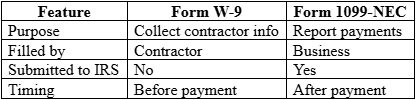
The W-9 is the foundation, and the 1099 is the final report.
Backup Withholding: What Happens If You Don’t Collect a W-9?
If a business doesn’t collect a W-9, backup withholding may be imposed on the business.
This means:
- 24% withholding on the payments made to the contractors
- The business sends this to the IRS
- The contractor is also impacted, as this means a reduction in the payment received
This is why collecting a W-9 is important for a business.
When to Update a W-9 Form
A W-9 is a non-static document and should always be updated whenever:
- The contractor changes name or structure
- The contractor’s address changes
- The contractor’s TIN changes
These are important details that need to be updated to ensure proper tax compliance.
Common W-9 Mistakes to Avoid
Small mistakes, therefore, can result in big problems. Here are some common mistakes:
- Incorrect or missing TINs
- Delayed collections
- Outdated information
- Improper storage of sensitive information
- Misclassification of contractors
By avoiding common mistakes, you will be able to ensure smooth contractor tax reporting.
Contractor Onboarding Tax Compliance Checklist
To help streamline your process, use this checklist:
- Collect completed Form W-9
- Verify TINs and legal name
- Store W-9 information
- Track payments
- Prepare and file Form 1099-NEC if required
This will ensure that you are fully compliant.
How to Securely Store W-9 Information
Form W-9 has sensitive information, and therefore, proper storage is crucial.
Best practices:
- Encrypt W-9 information
- Control access
- Not sharing W-9 information via unencrypted email
- Regularly auditing W-9 information
Secure storage will help your business and your contractors.
IRS Rules for W-9 Form Collection
The Internal Revenue Service demands that businesses comply with:
- Accurate collection of taxpayer information
- Record storage for audit purposes
- Proper data utilization for tax purposes only
Failure to comply may attract a penalty or additional withholding.
How W-9 Forms Fit into Contractor Tax Reporting
The W-9 Form is an integral part of contractor tax reporting. Here's how it works:
- Submission of W-9 Form by Contractor
- Verification and storage of W-9 Form by Business
- Tracking of Payments
- Submission of Form 1099-NEC
This process guarantees smooth contractor tax reporting.
Final Thoughts
Understanding Form W-9 is a must-know concept for all businesses that utilize contractors in the course of their operations. From the collection of accurate taxpayer identification numbers to the proper storage of these numbers, all processes are critical in the maintenance of compliance.
In conclusion, all processes are critical in the maintenance of compliance, and all processes can be made easier by observing the best practices, avoiding the common mistakes, and keeping the process highly organized.
Simplify W-9 Collection with PayProNext 🚀
Collect, verify, and store contractor W-9 forms effortlessly with PayProNext. Automate onboarding, reduce errors, and stay compliant, without the manual hassle. Focus on growing your business while PayProNext handles the paperwork.