

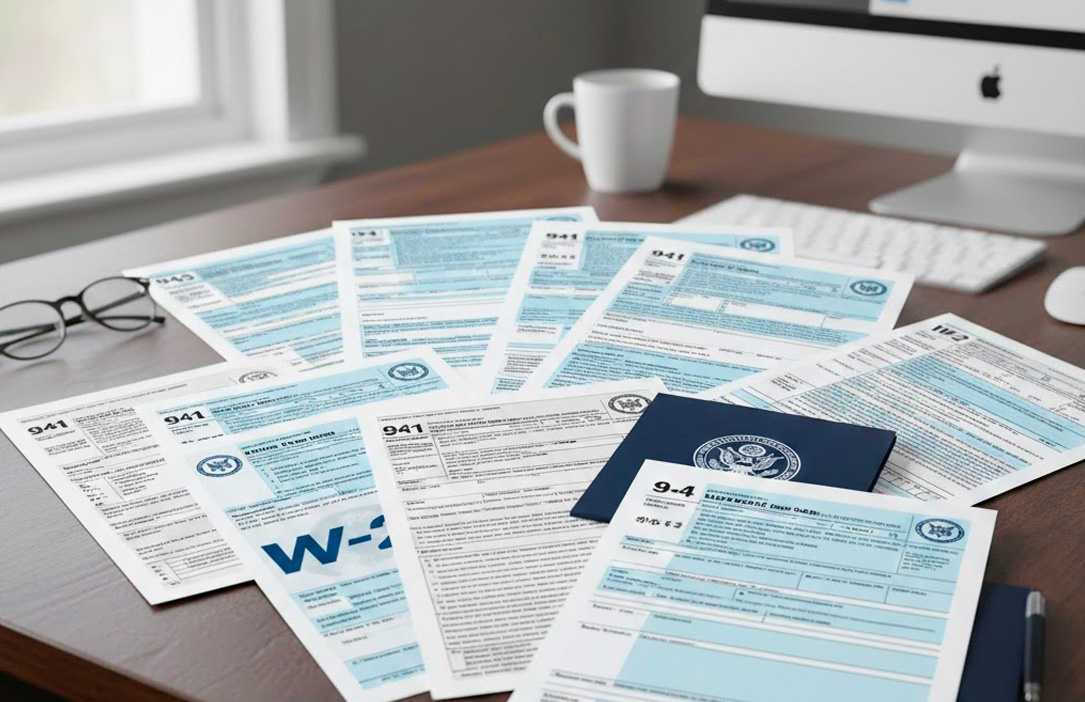
9 Essential IRS Payroll Forms Every Small Business Employer Should Know (2026 Guide)
Date Released
22 December, 2025
Payroll taxes are one of the most crucial tasks of a small business owner to handle. Although the initial step of payroll paperwork may be overwhelming, each IRS form has its purpose. Understanding what each form is, when to use it, and how many times it is needed might help you to prevent penalties and remain in compliance.
This guide simplifies the significant IRS payroll forms that small business employers might require in 2026 and elaborates on them in an understandable vocabulary, with the details you can put into practice.
1. Form SS-4: Application for Employer Identification Number (EIN)
The IRS must be able to identify your business before it can hire employees or payroll. That’s where Form SS-4 comes in. This is typically the first payroll-related step of any employer.
- Why it matters: You will not be able to remit payroll taxes, hire workers, or open most business bank accounts without an EIN.
- When to file: When you are starting your business, or you are hiring your first employee.
2. Form W-4: Employee’s Withholding Certificate
Each employee is taxed differently. Form W-4 enables employees to inform you about the amount of federal income tax that should be deducted out of his paycheck. It is your responsibility as an employer to collect and store this form in an appropriate manner.
- Employer responsibility: When a new employee is hired, they must complete a W-4 before receiving wages.
- 2026 context: Always use the latest IRS W-4 form, as federal withholding rules may change from year to year.
- Recordkeeping: Keep each W-4 on file for at least four years after the tax is due or paid, whichever is later.
Form W-4: IRS W-4 Form
3. Form W-2: Wage and Tax Statement
The employees require an end-of-year report showing what they got and what tax was deductible. It is one of the most common payroll forms that contains this information, such as Form W-2.
- Who files it: The employers have to submit a copy to every employee and also send a copy to the Social Security Administration (SSA).
- Deadline: January 31 of the year following payment of wages.
4. Form W-3: Transmittal of Wage and Tax Statements
When you are sending the W-2s to the government, the IRS and SSA also require you to provide a summary of all such W-2s. Form W-3 is a summary document.
- Paper filers: When it is necessary to submit paper W-2s to the SSA.
- Electronic filing: In case of e-filing of W-2s, the system automatically creates the W-3 data.
5. Form 941: Employer’s Quarterly Federal Tax Return
Form 941 will be encountered by most of the small businesses. This form records the withheld payroll taxes of the employees and taxes that the employer pays to the government.
What it reports: Federal income tax withheld, plus employee and employer portions of Social Security and Medicare taxes.
Due dates:
- April 30
- July 31
- October 31
- January 31
Important: The share of both the employee and the employer for the social security and Medicare tax should be reported.
Form 941: IRS Form 941
6. Form 944: Employer’s Annual Federal Tax Return
Some quite small employers do not have to submit payroll tax forms every quarter. Rather, the IRS can permit them to file only once annually, with the help of Form 944.
- Eligibility: This form may be assigned by the IRS in case of an annual payroll tax liability of less than 1,000 dollars.
- Key rule: Only very small employers with an annual payroll tax liability of $1,000 or less may be assigned by the IRS to file Form 944 instead of Form 941. Employers cannot choose to file Form 944 unless approved by the IRS.
- Filing frequency: Annual as compared to quarterly.
7. Form 940: Employer’s Annual Federal Unemployment (FUTA) Tax Return
Unemployment tax assists in financing unemployment benefits to the workers who lose employment. This tax is an employer-only tax that is reported and computed on Form 940.
Who must file: Most employers who:
- Those who pay over $1,500 in wages during any calendar quarter or employ at least one worker for any part of 20 or more weeks during the year must file Form 940.
Deadline: January 31 (February 10 if all FUTA taxes were deposited on time).
8. Form 1099-NEC: Nonemployee Compensation
Not all of your working staff are employees. In case you make payments to freelancers or independent contractors, you report such payments through Form 1099-NEC.
- Reporting threshold: A report is required when the amount paid to a non-incorporated service provider during the year exceeds $600.
- Deadline: January 31.
- Critical warning: Mishandling of employees as contractors is a frequent reason why the IRS audits and imposes penalties.
Form 1099-NEC: IRS Form 1099-NEC
9. Form 8027: Employer’s Annual Information Return of Tip Income and Allocated Tips
In some businesses, particularly in the food service industry, tipped income is involved. The IRS needs more reporting that will make sure that tips are adequately tracked and taxed.
- Who must file: Large food or beverage establishments that offer drinks or food to be eaten on the premises, and usually have over 10 employees on an average working day, even part-time employees.
- Purpose: Reports gross receipts, charged tips, and allocated tips.
Understanding Payroll Tax Deposit Schedules
Submission of payroll forms is not the end of compliance. The employers should also pay the taxes withheld on time. Your deposit plan relies on the amount of payroll tax that you submitted in previous periods.
- Monthly depositor: If your total payroll tax liability in the previous four-quarter lookback period was $50,000 or less.
- Semi-weekly depositor: If your total payroll tax liability in the previous four-quarter lookback period exceeded $50,000.
The lookback period refers to the four quarters ending on June 30 of the previous year. Deposit deadlines depend on whether you are monthly or semi-weekly.
Common Payroll Reporting Mistakes to Avoid
Payroll errors are universal, particularly for expanding businesses. It is wise to know what to be cautious about in order to escape expensive fines.
- Missing deadlines: Late filings or deposits result in penalties and interest.
- Incorrect employee data: The employee data has to be identical to SSA records (name and Social Security number).
- Ignoring state requirements: The majority of states have their own payroll and unemployment reporting regulations.
The Best Way to Organize Payroll Forms
In case your team is expanding, managing payroll manually becomes risky and time-consuming. Most employers resort to online resources or expert assistance to remain in compliance.
The payroll systems and services can:
- Automatic calculation of taxes.
- File forms electronically
- Track deadlines and deposits
This minimizes mistakes, and time is saved to run your business.
Summary Checklist for 2026 Payroll Compliance
| Form |
Purpose |
Filing Frequency |
| SS-4 |
Obtain EIN |
Once |
| W-4 |
Employee withholding |
Upon hire |
| W-2 |
Employee wage reporting |
Annual |
| W-3 |
W-2 transmittal |
Annual |
| 941 |
Federal payroll taxes |
Quarterly |
| 944 |
Annual payroll taxes (IRS-approved) |
Annual |
| 940 |
FUTA tax |
Annual |
| 1099-NEC |
Contractor payments |
Annual |
| 8027 |
Tip income reporting (if applicable) |
Annual |
It is not necessary to get confused with managing payroll. With the knowledge of the forms you need to complete with the IRS based on your business and keeping up on deadlines, you save your company, your employees, and your finances, and you save yourself the stress that is not necessary.
Important Compliance Notice
The instructions in the IRS rules, Forms, and filing instructions can be revised on a regular basis. It is general information content applicable to general informational purposes and applicable to current federal payroll requirements. Business-specific compliance requirements should be addressed by reference to the official IRS publications or with the help of a qualified payroll professional.
Frequently Asked Questions (FAQ) About Payroll Forms
Q1: Do all businesses need Form 8027?
No. Form 8027 will be required only of large food or beverage facilities that typically have over 10 employees working a typical business day. Your business does not belong to this category and, therefore, you do not have to file it.
Q2: Can I choose to file Form 944 instead of Form 941?
Not automatically. Very small employers (annual payroll tax liability of $1,000 or less) can only receive the Form 944 assigned to them by the IRS. You do not have the option of opting in unless it was approved by the IRS.
Q3: What happens if I misclassify a contractor as an employee (or vice versa)?
The wrong classification of workers may attract an IRS audit, fines, and retroactive tax. Always confirm the employee/ contractor status and file a 1099 -NEC with an independent contractor that has reached the $600 mark.
Q4: How long should I keep payroll records like W-4s and W-2s?
Retain W-4s and payroll records for a minimum of four years from the time the tax is due or paid, whichever is later. This makes sure that you are in line with the case of auditing your business by the IRS.
Q5: Are payroll forms the same for federal and state taxes?
No. This guideline is based on federal forms. The withholding, unemployment, and reporting requirements of most states vary, and therefore, it is always necessary to check the requirements of your state.