

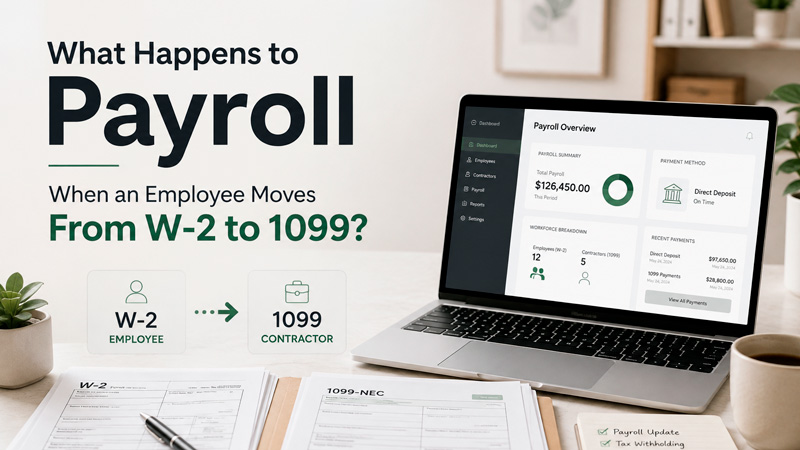
What Happens to Payroll When an Employee Moves From W-2 to 1099?
Date Released
19 August, 2026
A US employer's guide to what changes and what's legally required when a worker shifts from employee to independent contractor.
A team member requests to be paid as a contractor rather than as an employee. A department desires to save money by relocating a position from its payroll. For whatever reason, once a business begins considering a change from W-2 to 1099, payroll becomes complex. Everyone's taxes, benefits, year-end paperwork, and IRS worker classification rules all change simultaneously, and if you get anything wrong, you might be subject to back taxes, penalties, and an IRS audit. This article explains in detail what occurs when an employee transitions from W-2 to 1099 status, what the IRS permits, and how US employers can make the change without adding risk in compliance.
W-2 vs
1099: What Actually Changes on Payroll
The clearest way to see the impact is side by side. Moving a worker from W-2 to 1099 status doesn't just change a form; it changes who is responsible for taxes, benefits, and legal protections.
|
Payroll Factor |
W-2 Employee |
1099 Independent Contractor |
|
Tax withholding |
Employer withholds federal, state, Social Security, and Medicare taxes |
No withholding, contractor pays self-employment tax directly |
|
Year-end tax form |
Form W-2 |
Form 1099-NEC |
|
Payroll taxes (FICA/FUTA) |
Employer pays a matching share |
Employer pays none |
|
Benefits eligibility |
Often eligible for health insurance, PTO, retirement plans |
Not eligible under IRS/DOL rules |
|
Overtime & minimum wage |
Protected under the FLSA |
Not covered by the FLSA |
|
Work control |
Employer sets hours, tools, and methods |
Contractor controls how and when the work gets done |
The short answer: If you are on a W-2 payroll, the employer is responsible for paying and complying with the tax. If the job is classified as contract work in the first place, then that burden falls on the contractor if it happens to be a 1099 payroll.
The IRS
Rules That Decide Whether You Can Make the Switch
Here's the part most employers get wrong: a business cannot simply decide to reclassify a worker from employee to independent contractor. The IRS and the Department of Labor look at the actual working relationship, not the job title or the form used to pay someone. Worker classification comes down to three factors.
Behavioral control
Does the company direct how, when, and where the work gets done? Employees typically follow set schedules and company-provided processes. Contractors decide their own methods and timeline.
Financial control
Does the worker have a real opportunity for profit or loss, use their own equipment, and work for other clients? A worker who is financially dependent on one company, using that company's tools, looks like an employee regardless of pay structure.
Relationship type
Are there employee-type benefits, a permanent or ongoing relationship, and work that is central to the business? A long-term, exclusive, benefits-eligible role rarely qualifies as 1099 work, even after a title change.
If the actual job hasn't changed- same hours, same supervision, same tools- switching the worker from W-2 to 1099 payroll is a misclassification risk, not a legitimate reclassification.
The Payroll
Steps for a Legitimate W-2 to 1099 Transition
When the role genuinely meets the IRS test for independent contractor status, the payroll transition itself follows a fairly standard sequence.
- Stop payroll withholding on the effective date and remove the worker from the W-2 payroll run.
- Issue a final W-2 covering wages paid through the last day of employee status.
- Collect a completed Form W-9 from the worker before the first contractor payment.
- Set up contractor payments outside the tax-withholding payroll process; no federal, state, Social Security, or Medicare tax is withheld.
- Track total payments throughout the year so you can issue Form 1099-NEC for any contractor paid $600 or more.
- Remove the worker from employee benefit plans, since contractors aren't eligible for employer-sponsored health insurance, PTO accrual, or retirement matching.
- Update any state new-hire or contractor reporting required in your state.
Every one of these steps needs to be documented, since payroll records are exactly what the IRS and state labor departments review during a misclassification audit.
What It
Costs to Get Worker Classification Wrong
Failing to do so is one of the most common, and costly, payroll errors a growing business can make—classifying a W-2 employee as a 1099 contractor. In addition to the withheld back taxes and unpaid overtime (under FLSA), the employer may also be liable for unpaid benefits contributions and penalties, in addition to interest, if the IRS or a state agency decides a worker was misclassified. Employers in multiple states are exposed, as some states test for contractors more stringently than does the IRS.
That's why it makes no sense to make a move from W-2 to 1099 to lower payroll expenses. It must be made since the working relationship is the qualification.
PayProNext keeps W-2 and 1099 payroll compliant in four ways.PayProNext has four ways to keep W-2 payroll compliant and 1099 payroll compliant.
How
PayProNext Keeps W-2 and 1099 Payroll Compliant
Classification mistakes and late payments often begin when employees and contractors are required to go through two separate, manual systems. PayProNext supports both worker types on a single integrated payroll platform, while withholding tax is automatically calculated for W-2 workers, data on payments to contractors is collected independently from the taxed wages, and the Form 1099-NEC data is aggregated and available for filing at the end of the year without the need to manually reconcile.
That translates to fewer spreadsheets, fewer W-9s missing, and a clean payroll record should any classification be called into question for the HR manager or payroll administrator going through the transition from a W-2 to a 1099. Whether it's a specific position that your team is considering switching from employee to contractor, PayProNext can help you do the calculations and ensure the change is compliant from the outset.
Frequently
Asked Questions
Can an employer change an employee from W-2 to 1099?
Only if the actual working relationship meets the IRS test for independent contractor status. It's not enough for the employer to just re-describe the same job; all three of the following aspects of the job have to really change: the level of control over the job, its financial independence, and its permanence.
Is it legal to convert an employee into an independent contractor?
It's legal only when the converted role meets IRS and state classification rules. If you take on a role with a different job title, but the work remains the same, it is considered misclassification, and you are legally and tax-wise at risk.
How does payroll change when an employee becomes a
contractor?
The worker no longer has benefits eligibility, tax withholding stops, and payments are accounted for separately, rather than being a part of a W-2 payroll run, for Form 1099-NEC reporting.
Do employers withhold taxes for 1099 contractors?
No. Independent contractors are responsible for their own federal, state, and self-employment taxes. Employers don't withhold payroll taxes or pay a matching FICA share on contractor payments.
What are the IRS rules for worker classification?
The IRS evaluates behavioral control, financial control, and the type of relationship between the business and the worker. No single factor decides the outcome; it's the overall working relationship that determines W-2 vs 1099 status.
What happens if a worker is misclassified?
The employer can owe back payroll taxes, unpaid overtime, penalties, and interest, and may face state labor department or IRS audits. Misclassification claims can also be filed by the worker directly.
Does a 1099 contractor receive employee benefits?
No. Independent contractors aren't eligible for employer-sponsored health insurance, paid time off, or retirement plan contributions, since those benefits are tied to employee status under US labor law.
The Bottom
Line
Moving a worker from W-2 to 1099 changes far more than a payroll form; it shifts tax responsibility, removes benefits eligibility, and changes legal protections, and it's only valid when the underlying job qualifies under IRS rules. Get the classification right first, then let your payroll system handle the rest. PayProNext is built for US employers who need W-2 and 1099 payroll running accurately, side by side, without the compliance guesswork.