


Sexual Harassment in California: What Every Employer Needs to Know
Date Released
27 July, 2026
If you run a business with even a handful of employees in California, sexual harassment compliance is not optional paperwork you can file away and forget. It is one of the most heavily enforced areas of California employment law, and the rules are stricter, broader, and more employee-friendly than almost anywhere else in the country. A single missed training deadline or a mishandled complaint can turn into a costly lawsuit, a Civil Rights Department investigation, or a reputation problem that follows your company for years.
This guide breaks down exactly what California law requires, what counts as harassment, and how employers can build a workplace that is both compliant and genuinely safe.
What Is Considered Sexual Harassment in California?
Under California law, sexual harassment falls into two broad categories, and understanding the difference matters because each one creates a different kind of liability for employers.
Quid Pro Quo Harassment
This occurs when a job benefit, such as a promotion, raise, schedule change, or continued employment, is explicitly or implicitly tied to accepting unwelcome sexual advances. It does not need to happen more than once to be unlawful, and it does not need to come from a direct supervisor. Anyone with actual or apparent authority over an employee's job conditions can create quid pro quo liability.
Hostile Work Environment
A hostile work environment is created when unwelcome conduct of a sexual nature is severe or pervasive enough to interfere with an employee's ability to do their job. California courts apply this standard more broadly than federal law, meaning conduct that might not rise to a Title VII violation can still violate California's Fair Employment and Housing Act (FEHA).
Common examples that employers should recognize include:
- Unwanted touching, physical contact, or invasion of personal space
- Sexual comments, jokes, or innuendo directed at or overheard by employees
- Repeated requests for dates after being told no
- Displaying or sharing sexually explicit images, texts, or messages
- Comments or slurs targeting gender identity, gender expression, or sexual orientation
- Retaliation against an employee for rejecting advances or reporting misconduct
It is also worth noting that a person does not have to be the direct target of the conduct to have a valid claim. Someone who simply witnesses persistent harassing behavior in their workplace can also bring a claim under California law.
The Key California Sexual Harassment Laws Employers Must Know
California's protections against workplace sexual harassment sit primarily inside FEHA, one of the broadest anti-discrimination statutes in the country. FEHA prohibits harassment based on sex, gender, gender identity, gender expression, sexual orientation, pregnancy, and related conditions, and it applies to employers with five or more employees, including part-time and temporary staff.
FEHA is enforced by California's Civil Rights Department (CRD), formerly known as the Department of Fair Employment and Housing. The CRD accepts complaints, investigates claims, and can issue a right-to-sue notice that allows an employee to pursue litigation. Importantly, FEHA places an affirmative obligation on employers, not just a reactive one.
Employers are legally required to take all reasonable steps necessary to prevent harassment and discrimination before it happens, not just respond after a complaint is filed.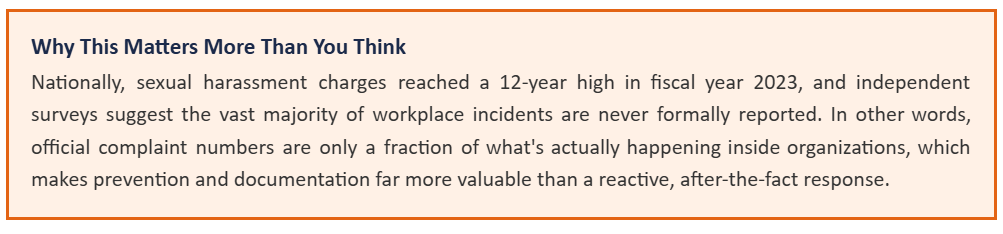
Employer Responsibilities: Policy and Training Requirements
California law does not leave employer obligations open to interpretation. Two requirements form the backbone of compliance: a written anti-harassment policy and mandatory training.
Your Anti-Harassment Policy Must Include:
- A clear statement that harassment based on protected characteristics is prohibited
- A description of what conduct qualifies as harassment, including examples
- A confidential, accessible complaint process with multiple reporting channels
- Assurance of protection against retaliation for reporting or participating in an investigation
- A commitment to a timely, impartial investigation and appropriate corrective action
This policy should be distributed to every employee, translated where necessary, and acknowledged in writing, ideally through a digital HR system that timestamps and stores acknowledgment records automatically.
Mandatory Training Under SB 1343
California employers with five or more employees, including seasonal and temporary workers, must provide interactive sexual harassment prevention training on the following schedule:
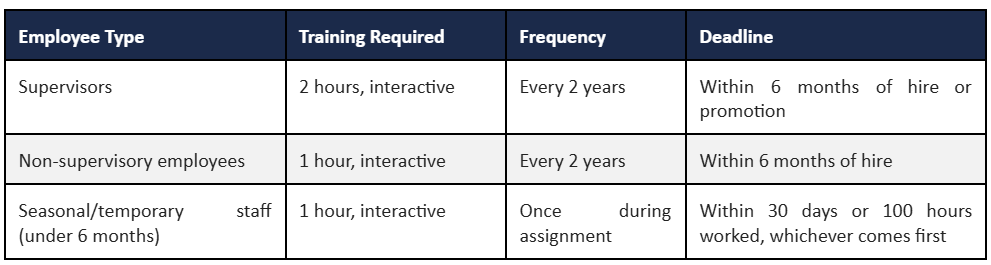
Training records should be retained for at least several years, since courts and regulators treat missing documentation as evidence that an employer failed to take reasonable preventive steps, regardless of what actually happened internally.
How to Prevent Workplace Sexual Harassment in California
Prevention is significantly cheaper and less disruptive than remediation. Employers that consistently avoid costly claims tend to share a few practical habits:
- Automate training reminders so no employee, new hire, or promoted supervisor slips through the two-year or six-month deadlines
- Keep policies current with FEHA amendments rather than reusing a template from years ago
- Offer more than one way to report concerns, including anonymous options, so employees are not forced to report to the person they are complaining about
- Train managers specifically on how to recognize early warning signs and respond appropriately, not just how to avoid personal liability
- Track policy acknowledgments and training completion inside your HR or payroll system instead of relying on spreadsheets or paper files
How to Respond When a Harassment Complaint Comes In
How an employer responds in the first 48 hours often determines whether a complaint stays internal or escalates into a CRD filing or lawsuit. A defensible process generally follows these steps:
1. Acknowledge the complaint promptly and in writing, without judgment or delay.
2. Separate the parties where appropriate to prevent further contact during the investigation.
3. Assign an impartial investigator, internal or external, with no reporting relationship to either party.
4. Interview the complainant, the accused, and relevant witnesses, and document everything in detail.
5. Reach a conclusion based on the evidence and apply consistent, proportionate corrective action.
6. Follow up with the complainant to confirm no retaliation has occurred, and document that follow-up.
Skipping or rushing any of these steps is one of the most common ways employers unintentionally strengthen an employee's legal claim.
Employer Liability and Retaliation Risks
California employers can be held liable for harassment committed by supervisors even if company leadership had no knowledge of the conduct. Liability for coworker or non-employee harassment (such as by a client or vendor) typically applies once the employer knew, or should have known, and failed to take immediate corrective action.
Retaliation claims carry their own separate exposure. An employee who reports harassment, participates in an investigation, or refuses unwanted advances is protected from any adverse action, including demotion, schedule cuts, exclusion, or termination. Retaliation claims are frequently easier for employees to prove than the underlying harassment claim itself, which is why documentation and consistency matter at every stage.
Frequently Asked Questions
What is considered sexual harassment in California?
California law recognizes two forms: quid pro quo harassment, where job benefits are tied to unwelcome sexual conduct, and hostile work environment harassment, where unwelcome sexual conduct is severe or pervasive enough to interfere with someone's ability to work.
What are California's sexual harassment laws?
The primary law is the Fair Employment and Housing Act (FEHA), enforced by the Civil Rights Department (CRD). FEHA prohibits harassment based on sex, gender identity, gender expression, and sexual orientation, and requires employers to take proactive preventive steps, not just respond after the fact.
Is sexual harassment training required in California?
Yes. Employers with five or more employees must provide two hours of interactive training to supervisors and one hour to non-supervisory employees, repeated every two years, with shorter deadlines for new hires, promotions, and short-term workers.
What should employers do after a harassment complaint?
Acknowledge the complaint quickly, separate the parties if needed, assign an impartial investigator, document every interview, reach a decision based on evidence, and follow up to confirm no retaliation occurred.
What is quid pro quo harassment?
It is harassment where a job benefit or continued employment is conditioned on accepting unwelcome sexual advances, whether that condition is stated directly or only implied.
Can employers be liable for workplace harassment they didn't know about?
Yes, particularly when the harasser is a supervisor. For coworker or third-party harassment, liability generally attaches once the employer knew or should have known and failed to act.
What is a hostile work environment?
A workplace where unwelcome sexual conduct is frequent or serious enough that it interferes with an employee's ability to perform their job, even if no tangible job benefit was ever threatened or offered.
The Bottom Line
California's sexual harassment laws are designed to push employers toward prevention, not just reaction. That means a written policy, consistent training, clear reporting channels, and reliable documentation aren't just legal checkboxes; they're the foundation of a workplace employees actually trust. Building that foundation is far easier when your payroll and HR systems work together instead of living in separate spreadsheets and email threads.
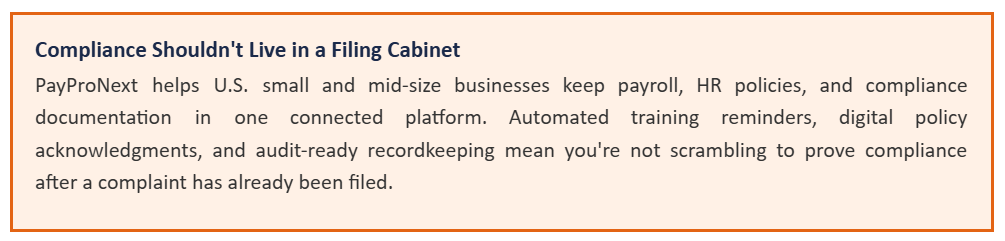
Want compliance built into your everyday HR workflow instead of bolted on after a complaint? See how PayProNext supports US small businesses with payroll, HR compliance tracking, and employee documentation in one place.