
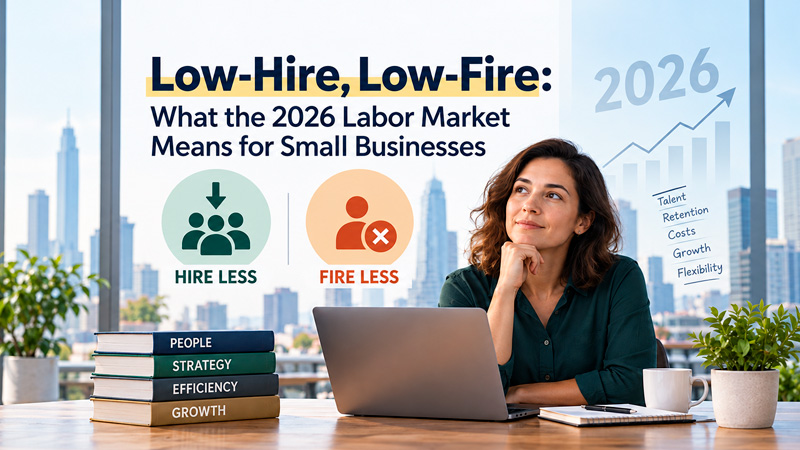
Low-Hire, Low-Fire: What the 2026 Labor Market Means for Small Businesses
Date Released
09 October, 2026
A restaurant owner has enough work to keep the team busy but not enough certainty to add a full-time hire. Sales are steady, not surging. Payroll is one of the largest lines on the budget. Meanwhile, the two best line cooks are the people she can least afford to lose.
That tension defines the low-hire, low-fire labor market: employers add staff cautiously, yet they are not cutting jobs in large numbers either. The practical question for owners is not "should I stop hiring?" It is how to decide, role by role, whether to hire, retain, cross-train, or redistribute work. This guide covers what current data show, what they mean for small businesses, and how to make those decisions without overreacting to national headlines. It also explains where payroll visibility fits, because every staffing choice eventually becomes a payroll commitment.
What Does a Low-Hire, Low-Fire Labor Market Mean?
A low-hire, low-fire labor market is one where employers hire less actively and also limit layoffs. Workers stay put, openings are filled slowly, and job growth stalls without a wave of job losses. It is different from a downturn with widespread layoffs.
The two halves can coexist for understandable reasons. Employers unsure about demand hold off on new payroll, but many also hesitate to lay off trained people they struggled to find and may need again. Layoffs carry their own costs: lost knowledge, lower morale, and rehiring later. These are reasonable business explanations, not proof that every employer behaves this way.
Current data are consistent with parts of that pattern. In August 2026, employers made 5.2 million hires (a 3.3% hiring rate) and 1.6 million layoffs and discharges (1.0%), according to the BLS Job Openings and Labor Turnover Survey released September 29, 2026. BLS said hires changed little over the year. Job openings, hires, quits, and layoffs measure different things, so no single number tells the story.
Payroll growth is modest, too. The September 2026 jobs report, released October 2, showed payrolls up just 29,000 (preliminary) and unemployment at 4.2%.
Both are national figures covering all employers, not small businesses specifically, and the jobs-report numbers are preliminary and subject to revision. The Federal Reserve's Beige Book, published September 2, 2026, shows the variation: employment rose very slightly overall, with five of twelve Districts reporting no change. The New York District called its labor market a "stable low-hire, low-fire environment," while others reported hiring difficulty. So the label fits some industries and regions better than others. For an owner, the takeaway is practical: a worker who leaves is harder to replace than headlines suggest, and a new hire is a longer commitment than it feels.
Why Are Businesses Hiring More Cautiously in 2026?
Some causes are documented; others are reasonable business considerations.
Documented in the Beige Book: contacts cited uncertainty tied to energy prices, policy, and international conflict, plus rising health care and insurance costs. Some employers also said artificial intelligence reduced the need for certain roles, particularly administrative ones, though the Fed described its effects as mixed.
Reasonable considerations, not proven causes: unpredictable customer demand, the cost of recruiting and training, and a preference for squeezing more output from the current team first.
Small businesses face an additional wrinkle. An NFIB survey of member firms found 32% of owners had openings they could not fill in September 2026, and 45% (87% of those hiring) reported few or no qualified applicants. Owners may be hiring less partly because hiring is hard, not only because demand is uncertain. Adding one person is also a bigger bet when you have fewer people, less cash cushion, and no HR department. A large employer can absorb a hire that does not work out. A ten-person company feels it in cash flow and team morale.
How the 2026 Labor Market Affects Small Businesses
Here is how this environment tends to show up in day-to-day operations.
1. Hiring delays create bottlenecks. A plumbing company postpones a hire, so the office manager keeps dispatching calls on top of billing. Response times stretch, callbacks slip, and customers notice before the owner sees it in the numbers. The cost of waiting is real even though it never appears as a line item.
2. Retaining experienced employees matters more. When fewer qualified candidates are available, replacing someone means recruiting time, onboarding, training, and a stretch of reduced productivity. Beige Book contacts in the San Francisco District reported struggling with lost institutional knowledge when retirees were replaced. Costs vary by role, so calculate your own rather than relying on a generic figure. A bookkeeping firm that loses its senior bookkeeper loses client history that never made it into a document, and the remaining staff absorbs that gap while the replacement ramps up.
3. Labor-cost decisions require better visibility. Without a clear view of payroll, overtime, and workload, owners guess. A restaurant may find overtime concentrates in two Friday shifts. That points to a part-time schedule fix, not a full-time hire. Without payroll and hours data side by side, the same owner might commit to a salary the business does not need.
4. Productivity cannot rest on stretching the team. Removing inefficiencies is different from asking people to absorb unlimited work. A retail owner who adds inventory counts, social media, and returns to the same three employees may see slower service and more errors, and may eventually lose one of them.
Should Small Businesses Hire or Retain Existing Employees?
Treat it as a test, not a slogan. Ask three questions before approving a hire:
- Persistence: Has the overload lasted through a full busy-and-slow cycle?
- Cost of delay: What does waiting cost in missed jobs, slower service, or overtime?
- Cushion: Could cash flow carry this payroll commitment if demand softens?
If all three answers point toward hiring, hire. If not, try something smaller first.
|
Business Signal |
Potential Response |
What to Evaluate First |
|
Workload exceeds capacity month after month. |
Hire a permanent role |
Revenue and cash-flow support for the added payroll |
|
Demand is seasonal or uneven. |
Part-time, seasonal, or contract help |
Which tasks truly repeat |
|
Work piles up in one person's queue |
Redistribute or cross-train |
Whether others can absorb it sustainably |
|
Delays trace to manual steps. |
Fix the process |
Whether the workflow, not headcount, is the constraint |
Hiring and retention are not mutually exclusive. Many businesses should hire selectively while strengthening retention across the existing team.
How Small Businesses Can Reduce Turnover Without Increasing Payroll
Unnecessarily
None of these steps eliminates turnover, but each addresses a common, preventable cause.
- Clarify expectations. Write down what good performance looks like for each role. Unclear standards frustrate strong employees.
- Find preventable exits. Review recent departures for patterns such as schedule conflicts or stalled growth. If three people left over the same shift pattern, that is a scheduling problem, not three separate resignations.
- Invest in practical training. Teach skills the business needs, which also builds cross-training coverage.
- Review schedules and workloads. Uneven hours and chronic overtime push people out.
- Benchmark pay. Use credible market data and what the business can afford. Targeted adjustments for hard-to-replace roles may beat across-the-board raises. NFIB found that a net 28% of owners raised compensation in September, so pay adjustments are common.
- Create a path for concerns. A regular one-on-one, even fifteen minutes monthly, lets problems surface before a resignation does.
- Use exit feedback. Keep a simple log of why people leave and review it quarterly.
Managing Labor Costs When Hiring Slows
Cutting labor costs is not the same as improving performance. Removing essential capacity can cause delays, errors, lost sales, and more turnover.
The better question is where labor spending connects to results. A more useful approach:
- Forecast payroll commitments against expected revenue.
- Review overtime and scheduling patterns for recurring spikes.
- Separate essential roles from temporary capacity needs.
- Track staffing needs in busy and slow periods.
- Compare labor costs with productivity, service quality, and demand.
- Test whether a process fix solves a capacity problem before adding headcount.
Workforce management software can help here. Depending on the platform, it may cover scheduling, time tracking, labor reporting, or forecasting. Not every product includes all of these, and many do not handle payroll, so check what a tool actually does. For a small business, the right fit depends on the problem: uneven schedules call for scheduling tools, while unclear labor costs call for reliable payroll reporting. Start with the gap you need to close, then choose the tool.
Where Payroll Visibility Fits Into Workforce Planning
Hiring and retention decisions are easier when you can see payroll obligations, employee pay, contractor payments, and reporting in one place.
PayProNext is a payroll solution for U.S. businesses. It supports W-2 and 1099 workers, federal, state, and local tax filing, multi-state payroll, employee and contractor portals, and payroll reports. It comes in Basic and full-service plans. The Basic plan calculates payroll but does not make direct deposits; direct deposit is part of the full-service plan.
PayProNext is not a complete workforce management or HR platform. Its value here is organized payroll data, which helps an owner see what a role costs before deciding to add one. Employee and contractor portals keep records in one place, and payroll reports show how pay changes over time. That information does not make the hiring decision for you, but it removes guesswork from the financial side of it.
Frequently Asked Questions
What does low-hire, low-fire mean?
It describes a labor market where employers hire cautiously and also avoid layoffs. Openings fill slowly, and workers stay in place, so job growth stalls without a surge in job losses.
Why are businesses hiring fewer employees in 2026?
Beige Book contacts pointed to uncertainty about energy prices, policy, and international conflict, higher benefit costs, and mixed AI effects. Not all businesses are hiring less; some industries and regions report active hiring.
How does a low-hire, low-fire labor market affect small businesses?
Delayed hires can overload existing staff, losing an experienced employee becomes costlier, and owners need clearer visibility into payroll and workload to plan capacity.
Should small businesses hire or retain existing employees?
It depends on whether overload is persistent, what delay costs, and whether cash flow supports the payroll. If not, cross-training or redistributing work may be the safer first step.
How can businesses reduce employee turnover?
Set clear expectations, study why people leave, offer useful training, balance schedules, benchmark pay, and give employees a way to raise concerns early.
How can small businesses manage labor costs during a slowdown?
Forecast payroll against revenue, review overtime, separate essential roles from temporary needs, and fix process problems before adding headcount. Layoffs and wage cuts are not universal solutions.
Prepare Your Workforce for More Deliberate Hiring Decisions
A cautious labor market calls for better decisions about hiring, retention, workload, and payroll, not automatic hiring freezes. Start with the three-question test, protect the employees you cannot easily replace, and make sure your payroll data is clear enough to support each choice.
Explore PayProNext to simplify payroll management as your business plans its next stage of growth.