
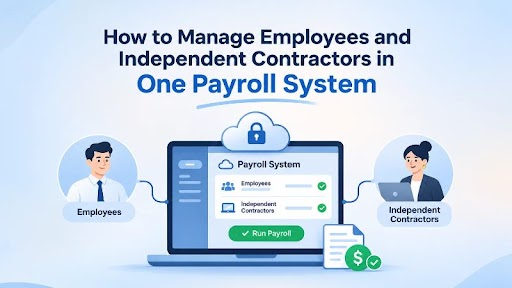
How to Manage Employees and Independent Contractors in One Payroll System
Date Released
04 November, 2026
Picture a company with four employees and three independent contractors. Every pay period, the owner runs regular payroll, pays contractors for finished work, keeps payment records, and remembers that each group follows different tax reporting rules. When those tasks are scattered across spreadsheets, email threads, and separate payment apps, small gaps appear: a missing form, a duplicated payment, a scramble at year-end.
That is the daily reality of employee and contractor payroll, and disconnected processes make it harder than it needs to be. This guide explains how the two worker types differ, how to manage both in one system without treating them the same, and what to look for in payroll software.
Can Employees and Independent Contractors Be Paid Through One Payroll System?
Yes, if the system includes both employee and contractor features. One platform can handle payments and records for W-2 employees and 1099 contractors. The tax treatment and reporting still differ: employees have taxes withheld and receive Form W-2, while properly classified contractors generally do not and may receive Form 1099-NEC.
Understanding the Difference Between W-2 Employees and 1099 Contractors
W-2 Employees
Employees generally receive wages through your payroll. You withhold applicable federal income tax, Social Security tax, and Medicare tax from their pay, and you pay the employer-side payroll taxes you owe. Each year, you furnish Form W-2 so employees can report their wages and withholding.
1099 Independent Contractors
Contractors generally operate as self-employed service providers and handle their own income and self-employment taxes. Businesses generally do not withhold regular payroll taxes from properly classified contractors, but there are exceptions. Backup withholding can apply, for example, when a contractor does not provide a taxpayer identification number.
Reporting has its own rules. For payments made after December 31, 2025, the federal Form 1099-NEC threshold is $2,000 per payee in a calendar year, up from $600. Not every payment must be reported, since exceptions apply (payments to most corporations, for instance), and state requirements can differ. Check the IRS general instructions for your situation.
Side-by-Side Comparison
| Topic | W-2 Employee | 1099 Contractor |
| Tax Withholding | Employer withholds income tax, Social Security, and Medicare, and pays employer-side payroll taxes |
Generally no regular payroll withholding for properly classified contractors; backup withholding may apply in limited cases |
| Payment Treatment | Wages paid through payroll on a set schedule |
Payments based on agreed terms and approved invoices |
| Year-end Reporting | Form W-2 | Form W-2 or Form 1099-NEC when reporting requirements are met |
How to Manage Employees and Contractors in One Payroll System
A repeatable four-step routine keeps both groups organized in one place.
Step 1: Set Up Each Worker Correctly
Everything downstream depends on accurate onboarding and classification.
- Collect Form W-4 from each employee.
- Request Form W-9 from contractors when appropriate.
- Record classification, pay terms, and payment details for every worker.
Step 2: Organize Employee Payroll
Set pay rates and schedules, then calculate gross wages, deductions, and withholding each cycle. Keep employer payroll tax responsibilities in view and maintain complete payroll records.
Step 3: Process Contractor Payments
Contractors are paid for agreed work, not through wage calculations. Record payment terms and approved invoices, and track payments separately from employee wages.
- Do not apply employee withholding rules to properly classified contractors.
- Keep records that support year-end information reporting.
Step 4: Review Records and Prepare Year-End Reporting
Before year-end, reconcile what you paid each group.
- Review employee W-2 information.
- Review contractor payment totals and any applicable 1099-NEC reporting.
- Keep supporting records organized.
A shared platform does not mean employees and contractors should be treated identically. One system can centralize your records, but each worker's classification determines which rules apply.
How PayProNext Helps Organize Both Worker Types
Managing employees and independent contractors doesn't require maintaining completely disconnected payroll records. PayProNext brings employee and contractor payroll management into one platform, helping businesses organize worker information and payroll activities.
Whether you're processing regular employee wages or managing payments for independent contractors, PayProNext offers a centralized solution to support your payroll operations. This gives small businesses a more organized way to manage different worker types while keeping their respective payment and reporting requirements separate.
Employee and Contractor Payroll Mistakes to Avoid
Most problems come from blurred lines between the two groups. Watch for these:
- Mixing contractor payments with employee wages without proper classification
- Applying the wrong withholding rules to either group
- Missing required forms or deadlines
- Keeping incomplete payment records
- Assuming every contractor automatically qualifies for 1099 treatment
- Failing to revisit classification as working relationships change
A contractor who begins working fixed hours under your direction, for example, may no longer fit the contractor category even if the original agreement never changed.
How to Avoid Worker Misclassification
Classification depends on the actual working relationship, not the title in a contract or whether you issue a 1099. The IRS guidance on classification groups the evidence into three categories:
- Behavioral control: whether you control how the work is done, through instructions or training.
- Financial control: whether you control the business side of the work, such as tools, expense reimbursement, and how the worker is paid.
- Relationship of the parties: how the parties describe the arrangement, including written contracts, benefits, and whether the work is expected to continue.
The IRS test is not the only one. Federal labor laws and individual states may apply different tests, so a worker could be a contractor under one and an employee under another. When classification is unclear, review the relevant rules and consult a qualified tax or employment professional.
What to Look for in Payroll Software for Employees and Contractors
Not every payroll tool supports both employee and contractor payment management. When comparing payroll software for employees and contractors, businesses should look beyond basic wage calculations and consider how the platform handles different worker types.
A suitable payroll solution should help organize employee information, manage payroll calculations, track contractor payments, and maintain clear payment records.
Important features to consider include:
- Employee and contractor management: Maintain separate worker records within one platform.
- Employee payroll calculations: Calculate wages and applicable deductions.
- Contractor payment tracking: Organize contractor payment information and approved invoices.
- Flexible payment schedules: Support different payment arrangements for employees and contractors.
- Payroll reporting: Maintain accessible payroll information and payment history.
- Year-end reporting support: Check for W-2 and applicable 1099 reporting capabilities.
- Direct deposit: Choose a plan that supports electronic payment delivery if required.
Why Consider PayProNext for Employee and Contractor Payroll?
For small businesses, managing payroll should not mean coordinating multiple disconnected tools just to pay different types of workers.
PayProNext provides a centralized platform for managing W-2 employee and 1099 contractor payroll information, helping businesses organize worker records and payroll activities.
Businesses can explore the following capabilities:
- Manage employee and contractor information.
- Handle payroll calculations according to the selected plan.
- Organize worker and payment records.
- Choose between different payroll service options.
- Access direct deposit through the Complete (Full Service) plan.
PayProNext offers two plan options to accommodate different business requirements:
Basic Plan: Supports payroll calculations but does not include direct deposit.
Complete (Full Service) Plan: Offers expanded payroll services and supports direct deposit.
Before selecting a plan, review the available features and service details to determine which option matches your workforce and payroll requirements.
Managing Employees and Contractors Shouldn't Mean Managing Two Separate Payroll Headaches.
Whether your business pays employees, independent contractors, or both, the right payroll process can make payment tracking and recordkeeping easier. Explore PayProNext to see how its payroll solution can support your business.
Visit PayProNext or request a demo to learn more.
Frequently Asked Questions
Can employees and independent contractors be paid through one payroll system?
Yes, as long as the system offers both employee and contractor features. You can manage payments and records in one place, but each group keeps its own tax treatment and reporting.
What is the difference between W-2 and 1099 payroll?
W-2 payroll covers employees: wages, tax withholding, and Form W-2. 1099 payments go to independent contractors, who generally handle their own taxes and may receive Form 1099-NEC.
How do you pay employees and contractors together?
Run employee payroll on its regular schedule and pay contractors under agreed terms and approved invoices, all within one system. Keep the two payment types clearly labeled so wages and contractor payments never blend together.
Do employers withhold taxes from independent contractors?
Generally not for properly classified contractors, though backup withholding can apply if a contractor does not provide a valid taxpayer identification number. A worker who is actually an employee is subject to payroll tax rules regardless of the label.
What forms are required for employees and contractors?
Employees generally complete Form W-4 and receive Form W-2. Contractors are typically asked for Form W-9 and may receive Form 1099-NEC if reporting requirements are met.
Can payroll software generate both W-2 and 1099 forms?
Some can, but it varies by product and plan. Confirm which year-end forms a platform supports before relying on it.
Which payroll software is suitable for businesses with both employees and contractors?
Businesses should look for payroll software that supports separate employee and contractor records, payroll calculations, payment tracking, and applicable year-end reporting. PayProNext offers a centralized platform for managing employee and contractor payroll information, with different service options to accommodate business requirements.
How can small businesses avoid worker misclassification?
Evaluate the real working relationship using the IRS behavioral, financial, and relationship factors, check state rules, revisit classifications as roles change, and seek professional guidance when unsure.
Simplify Employee and Contractor Payroll with PayProNext
Managing employees and independent contractors shouldn't mean juggling separate payroll processes, disconnected payment records, and unnecessary administrative work.
Whether your business has four employees and three contractors or a growing workforce with different payment arrangements, keeping payroll organized matters.
PayProNext brings employee and contractor payroll management together in one centralized platform.
Designed to support businesses managing W-2 employees and 1099 contractors, PayProNext helps organize worker information, payroll calculations, and payment activities according to the selected plan.
Find the Right Payroll Plan for Your Business
Basic Plan
A suitable option for businesses looking for payroll calculations and organized payroll management without direct deposit.
Complete (Full Service) Plan
An expanded option for businesses looking for additional payroll services, including direct deposit support.
Both options give businesses a way to explore payroll management based on their operational requirements.
Ready to Make Payroll Management Simpler?
You don't need disconnected processes to manage different types of workers.
Bring your employee and contractor payroll information together with PayProNext and explore a payroll solution designed to support your business.
Compare Plans. Explore Payroll Features. Request a Demo.
Visit PayProNext to get started.