

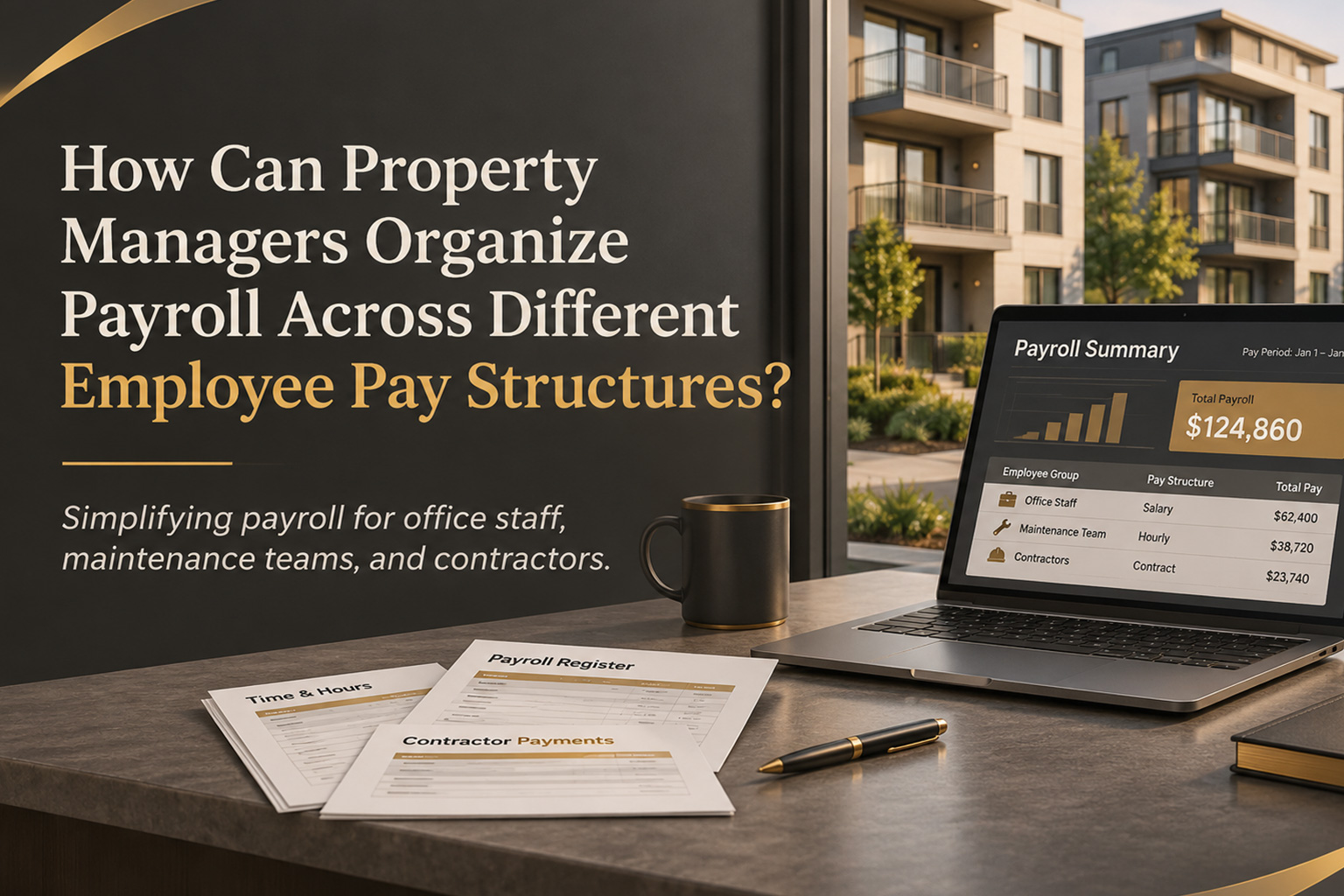
How Can Property Managers Organize Payroll Across Different Employee Pay Structures?
Date Released
23 November, 2026
Property management payroll is rarely simple. A maintenance technician may cover three buildings in one week. A leasing agent may earn an hourly wage plus a commission on each signed lease. A regional manager may be salaried, while a part-time groundskeeper is paid by the hour.
Each pay structure carries its own overtime, tax, and recordkeeping considerations. This guide explains how to organize payroll for property management companies, from classifying employees to tracking hours across sites and choosing the right tools. The short answer: classify every employee correctly, document every pay component, track hours by employee, and review records on a regular schedule.
Why Property Management Payroll Requires Organization
Property management employee payroll often combines several job types under one company:
- Property managers: often salaried, sometimes with occupancy or budget bonuses, so property manager payroll can mix fixed and variable pay.
- Leasing agents: hourly, salaried, commission-based, or a combination.
- Maintenance teams: usually hourly, with overtime and possible emergency call-outs.
- Administrative staff: hourly or salaried.
Pay method does not decide overtime eligibility. Under the Fair Labor Standards Act (FLSA), nonexempt employees generally earn overtime at one and a half times their regular rate after 40 hours in a workweek, whether they are paid hourly, by salary, or by commission. According to the U.S. Department of Labor (DOL), exempt status depends on salary and duties tests, not job titles. A “property manager” title does not automatically make someone exempt.
How to Organize Payroll Across Different Pay Structures
Hourly and Salaried Employees
Record each employee’s classification (exempt or nonexempt), pay rate, and pay frequency in their file. Hourly and salaried nonexempt employees both need accurate hours records. Review classifications periodically, since role changes can affect overtime eligibility.
Leasing Commissions and Performance-Based Pay
Put commission terms in writing: what triggers the commission (lease signing, move-in, or first rent payment), how it is calculated, when it is paid, and what happens if a lease falls through. Do not assume leasing agents are independent contractors. Under IRS and DOL guidance, classification depends on the actual working relationship, not the label in an agreement.
Maintenance Staff and Overtime
Track all compensable time, including travel between properties during the workday and qualifying emergency call-outs. Whether on-call time counts depends on the facts. Add up hours across every property for each workweek before calculating overtime.
Bonuses and Incentives
Commissions and nondiscretionary bonuses, such as an occupancy bonus promised in advance, generally must be included in a nonexempt employee’s regular rate. Example: an agent earning $18 per hour works 45 hours and earns a $450 commission that week. Straight-time pay is $810 plus $450, or $1,260. The regular rate is $28 ($1,260 ÷ 45), so the overtime premium is $70 (0.5 × $28 × 5 hours), for total pay of $1,330. This is a simplified illustration; state rules and commission periods can change the calculation.
Accurate Time and Payroll Records
Keep hours, pay rates, commissions, bonuses, and deductions for every pay period. The DOL generally requires payroll records for three years, and the IRS generally requires employment tax records for at least four years.
Managing Payroll Across Multiple Properties
Multi-property payroll works best with a few consistent habits:
- Assign each employee a home property and list any additional properties they cover.
- Record hours by property, but total them by employee for overtime.
- Allocate labor costs to properties in your accounting reports.
- Reconcile payroll records to accounting records each month.
- Review state requirements when employees work or live in different states.
For example, a technician who works Monday at one community and Thursday at another should have one weekly hours total, with each shift tagged to its property. Tracking by property helps with budgeting and owner reporting, but it does not by itself satisfy payroll tax or labor-law requirements. Overtime is calculated per employee per workweek, not per property. If properties are owned by separate entities, confirm with an employment attorney or CPA which entity is the employer.
How Property Management Payroll Software Helps
Property management payroll software can reduce manual errors by calculating pay, storing employee records, and producing reports. Property management payroll management also gets easier when records live in one place instead of scattered spreadsheets. When comparing options, ask whether the software:
• Handles hourly, salaried, commission, and bonus pay
• Explains how overtime is calculated when additional earnings are present
• Offers reports by employee and pay period
• Supports tax filing, W-2 and 1099 forms, and direct deposit
• Exports data to your accounting system
• Lists pricing clearly, including per-employee and add-on fees
Before committing, ask vendors to walk through a sample week for an hourly employee who also earns a commission.
PayProNext for Property Management Businesses
PayProNext serves U.S. businesses in all 50 states. Basic Payroll starts at $7 per month and supports payroll calculations and paycheck preparation, without direct deposit. Complete Payroll starts at $15 per month plus $1.50 per employee per payroll and adds services such as tax filing support and W-2/1099 processing; direct deposit is available as an add-on.
PayProNext is a general payroll platform, not property-specific software. If you need property-level job costing, leasing commission automation, maintenance scheduling, or integrations with property management platforms, confirm availability with PayProNext first and plan for additional tools.
Frequently Asked Questions
How do property management companies handle different employee pay structures?
They classify each worker as exempt or nonexempt, document each pay component (hourly rate, salary, commission, bonus), and run every type through a consistent payroll process. Written pay policies and accurate records keep the structures from conflicting.
How are leasing agents paid in property management?
Common models include hourly wages, salary, or base pay plus commission. Employee agents are paid through payroll with withholding. Nonexempt employees must still receive minimum wage and overtime when commissions are involved.
How should property managers pay maintenance employees?
Most maintenance employees are nonexempt and paid hourly. Track all hours worked, including travel between properties and compensable call-outs, and pay overtime after 40 hours in a workweek. Some states add daily overtime rules.
Can property managers pay employees hourly and on commission?
Yes. An employee can earn an hourly wage plus commission. For nonexempt employees, the commission generally must be included in the regular rate, which can increase overtime pay, as the example above shows.
How do property managers track payroll across multiple properties?
Record hours by property, total them by employee, and use consistent pay-period reports to allocate labor costs. Software or a structured spreadsheet can help, but property tracking does not replace tax and labor-law compliance.
How do property management companies calculate overtime?
For nonexempt employees, overtime is generally 1.5 times the regular rate for hours over 40 in a workweek. The regular rate includes most earnings, such as commissions and nondiscretionary bonuses, not just the hourly wage. Some states have additional requirements.
What payroll software is best for property management companies?
The best choice depends on your pay types, headcount, and reporting needs. Payroll for property management companies should be compared using the criteria above. General platforms like PayProNext can handle payroll calculations and tax filing support, but confirm separately whether you need property-specific features or integrations.
Simplify Property Management Payroll Administration
Organized payroll starts with correct classification, documented pay rules, and reliable records. Whether you manage five properties or fifty, a consistent process reduces errors and protects your team. A short monthly payroll review can catch missing commissions or misclassified roles early. Explore PayProNext at https://www.paypronext.com to see whether its payroll plans fit your property management company.