
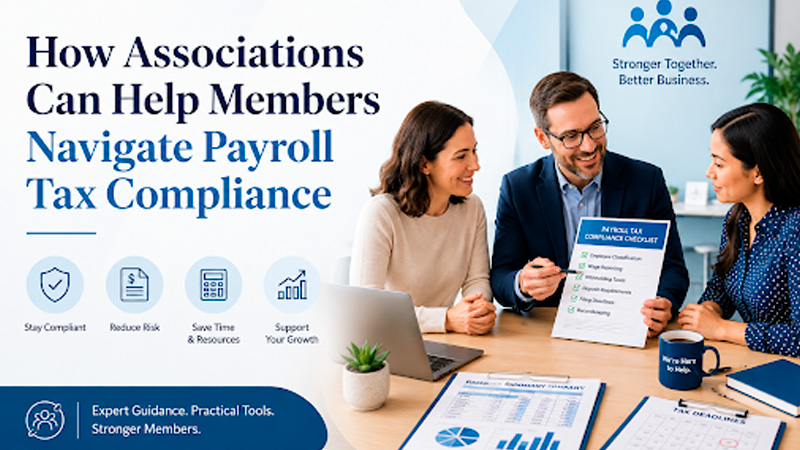
How Associations Can Help Members Navigate Payroll Tax Compliance
Date Released
27 August, 2026
Running payroll is one thing. Staying on top of payroll tax compliance is another challenge entirely, especially for the small business owners who make up the backbone of most trade and professional associations. Between federal withholding rules, state unemployment tax rates, and shifting deposit deadlines, it's easy for a growing company to fall behind without ever meaning to.
That's where associations have an opening. Members already trust their association for education, networking, and advocacy. Extending that trust to payroll compliance for members, through resources, partnerships, and practical guidance, can turn a stressful back-office task into one less thing members have to worry about.
This guide breaks down what payroll tax compliance actually involves, why it matters so much for small businesses, and how associations can step in with real, useful support.
What Is
Payroll Tax Compliance?
Payroll tax compliance means correctly calculating, withholding, depositing, and reporting every payroll-related tax an employer owes, on time and to the right agency. That includes federal income tax withholding, Social Security and Medicare (FICA), federal unemployment tax (FUTA), and state-level obligations such as state income tax withholding and state unemployment insurance (SUTA).
For a single-location small business, staying compliant already takes real effort. For association members who operate across state lines, run seasonal crews, or manage hourly and salaried staff side by side, payroll tax requirements multiply fast.
Why Payroll
Tax Compliance Matters for Small Businesses
Small businesses rarely have a dedicated payroll or tax department. Often, the owner, an office manager, or a bookkeeper is handling payroll tax compliance in addition to a dozen other responsibilities. That reality creates a few predictable problems:
- Mistakes are more likely. Not because the business isn't careful, but because payroll tax rules change often and aren't always communicated clearly to smaller employers.
- Penalties hit harder. A missed deposit or late filing that a large enterprise absorbs without much notice can strain a small business's cash flow and reserves.
- Time is the real cost. Hours spent untangling a tax notice are hours not spent serving customers, hiring, or growing the business.
This is exactly the kind of friction associations are well positioned to reduce for their members.
Payroll
Taxes Employers Need to Know
Every employer, association member or not, is generally responsible for some combination of the following:
- Federal income tax withholding, based on each employee's Form W-4
- FICA taxes, Social Security and Medicare, split between employer and employee
- FUTA, federal unemployment tax, paid by the employer
- State income tax withholding, required in most, but not all, states
- SUTA, state unemployment insurance, with rates that vary by state and by employer experience rating
- Local payroll taxes, required in certain cities and counties
Deposit schedules depend on the size of a business's payroll and can be monthly or semiweekly for federal taxes, with a separate schedule at the state level. Losing track of the pattern for even one pay period is one of the most common employer payroll compliance mistakes.
What
Happens If a Business Misses a Payroll Tax Deadline
The IRS and state tax agencies apply penalties on a sliding scale that grows more expensive the longer a deposit or filing goes unresolved, often starting in the low single digits for a short delay and climbing well into double digits for deposits that remain unpaid. Interest accrues on top of that. Beyond the direct cost, repeated missed deadlines can draw closer scrutiny from tax agencies, which becomes its own drain on a small business's time and attention.
|
Quick Reference Most federal payroll tax deposits follow a monthly or semiweekly schedule based on prior-year tax liability. Associations that maintain a shared compliance calendar help members avoid the single most common cause of missed deadlines: simply losing track of which schedule applies. |
How
Associations Can Help Members With Payroll Compliance
Associations don't need to become payroll experts to make a meaningful difference for members. A few approaches tend to work well in practice:
Education and Awareness
Regular content, webinars, newsletter reminders around key filing dates, and short explainer articles keep payroll tax compliance for associations' members on their radar before problems start, not after.
A Shared Compliance Calendar
Many members are tracking the same federal and state deadlines. A single, association-maintained calendar of payroll tax due dates saves every member from having to build one on their own.
Preferred Vendor Programs
Vetting and recommending payroll compliance software gives members a trusted starting point instead of leaving each business to evaluate the market alone. This is often where association payroll support has the most direct impact, since the right software absorbs the calculation, filing, and deposit work that causes the most errors.
Peer Knowledge-Sharing
Member forums or roundtables where business owners can ask how others handle multi-state payroll, or what changed with SUTA rates this year, often surface practical answers faster than a general search.
How Small
Businesses Can Stay Current With Payroll Tax Rules
Members can pair association resources with a few habits of their own:
- Review withholding tables and state unemployment rates at the start of each year, since both routinely change.
- Build in a buffer before each deposit deadline instead of filing at the last possible moment.
- Reconcile payroll tax liabilities against actual deposits every quarter, not just at year-end.
- Subscribe to updates directly from the IRS and relevant state agencies.
- Use payroll software that calculates and files taxes automatically, reducing the chance of manual error.
Manual
Payroll vs. Payroll Compliance Software
For members deciding whether to keep handling payroll tax compliance by hand or move to dedicated software, the trade-offs generally come down to time, accuracy, and how the business scales:
|
Category |
Manual Payroll Processing |
Payroll Compliance Software (PayProNext) |
|
Tax rate updates |
Tracked by hand; easy to miss mid-year changes |
Federal and state rates updated automatically |
|
Deposit deadlines |
Manually calendared; risk of missed windows |
Deposits scheduled and filed on the correct cadence |
|
Multi-state support |
Requires separate research for each state |
Built-in multi-state withholding and SUTA handling |
|
Error risk |
Higher, especially with staff turnover |
Lower, with automated calculations and validation |
|
Owner time required |
Hours per pay period |
Minutes of review per pay period |
|
Audit readiness |
Records scattered across spreadsheets and files |
Centralized, exportable compliance records |
Can Payroll
Software Help Businesses Stay Compliant?
Yes. Payroll compliance software handles the parts of payroll tax compliance that are easiest to get wrong by hand: calculating the correct withholding, applying current federal and state rates, and filing on the applicable deposit schedule. For association members juggling payroll alongside everything else running a small business requires, that kind of automation turns compliance from a recurring source of stress into a background process.
|
For Association Leaders PayProNext works with associations across the U.S. to build member benefit programs around payroll and compliance support. If your association is exploring a preferred vendor arrangement, our team can walk through what that partnership could look like for your members. |
Frequently
Asked Questions
What is payroll tax compliance?
Payroll tax compliance is the process of correctly calculating, withholding, depositing, and reporting all required payroll taxes, including federal and state income tax withholding, FICA, FUTA, and SUTA, on the schedule set by each tax agency.
Why is payroll tax compliance important for small businesses?
Small businesses typically operate without a dedicated payroll department, which makes them more vulnerable to costly penalties, interest charges, and time lost resolving tax notices when a deposit or filing is missed.
How can associations help members with payroll
compliance?
Associations can offer compliance calendars, educational content, peer knowledge-sharing, and vetted preferred vendor programs for payroll compliance software, giving members reliable resources instead of leaving them to research everything alone.
What payroll taxes do employers need to pay?
Employers are generally responsible for federal income tax withholding, FICA (Social Security and Medicare), FUTA, state income tax withholding where applicable, SUTA, and any required local payroll taxes.
What happens if a business misses a payroll tax
deadline?
The IRS and state agencies apply escalating penalties and interest the longer a deposit or filing remains outstanding, and repeated missed deadlines can lead to closer scrutiny from tax agencies.
How can small businesses stay current with payroll tax
rules?
Reviewing withholding tables and state rates annually, building in a deposit buffer, reconciling liabilities quarterly, subscribing to agency updates, and using payroll software that automates calculations and filings all help businesses stay current.
Can payroll software help businesses stay compliant?
Yes. Payroll compliance software automates withholding calculations, applies current federal and state tax rates, and files deposits on the correct schedule, significantly reducing the manual errors that lead to compliance problems.
|
Explore a Payroll Benefit Program for Your Members If your association is looking for ways to support members with payroll tax compliance, PayProNext can walk you through how an association partnership works and what it could look like for your membership. |